
Academic Administration Strategies for Enhancing Students’ Innovation Capability in Schools under the Primary Educational Service Area Office Surat Thani Area 2
Article Sidebar
Main Article Content
Abstract
The objectives of this research were to: 1) study the priority needs for academic administration that enhances students’ innovation capability; 2) develop academic administration strategies to enhance students’ innovation capability; and 3) evaluate the academic administration strategies developed to enhance students’ innovation capability. The research was conducted in three steps. Phase 1 involved studying the priority needs for academic administration that enhances students’ innovation capability. The sample consisted of 124 school principals selected through proportional stratified random sampling. The research instrument was a questionnaire. Phase 2 involved the development and validation of academic administration strategies to enhance students’ innovation capability. Data obtained from Phase 1 was used to analyze the internal and external environments through SWOT analysis and to construct a TOWS Matrix for strategy formulation. The proposed strategies were then verified through in-depth interviews with 10 experts. Phase 3 involved evaluating the developed strategies. The sample consisted of 40 school administrators selected through purposive sampling. The research instrument was an evaluation form. Data were analyzed using percentage, mean, and standard deviation.
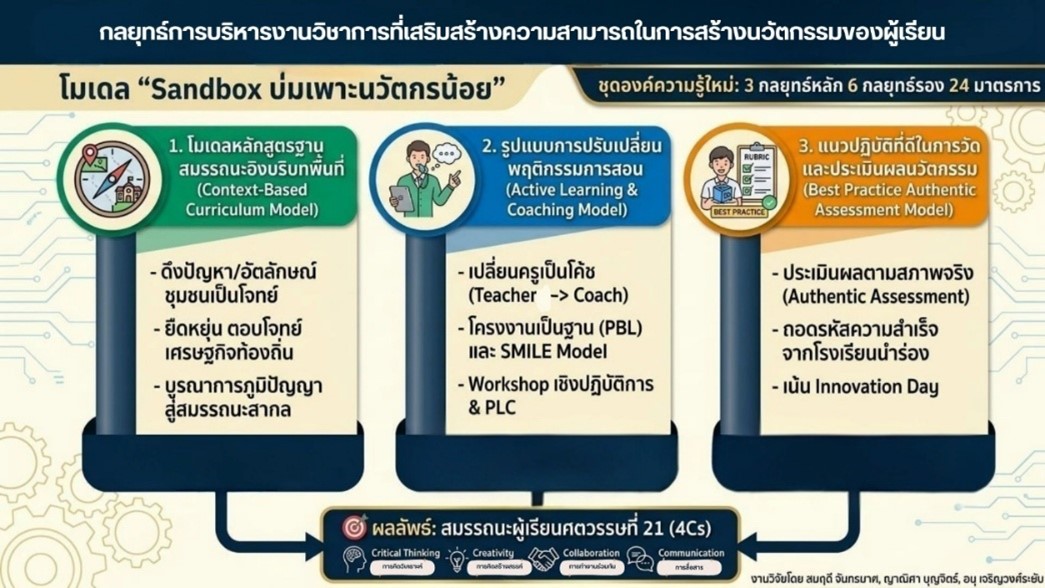
The results revealed that: 1) regarding the priority needs for academic administration that enhances students’ innovation capability, the top three development priorities were learning process development (PNImodified = 0.46), followed by measurement and evaluation (PNImodified = 0.45) and curriculum development (PNImodified = 0.44), respectively; 2) the academic administration strategies developed to enhance students’ innovation capability consisted of three main strategies, six sub-strategies, and twenty-four measures; and 3) the academic administration strategies developed to enhance students’ innovation capability were rated at the highest level in terms of accuracy, appropriateness, and usefulness, while feasibility was rated at a high level.
Downloads
Article Details

This work is licensed under a Creative Commons Attribution-NonCommercial-NoDerivatives 4.0 International License.
References
Bhuiyan, B. A., Molla, M. S., & Alam, M. (2021). Managing innovation in technical education: Revisiting the developmental strategies of Politeknik Brunei. Annals of Contemporary Developments in Management & HR, 3(4), 44-57. https://doi.org/10.33166/ACDMHR.2021.04.004
Chaemchoy, S. (2020). Secondary school management innovation for creating innovators. https://www.academia.edu/44349450/นวัตกรรมการบริหารโรงเรียนมัธยมศึกษาเพื่อสร้างนวัตกร_SECONDARY_SCHOOL_MANAGEMENT_INNOVATION_FOR_CREATING_INNOVATORS [In Thai]
Chatriwisit, R., Phuchinda, S., Chutrakul, A., Chinanurak, N., Puengkrai, P., & Nilju, W. (2010). Strategic management. Tangsap Printing. [In Thai]
Cha-um, T., Booncherdchoo, N., Saengloetuthai, J., & Srisopha, Y. (2020). Academic administration strategies for private school in global context. Academic Journal of Phetchaburi Rajabhat University, 10(2), 102–110. https://journal.pbru.ac.th/admin/upload/article/2999-2021-03-31.pdf [In Thai]
Cronbach, L. J. (1951). Coefficient alpha and the internal structure of tests. Psychometrika, 16(3), 297-334. https://doi.org/10.1007/BF02310555
Dahri, N. A., Al-Rahmi, W. M., Almogren, A. S., Yahaya, N., Vighio, M. S., Al-Rahmi, A. M., Al-Adwan, A. S., & Al-Samarraie, H. (2023). Acceptance of mobile learning technology by teachers: Influencing mobile self-efficacy and 21st-century skills-based training. Sustainability, 15(11), 8514. https://doi.org/10.3390/su15118514
Darling-Hammond, L. (2017). Teacher education around the world: What can we learn from international practices. European Journal of Teacher Education, 40(3), 291–309. https://doi.org/10.1080/02619768.2017.1315399
Dess, G. G., & Miller, A. (1993). Strategic management. McGraw-Hill Book.
Fongsri, P. (2015). Construction and development of research instruments. Pornsap Printing. [In Thai]
Fox, M. O. (2011). Implementing 21st century skills: A paradox in a traditional world of education [Doctoral dissertation, College of Saint Elizabeth]. ProQuest Dissertations & Theses Global. (Publication No. 3469112). https://media.proquest.com/media/hms/ORIG/2/vimqI?_s=9RvpbWqsDA%2FipDhvNxBy6RxWf2c%3D
Hughes, J. (2003). Project-based learning for 21st-century skills. ERIC. https://eric.ed.gov/?id=EJ1387646
Jarernrak, K. (2022). Competency-based curriculum development of education sandbox pilot schools in Rayong Primary Educational Service Area Office 2. Journal of UBRU Educational Review (Online), 2(1), 15-28. https://share.google/Wphp2Ct9icgBfmvMX [In Thai]
Kao-ian, J. (2014). Academic administration techniques in educational institutions: Strategies and guidelines for professional administrators (2nd ed.). Chanmuang Press. [In Thai]
Khawgirb, J, & Nakaro, A. (2019). Factors Affecting Academic Administration of Educational Opportunity Expansion Schools under Krabi Primary Educational Service Area Office. Phuket Rajabhat University Academic Journal, 15(2), 163–176. https://so05.tci-thaijo.org/index.php/pkrujo/article/view/242201 [In Thai]
Khejonnan, N. (2009). Strategic management (2nd ed.). Se-Education. [In Thai]
Khongterm, R. (2018). Academic administration strategies to enhance learning and innovation skills of student in Loei Private School [Unpublished master’s thesis}. Khon Kaen University. [In Thai]
Kim, P., Buckner, E., Kim, H., Makany, T., & Talei, N. (2009). A mobile classroom model in extreme environment: Stanford Mobile Inquiry-based Learning Environment (SMILE). Seeds of Empowerment, Stanford University. View article
Likert, R. (1932). A technique for the measurement of attitudes. Archives of Psychology, 140, 1–55.
Ministry of Education. (2018). Guidelines for developing school curriculum based on the Basic Education Core Curriculum B.E. 2551 (Abridged version B.E. 2560) (2nd ed.). Kurusapa Ladprao Press. [In Thai]
Muangsrijan, K. (2021). A management model to develop student’ s innovative characteristics in school expanding educational opportunities [Doctoral dissertation, Naresuan University]. NU Intellectual Repository. https://nuir.lib.nu.ac.th/dspace/bitstream/123456789/5044/3/62030746.pdf [In Thai]
Namphim, P., & Jasuwan, S. (2021). Instructional leadership affecting effectiveness of academic administration in basic education schools. the 14th National and International Academic Conference. Suan Sunandha Rajabhat University. https://share.google/bMcKjEIkmEgBUTjkU [In Thai]
Naveekarn, S. (2001). Strategic management. Thammasat Business School. [In Thai]
Office of the Basic Education Commission. (2013). Guidelines for learning management in accordance with the
st century skills. Agricultural Co-operative Federation of Thailand. [In Thai]
Office of the Basic Education Commission. (2020). Handbook for developing school curriculum to enhance 21st century competencies. Bureau of Academic Affairs and Educational Standards. [In Thai]
Office of the Education Council. (2017a). Learning management to promote 21st century skills. Prikwan Graphic. [In Thai]
Office of the Secretariat of the Education Council. (2017). Education in Thailand 2017. Prikwan Graphic. [In Thai]
Olson, K. (2018). Ethical issues in grounded theory. In R. Iphofen & M. Tolich (Eds.), The SAGE handbook of qualitative research ethics (pp. 486–494). Sage. https://methods.sagepub.com/hnbk/edvol/the-sage-handbook-of-qualitative-research-ethics-srm/chpt/32-ethical-issues-grounded-theory#_
Partnership for 21st Century Learning, A Network of Battelle for Kids. (2023). framework for 21st century learning. Battelle for Kids. https://www.battelleforkids.org/wp-content/uploads/2023/11/P21_Framework_Brief.pdf
Permpool, K., Panjeang, P., & Cojcharat, Y. (2018). Academic management competencies of administrators in Princess Chulabhorn’s Colleges in the South of Thailand. In The 9th Hatyai National and International Conference (pp. 415–430). Hatyai University. [In Thai]
Phusee-orn, S. (2018). Application of the SPSS program for data analysis in research. Chulalongkorn University Press. [In Thai]
Porter, M. E. (1980). Competitive strategy: Techniques for analyzing industries and competitors. Free Press.
Prasoetsap, S. (2019). STEM education: Problems from the engineering design process. Namsil Advertising. [In Thai]
Robinson, K. (2011). Out of our minds: Learning to be creative. Wiley.
Santiwong, T. (2006). Organization and management (11th ed.). Thai Wattana Panich. [In Thai]
Sereerat, B. (2022). The development of learners to be innovators in the 21st century. Academic Institute. [In Thai]
Sereerat, B., Srimongkhon, K., Phetruen, C., & Phonok, P. (2024). A study of competency-based learning management of basic education schools. Bansomdejchaopraya Rajabhat University. In Thai]
Srisa-ard, B. (2011). Introduction to research (9th ed.). Suwiriyasan. [In Thai]
Srisa-ard, B. (2017). Basic research (10th ed.). Suwiriyasarn. [In Thai]
Suanpang, P. (2021). Information technology and innovation for knowledge management. Se-Education. [In Thai]
Suratthani Primary Educational Service Area Office 2. (2024). Action plan for the academic year 2024. Suratthani Primary Educational Service Area Office 2. [In Thai]
Surat Thani Primary Educational Service Area Office 2. (2024). Fiscal Year 2024 Action Plan. Policy and Planning Group. [In Thai]
The Educational Sandbox Act B.E. 2562. (2019). Royal Thai Government Gazette. Vol. 136, Part 56 A, pp. 102-120.
Torrance, E. P. (1974). Torrance tests of creative thinking: Norms-technical manual. Personnel Press.
Urangam, A., & Ratanopatsuwanlee, S. (2017). Development of academic administration guidelines for the educational institutions under Surin Office of Primary Education Service Area 3. Journal of Educational Administration and Supervisor, Mahasarakham University, 8(2), 218-232. https://so20.tci-thaijo.org/index.php/JAD/article/view/445/346 [In Thai]
Vehachart, R. (2011). Academic administration of basic education schools (5th ed.). Department of Educational Administration, Faculty of Education, Thaksin University. [In Thai]
Watchrasangkat, S. (2021). Strategies on learning and innovation skills development for primary students in schools under the Office of the Basic Education Commission in the Northeast [Doctoral dissertation, Sakon Nakhon Rajabhat University]. SNRU e-Thesis. https://gsmis.snru.ac.th/e-thesis/file_att1/2022060662632233101_fulltext.pdf [In Thai]
Wheelen, T. L., & Hunger, J. D. (2006). Strategic management and business policy toward global sustainability (10th ed.). Pearson Prentice Hall.
Wonganutrot, P. (2010). Academic administration. Sue-Soem-Bangkok Center. [In Thai]
Wongwanich, S. (2015). Needs assessment research (3rd ed.). Chulalongkorn University Press. [In Thai]
World Economic Forum. (2023). The future of jobs report 2023. https://www.weforum.org/reports/the-future-of-jobs-report-2023/
Yamane, T. (1973). Statistics: An introductory analysis (3rd ed.). Harper & Row.
Zhu, C. (2015). Organizational culture and technology-enhanced innovation in higher education. Technology, Pedagogy and Education, 24(1), 65-79. DOI: 10.1080/1475939X.2013.822414
