
แนวทางการพัฒนานวัตกรรมการบริหารงานบุคคลของผู้บริหารสถานศึกษา สังกัดสำนักงานเขตพื้นที่การศึกษาประถมศึกษาเชียงใหม่ เขต 1
Article Sidebar
Main Article Content
บทคัดย่อ
การวิจัยนี้มีวัตถุประสงค์เพื่อ (1) ศึกษาสภาพปัญหาและความต้องการการบริหารงานบุคคลของผู้บริหารสถานศึกษา (2) ศึกษาการบริหารงานบุคคลของผู้บริหารสถานศึกษาที่มีผลการปฏิบัติที่เป็นเลิศ และ (3) พัฒนา ตรวจสอบและประเมินแนวทางการพัฒนานวัตกรรมการบริหารงานบุคคลของผู้บริหารสถานศึกษา สังกัดสำนักงานเขตพื้นที่การศึกษาประถมศึกษาเชียงใหม่ เขต 1 ระยะที่ 1 ประชากร ได้แก่ 1) ผู้บริหารสถานศึกษา จำนวน 80 คน และรองผู้บริหารสถานศึกษา จำนวน 15 คน สังกัดสำนักงานเขตพื้นที่การศึกษาประถมศึกษาเชียงใหม่ เขต 1 เก็บรวบรวมข้อมูลโดยใช้แบบสอบถามแบบประมาณค่า 5 ระดับ วิเคราะห์ข้อมูลโดยใช้ค่าเฉลี่ยและส่วนเบี่ยงเบนมาตรฐาน ระยะที่ 2 กลุ่มตัวอย่าง ได้แก่ ผู้บริหารสถานศึกษาที่ได้รับรางวัลระดับชาติ ซึ่งเป็นโรงเรียนพระราชทานและโรงเรียนคุณภาพประจำตำบล เก็บรวบรวมข้อมูลโดยใช้แบบสัมภาษณ์แบบกึ่งโครงสร้างและแบบสังเกตแบบไม่มีส่วนร่วม วิเคราะห์ข้อมูลโดยใช้การวิเคราะห์เนื้อหา และระยะที่ 3 ตรวจสอบความถูกต้องและเหมาะสมของแนวทางการพัฒนานวัตกรรมการบริหารงานบุคคลของผู้บริหารสถานศึกษาโดยผู้เชี่ยวชาญ จำนวน 3 คน ประเมินความเป็นไปได้และความเป็นประโยชน์ของแนวทางการพัฒนานวัตกรรมการบริหารงานบุคคลของผู้บริหารสถานศึกษา ประชากรผู้มีส่วนได้ส่วนเสีย ได้แก่ ผู้บริหารสถานศึกษาและรองผู้บริหารสถานศึกษา จำนวน 81 คน วิเคราะห์ข้อมูลโดยใช้ค่าเฉลี่ยและส่วนเบี่ยงเบนมาตรฐาน
ผลการวิจัยพบว่า (1) สภาพปัญหาการบริหารงานบุคคลของผู้บริหาร โดยรวมอยู่ในระดับมาก ( = 4.22, σ = 0.05) เมื่อพิจารณาเป็นรายด้าน พบว่า ด้านการวางแผนอัตรากำลังเป็นด้านที่มีค่าเฉลี่ยสูงที่สุด คือ ระดับมาก (
= 4.32, σ = 0.07) ความต้องการบริหารงานบุคคลของผู้บริหาร พบว่า โดยรวมอยู่ในระดับมาก (
= 4.40, σ = 0.10) เมื่อพิจารณาเป็นรายด้าน พบว่า ด้านการวางแผนอัตรากำลังเป็นด้านที่มีค่าเฉลี่ยสูงที่สุด คือ ระดับมาก (
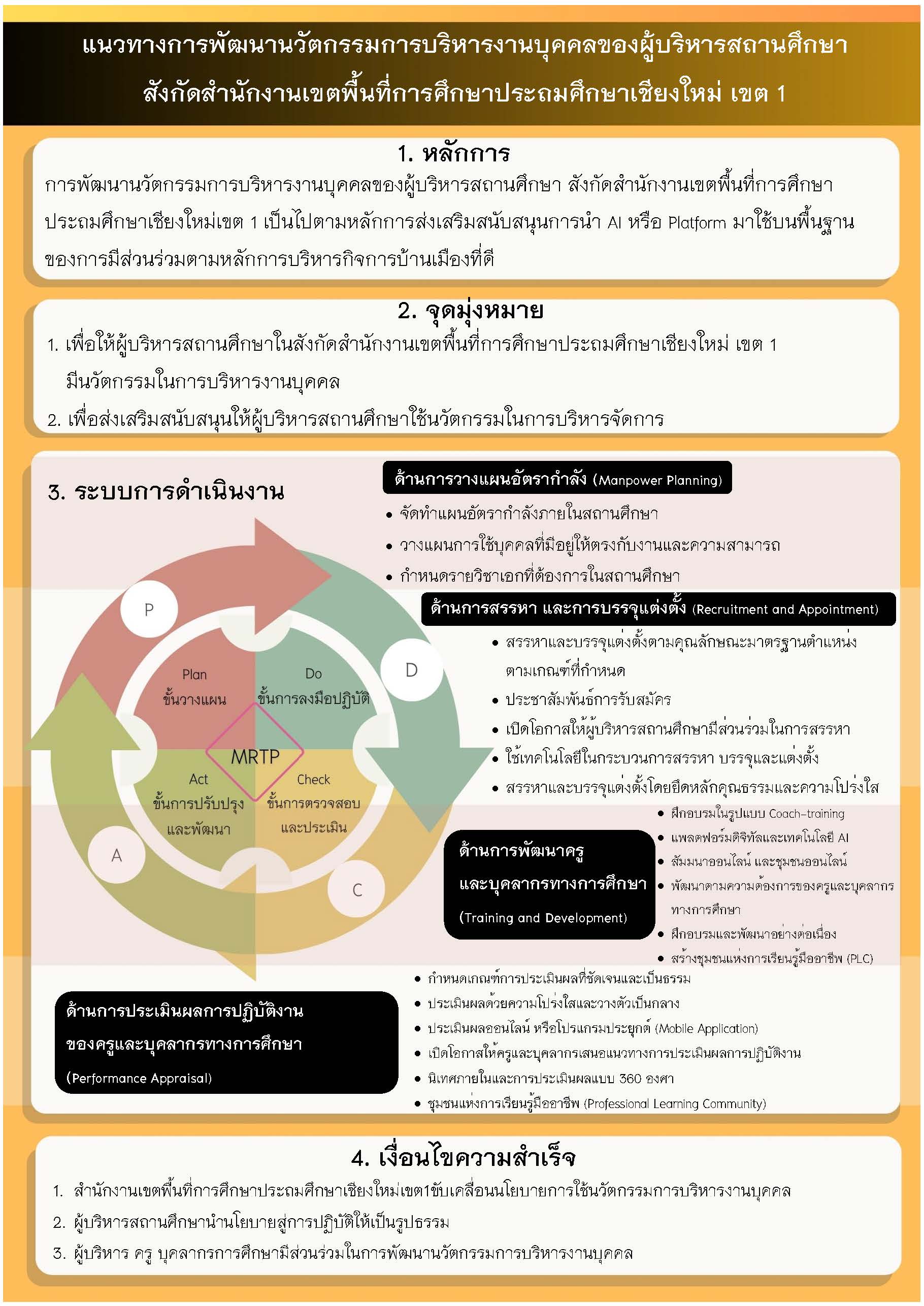
= 4.47, σ = 0.06) (2) การศึกษาการบริหารงานบุคคลของผู้บริหารสถานศึกษาที่มีผลการปฏิบัติที่เป็นเลิศ ทั้ง 4 ด้าน พบว่า โรงเรียนที่มีผลการปฏิบัติที่เป็นเลิศใช้นวัตกรรมการบริหาร คือ การนําเทคโนโลยีดิจิทัลมาใช้ในการพัฒนาสถานศึกษา ส่งเสริมและสนับสนุนการมีส่วนร่วมในการบริหารการเปลี่ยนแปลงนวัตกรรมในสถานศึกษาให้เกิดการพัฒนาอย่างยั่งยืน เป็นนวัตกรรมที่ปรารถนาให้นักเรียนมีความเป็นเลิศทางวิชาการ (3) แนวทางการพัฒนานวัตกรรมการบริหารงานบุคคลของผู้บริหารสถานศึกษา สังกัดสำนักงานเขตพื้นที่การศึกษาประถมศึกษาเชียงใหม่ เขต 1 มีความถูกต้องและครบถ้วนของเนื้อหา มีความเหมาะสมสามารถนำไปใช้ได้จริง การประเมินความเป็นไปได้และความเป็นประโยชน์ในภาพรวมอยู่ในระดับมากที่สุด ซึ่งประกอบด้วย 1) หลักการ 2) จุดมุ่งหมาย 3) ระบบการดำเนินงาน ที่ใช้กระบวนการมีส่วนร่วมตามวงจรคุณภาพ ได้แก่ 3.1) ขั้นวางแผน 3.2) ขั้นการลงมือปฏิบัติ 3.3) ขั้นการตรวจสอบและประเมิน 3.4) ขั้นการปรับปรุงและพัฒนา และ 4) เงื่อนไขความสำเร็จ
Downloads
Article Details

อนุญาตภายใต้เงื่อนไข Creative Commons Attribution-NonCommercial-NoDerivatives 4.0 International License.
เอกสารอ้างอิง
Akarataweewattanathorn, S. (2019). Artificial intelligence innovation and human resource recruitment. (Master thesis, Department of Management, Mahidol University). [In Thai]
Bencsik, A. & Csinger, B. (2021). Innovations in human resources management of higher education institutions: Technostress factors. Marketing and Management of Innovations, 4, 55-67.
Chantanee, P. (2022). Human resource management in digital. Journal of Academic and Social Science Innovation, 4(1), 204-216. [In Thai]
Chantrathip, M. (2022). Vision for driving educational innovation areas in Chiang Mai Province. Office of Educational Innovation Area Administration. Retrieved from https://www.edusandbox.com/8-jul-cmi-vision/ [In Thai]
Daengphirom, S. (2019). Educational administration by using new innovations in the 21st-century school. In The 3rd National Academic Conference for the Presentation of Research Results "Graduate School Conference 2019" (pp. 176-177). November 15th, 2019. Bangkok: Faculty of Education, Suan Sunandha Rajabhat University. [In Thai]
Jaiman, W. (2018). Guidelines for the use of information technology for the administration of small schools under the Office of the Primary Educational Service Area, Chiang Rai Area 2. Journal of Graduate Research, 9(1), 131-147. [In Thai]
Junboonnak, E., Ngamprakhon, S., & Ruangsanka, R. (2018). The development of personnel administration model to the excellence of educational institutes of Secondary Educational Service Areas. Journal of Peace Studies, MCU, 6(3), 1041-1055. [In Thai]
Kalong, P. (2020). Guidelines for the use of information technology for the administration of basic education institutions under the Office of the Primary Educational Service Area, Chaiyaphum Area 1. Journal of Graduate Research, 11(1), 149-162. [In Thai]
Kanasan, N. (2024). School management towards excellence in the 21st century by using NIKORN MODEL. Journal of Academic for Eastern Institute of Technology Suvarnabhumi, 3(1), 9-16. [In Thai]
Kanjanautt, P. (2018). The approach of efficiency personnel administration in basic education commission school. (Master thesis, Educational Administration and Management, Srinakharinwirot University). [In Thai]
Kantaping, S. (2019). Guidelines for learning management of Ban Mae Kon School in Chiang Dao District, Chiang Mai Province. Journal of Graduate Research, 10(2), 153-174. [In Thai]
Matkul, K. & Prasertphorn, V. (2021). The necessity for developing personnel administration of educational institutions under the Office of the Secondary Education Area 25. Journal of Buddhist Education and Research, 7(1), 52-61. [In Thai]
Ministry of Education. (2019). Educational Innovation Area Act B.E. 2562. (30 April 2019). Government Gazette. Volume 136, Part 56 A, pages 102-120. [In Thai]
Office of the Secretary of the Education Council. (2021). Innovation in educational administration in Thailand and selected countries to develop learners into the 21st century. Bangkok: Office of Educational Standards and Learning Development. [In Thai]
Panyaake, R. & Tesaputa, K. (2020). Innovative leadership of school administrators affecting teacher performance Office of the Secondary Education Area 27. Journal of Educational Administration and Supervision, 11(2), 52-61. [In Thai]
Phampantup, A. & Manyanon, S. (2022). The personnel administration of schools under Udon Thani primary educational service area office 4. Journal of management science Sakon Nakhon Rajabhat university, 2(1), 41-54. [In Thai]
Phoglin, J. (2022). Guidelines of the development of personnel administration in schools under Ubon Ratchathani municipality. Journal of MCU Ubon Review, 7(1), 509-520. [In Thai]
Sangkha, P. & Phiamphuchana, N. (2023). Needs and guidelines for personnel administration in small educational institutions under the Office of the Primary Educational Service Area, Khon Kaen Area 5. Journal of Buddhist Philosophy Evolution, 7(1), 488-499. [In Thai]
Schislyaeva, E. R. (2021). Personnel management innovations in the digital era: Case of russia in COVID-19 pandemic. Academy Of Strategic Management Journal, 20(2), 1-16.
Sisa-aad, B. (2017). Preliminary research. (10th ed.). Bangkok: Suwiriyasan. [In Thai]
Techanok, A. (2020). Education management towards excellence in the 21st century. Journal of Modern Learning Development, 5(6), 364-373. [In Thai]
