
Future Scenarios of School Administrators’ Competencies in the Artificial Intelligence Era Among Provincial Kindergarten Schools in Thailand
Article Sidebar
Main Article Content
Abstract
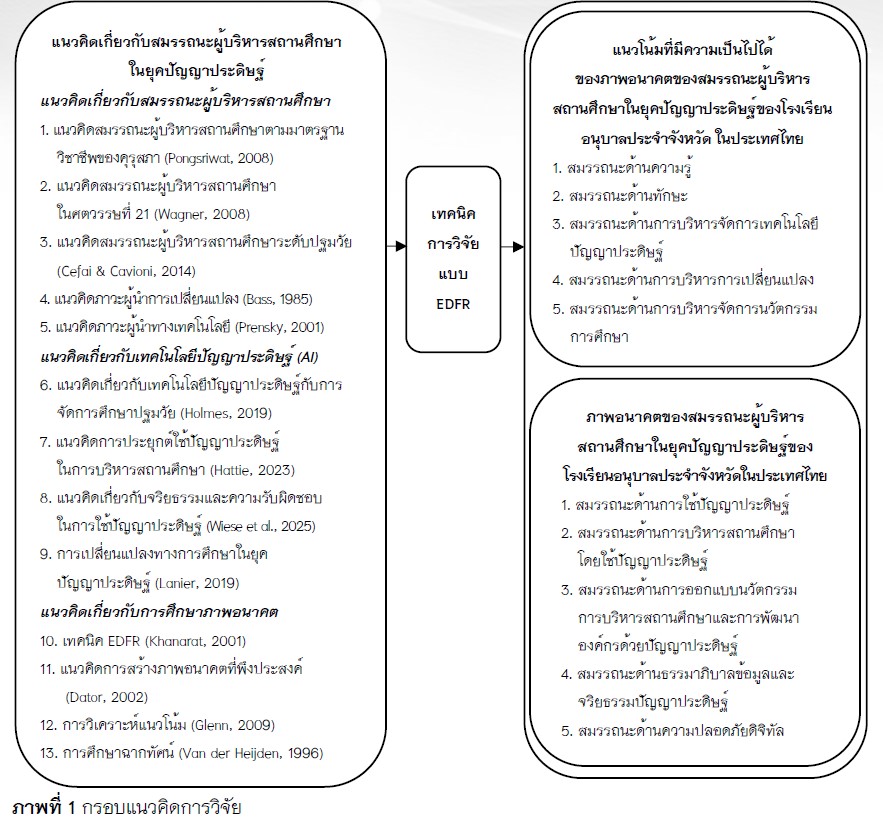
This study aimed to (1) examine possible trends in future competencies of school administrators and (2) develop future scenarios of school administrators’ competencies in the artificial intelligence era in provincial kindergarten schools in Thailand. The study employed the Ethnographic Delphi Futures Research (EDFR) technique to obtain consensus from key informants. In the first round, 11 experts participated, while 23 experts were involved in the second and third rounds. The participants included national-level policymakers, educational administrators at the district level, school administrators, and academics in early childhood education, educational technology, innovation, and artificial intelligence in education. Research instruments included in-depth interviews and questionnaires on future competency trends. Data were analyzed using content analysis and statistical measures, including median, mode, and interquartile range.
The findings revealed that: 1) all five core competencies were rated at the highest level of importance. Ranked by median scores, these included educational innovation management, knowledge, change management, skills, and artificial intelligence technology management. 2) The future competencies of school administrators over the next decade consist of five key areas: artificial intelligence utilization, AI-based school administration, innovation and organizational development design using AI, data governance and AI ethics, and digital security.
Downloads
Article Details

This work is licensed under a Creative Commons Attribution-NonCommercial-NoDerivatives 4.0 International License.
References
Afandi, A., Bafadal, I., Burhanuddin, H., Hadi, S., & Taufiq, A. (2021). Investigating school principals’ learning leadership practices in three Indonesian excellent schools. Eurasian Journal of Educational Research, 96, 119–135. https://files.eric.ed.gov/fulltext/EJ1325850.pdf
Antonopoulou, H., Matzavinou, P., Giannoukou, I., & Halkiopoulos, C. (2025). Teachers’ digital leadership and competencies in primary education: A cross sectional behavioral study. Education Sciences, 15(2), 215. https://doi.org/10.3390/educsci15020215
Bafadal, I., Nurabadi, A., Sobri, A. Y., & Gunawan, I. (2019). The competence of beginner principals as instructional leaders in primary schools. International Journal of Innovation, Creativity and Change, 5(4), 625-639. https://www.ijicc.net/images/vol5iss4/Pt_2/54217_Bafadal_2019_E_R.pdf
Bass, B. M. (1985). Leadership and performance beyond expectations. Free Press.
Burns, J. M. (1978). Leadership. Harper & Row.
Cameron, E., & Green, M. (2015). Making sense of change management (4th ed.). Kogan Page.
Chiangrang, K. (2021). The study core competency of school administrators on 21st century Benchamit School Group under The Secondary Educational Service Area Office 36 [Master’s thesis, University of Phayao]. https://updc.up.ac.th/handle/123456789/222
Cefai, C., & Cavioni, V. (2014). Social and emotional education in primary school: Integrating theory and research into practice. Springer
Dator, J. A. (2002). Advancing futures: Futures studies in higher education. Greenwood Publishing Group.
Dyantyi, N., & Ncanywa, T. (2024). Reflections on principals’ leadership practices in deprived schools: A case of the Amathole East Education District. E-Journal of Humanities, Arts and Social Sciences, 5(6), 876-886. https://doi.org/10.38159/ehass.2024567
Fullan, M. (2007). The new meaning of educational change (4th ed.). Teachers College Press.
Fullan, M. (2014). The principal: Three keys to maximizing impact. Jossey Bass.
Glenn, J. C. (2009). Introduction to the futures research methods series. In J. C. Glenn & T. J. Gordon (Eds.), Futures research methodology — Version 3.0 (pp. 1–106). The Millennium Project.
Grant Thornton. (2019). The future of leadership: Anticipating 2030. https://www.grantthornton.global/en/insights/articles/leadership-2030/
Hattie, J. (2023). Visible learning: The sequel. Routledge.
Hattie, J., & Timperley, H. (2007). The power of feedback. Review of Educational Research, 77(1), 81–112. https://doi.org/10.3102/003465430298487
Hargreaves, A., & Harris, A. (2015). High performance leadership in unusually challenging educational circumstances. Estonian Journal of Education, 3(1), 28–49. https://doi.org/10.12697/eha.2015.3.1.02b
Holmes, W., Bialik, M., & Fadel, C. (2019). Artificial intelligence in education: Promises and implications for teaching and learning. Center for Curriculum Redesign.
Horton International. (2019). Five critical competencies for leadership in the future. Horton International. https://hortoninternational.com/five-critical-competencies-for-leadership-in-the-future/
Kadri, K., Mansor, A. N., & Nor, M. Y. M. (2021). Principal and teacher leadership competencies and 21st Century teacher learning and facilitating practices: Instrument development and demographic analysis. Creative Education, 12(9), 2196–2215. https://doi.org/10.4236/ce.2021.129168
Keesukphan, E. (2016). School management in the digital era. TruePlookpanya. https://www.trueplookpanya.com/knowledge/content/52232 [In Thai]
Khanarat, S. (2001). An analytical survey on methodology of research using EDFR technique [Master’s thesis, Chulalongkorn University]. Chula DigiVerse. http://cuir.car.chula.ac.th/handle/123456789/66090 [In Thai]
Kotter, J. P. (1996). Leading change. Harvard Business School Press.
Kramer, M., & Engeström, R. (2019). Teachers’ beliefs as a component of motivational force of professional agency. Learning, Culture and Social Interaction, 21, 214–222. https://doi.org/10.1016/j.lcsi.2019.03.007
Kotcharat, J., Chaikaew, M., & Phoesalae, N. (2017). Scenario of lifelong education management to develop the quality of life of youth in the special administrative zone in the southern border. Journal of MCU Social Sciences Review, 6(2), 63–80. https://so03.tci-thaijo.org/index.php/jssr/article/view/239615/164678
Lanier, J. (2019). Ten arguments for deleting your social media accounts right now. Henry Holt and Company.
Leithwood, K., Harris, A., & Hopkins, D. (2019). Seven strong claims about successful school leadership. School Leadership & Management, 40(1), 27-42. https://doi.org/10.1080/13632430701800060
Mongkol, K. (2021). Strategic foresight under crisis. MBA-KKU Journal, 14(1), 1–11. https://so04.tci-thaijo.org/index.php/mbakkujournal/article/view/251497 [In Thai]
Office of the Basic Education Commission. (2020). Core curriculum for basic education B.E. 2551 (Revised 2020). Agricultural Cooperatives Printing House of Thailand.
Organisation for Economic Co-operation and Development (OECD). (2020). Back to the future of education: Four OECD scenarios for schooling, educational research and innovation. OECD Publishing. https://www.oecd.org/en/publications/back-to-the-future-s-of-education_178ef527-en/full-report/component-8.html
Pakdee, S. (2024). Guidelines for applying artificial intelligence (AI) in educational management under the Secondary Educational Service Area Office Bangkok 2 [Master’s thesis, Srinakharinwirot University]. iThesis Srinakharinwirot University. https://ir-ithesis.swu.ac.th/handle/123456789/3015 [In Thai]
Personal Data Protection Act B.E. 2562. (2019, May 27). Government Gazette. Vol. 136 Part 69 A pp. 52-95. [In Thai]
Poolpatarachewin, C. (2003). Ethnographic Delphi futures research (EDFR). Journal of Education Studies, 32(1), Article 2. https://digital.car.chula.ac.th/educujournal/vol32/iss1/2
Pongsriwat, S. (2008). Leadership: Theory and practice — The science and art toward complete leadership (2nd ed.). Wirat Education. [In Thai]
Prensky, M. (2001). Digital natives, digital immigrants. On the Horizon, 9(5), 1–6. http://dx.doi.org/10.1108/10748120110424816
Rattanapitakthada, C., & Trairat, P. (2023). Educational Leaders’ Competencies to Survive and Thrive in a BANI World. Pacific Institute of Management Academic Journal, 9(1), 16–28. https://so05.tci-thaijo.org/index.php/pacific/article/view/263622/177720 [In Thai]
Reichgelt, T., Jackson, J. A., Conran, J. G., West, C. K., Kennedy, E. M., & Lee, D. E. (2025). Humid mesothermal climate and open forest at the early Miocene Landslip Hill deposit (Gore Lignite Measures), Southern Zealandia. Earth History and Biodiversity, 4, 100027. https://doi.org/10.1016/j.hisbio.2025.100027
Scott, B. (2018). Complexity science, generative leadership, and neuroscience: foundations for developing socially adept educational leaders. Journal of Critical Issues in Educational Practice, 8(1), Article 3. https://scholarworks.lib.csusb.edu/wie/vol8/iss1/3
Senge, P. M., Cambron-mccabe, N., lucas, T., Smith, B., Dutton, J., & Kleiner, A. (2000). Schools that learn: A fifth discipline fieldbook for educators, parents, and everyone who cares about education. Doubleday.
Sod-ium, P. (2023). Competencies of School Administrators in the 21st Century: A Study of Private Schools in Loei Province. Chintasit Academic Journal, 1(4), 189–200. https://so19.tci-thaijo.org/index.php/Chintasit/article/view/893 [In Thai]
Tapscott, D. (1998). Growing up digital: The rise of the net generation. McGraw-Hill.
Van der Heijden, K. (1996). Scenarios: The art of strategic conversation. John Wiley & Sons. http://www.laprospective.fr/dyn/francais/memoire/texte_fondamentaux/the-art-of-strategic-conversation-van-der-heijden.pdf
Vora, T. (2016). 12 critical competencies for leadership in the future. https://tanmayvora.com/leadership-skills-for-the-future/
Wagner, T. (2008). The global achievement gap: Why even our best schools don’t teach the new survival skills our children need—and what we can do about it. Basic Books.
Wang, H., Songsiengchai, S., Somrang, K., Angsuwotai, N., & Chiamthong, P. (2024). The effects of cooperative learning approaches on emotional involvement to enhance artistic creative literacy among third grade art students in Chinese Secondary Vocational School. International Journal of Education & Literacy Studies, 12(4), 221-234. http://dx.doi.org/10.7575/aiac.ijels.v.12n.4p.221
Wiese, L. J., Patil, I., Schiff, D. S., & Magana, A. J. (2025). AI ethics education: A systematic literature review. Computers and Education: Artificial Intelligence, 8, 100405. https://doi.org/10.1016/j.caeai.2025.100405
World Economic Forum. (2022). The global risks report 2022 (17th ed.). World Economic Forum. https://www3.weforum.org/docs/WEF_The_Global_Risks_Report_2022.pdf
