
Guidelines for Developing Teachers' Digital Competence in Online Lesson Creation at Fang Vocational College, Chiang Mai Province
Article Sidebar
Main Article Content
Abstract
This study aimed to: 1) examine the current and desired conditions, as well as the needs for developing teachers’ digital competence in creating online lessons; 2) identify best practices for enhancing such competencies; and 3) develop and validate a guideline for improving digital competence among teachers at Fang Vocational College, Chiang Mai Province The study was conducted in three phases: 1) a survey of 70 administrators and teachers at Fang Vocational College to assess the current situation, desired outcomes, and training needs; 2) an investigation of best practices through interviews with 12 experts; and 3) the development and validation of a guideline in collaboration with five specialists. Research instruments comprised a needs assessment questionnaire, a focus group discussion guide, a guideline quality assessment form, and a satisfaction questionnaire. Quantitative data were analyzed using descriptive statistics (frequency, percentage, mean, and standard deviation) and the Modified Priority Needs Index (PNI Modified), while qualitative data were analyzed using content analysis.
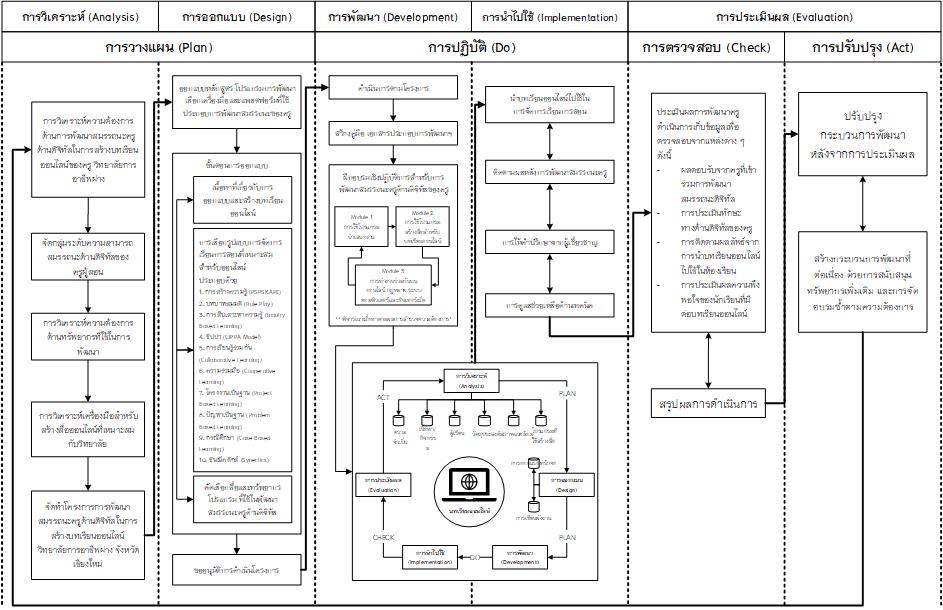
The findings revealed that: 1) the overall current level of teachers’ digital competence in creating online lessons was moderate (mean = 3.78), while the desired level was high (mean = 4.45), with a PNI Modified score of 0.67, indicating a considerable need for development; 2) best practices suggest that administrators should support lifelong learning through accessible, learner-centered online content, leverage artificial intelligence (AI) to enhance instructional effectiveness, define clear learning objectives, and implement continuous assessment; and 3) the developed a guideline, based on best practices, the PDCA cycle, and the ADDIE model, was validated by experts as highly appropriate and accurate. Stakeholder satisfaction with the guideline was rated at the highest level.
Downloads
Article Details

This work is licensed under a Creative Commons Attribution-NonCommercial-NoDerivatives 4.0 International License.
References
Al-Fraihat, D., Joy, M., & Sinclair, J. (2020). Evaluating e-learning systems success: An empirical study. Education and Information Technologies, 25(5), 5711–5736. https://doi.org/10.1007/s10639-020-10204-2
Amemasor, S. K., Oppong, S. O., Ghansah, B., Benuwa, B.-B., & Essel, D. D. (2025). A systematic review on the impact of teacher professional development on digital instructional integration and teaching practices. Frontiers in Education, 10, 1-14. https://doi.org/10.3389/feduc.2025.1541031
Chongcharoen, K. (2024). Digital school management: A case study of successful schools for integrating digital technology to develop the quality of learners. Journal of Graduate Research, 12(2), 13-26. [In Thai]
Deming, E. W. (1986). Out of the crisis. Massachusetts: Center for Advanced Engineering Study.
Fang Industrial and Community Education College. (2022). Self-assessment report: Sar 2022. Chiang Mai: Fang Industrial and Community Education College. [In Thai]
Ghafar, Z. N. (2024). A learner-centered approach to learning: Students from diverse professional backgrounds. Journal of Digital Learning and Distance Education, 3(2), 958-966. https://doi.org/10.56778/jdlde.v3i2. 302.
Herrera, A. M. N., Guzman, B. L. M., Freire, G., Campos, R. C. A., Cabezas, P. C. M., Guevara, A. G. E., & Fourney, L. S. A. (2023). Teaching competencies in education for sustainable development: A study from action research. Migration Letters, 20(11), 779–787. https://doi.org/10.59670/ml.v20iS11.5764
Insa-ard, S. (2018). The Design of e-learning to develop higher-order thinking skills. Bangkok: SE-ED. [In Thai]
Intachum, P., Wangcham, S., & Yomsoongnern, J. (2023). The development guidelines of technology utilization for learning management of Ban Hong Rattana Wittaya School in Lamphun Province. Journal of Graduate Research, 14(1), 99-112. [In Thai]
Kesonsuriwong, P. & Chaowachai, S. (2023). Guidelines development of English teachers’ learning management competency in the digital age under the Office of Nakhon Sawan Primary Educational Service Area Office 2. Journal of Graduate Research, 14(1), 81-97. [In Thai]
Lirayapong, P. (2022). Guidelines for teacher digital competence development: Application of mixed method research. (Master thesis, Industrial Education and Technology, King Mongkut's Institute of Technology Ladkrabang). [In Thai]
Ministry of Education. (2023). Announcement of the Ministry of Education on policies and key focus areas for the Fiscal Year 2023. Bangkok: Ministry of Education. [In Thai]
Müller, C., Mildenberger, T., & Steingruber, D. (2023). Learning effectiveness of a flexible learning study programme in a blended learning design: Why are some courses more effective than others?. International Journal of Educational Technology in Higher Education, 20(10). https://doi.org/10.1787/c74f03de-en
Office of the Basic Education Commission. (2010). Teacher competency assessment manual. Bangkok: Office of the Basic Education Commission. [In Thai]
Office of the Teacher Civil Service and Educational Personnel Commission. (2020). Digital skills development for teachers and educational personnel. Bangkok: Office of the Teacher Civil Service and Educational Personnel Commission. [In Thai]
Office of the Vocational Education Commission. (2019). Guidelines and practices for managing vocational education at the Diploma and Higher Vocational Certificate Levels. Bangkok: Minburi Technical College. [In Thai]
Prasojo, L. D., Habibi, A., & Mukminin, A. (2020). Integrating technology into instruction: The implementation of Google Classroom in Indonesia. Education and Information Technologies, 25(6), 4781–4796. https://doi.org/10.1007/s10639-020-10127-9
Promsuwan, K. & Kuroda, A. (2021). The development of a training course enhancing competency in classroom management through contemplative education of the pre-service teachers. Journal of MCU Peace Studies, 9(3), 1075-1090. [In Thai]
Sanchai, J. & Koomkhainam, T. (2023). Guidelines for developing digital skills of school’s administrators under the Buengkan Secondary Educational Service Area Office. Journal of Graduate Research, 14(2), 99-114. [In Thai]
Sriduangkam, W. (2023). Main operations manual: Recruitment of university support personnel at University of Phayao. Phayao: University of Phayao. [In Thai]
Srichan, T. & Kosolkittiamporn, S. (2023). The 20 years of national strategy for the development of Thailand. Journal of Modern Learning Development, 8(1), 414-435. [In Thai]
Tedpol, K. & Wannasri, J. (2021). The relationships between the school administrator’s digital literacy and information technology management in school under Uttaradit Primary Educational Service Area Office 1. Education Journal, 5(1), 77-88. [In Thai]
Thila, M. (2024). Guidelines for developing digital competencies of teachers attached to office of the vocational education commission, Chiang Mai Province. (Master thesis, Education Administration, Chiang Mai University). [In Thai]
Weskavee, S., Sangsvang, C., & Kitipichetsan, J. (2024). The development of digital skills of vocational college students under the Office of the Vocational Education Commission. Journal of Association of Professional Development of Educational Administration of Thailand, 6(3), 438-450. [In Thai]
Westerman, G., Bonnet, D., & McAfee, A. (2014). Leading digital: Turning technology into business transformation. Boston: Harvard Business Review Press.
Zhang, X., Sazalli, N. A. H., & Miskam, N. N. (2024). Improving teachers' digital competence in higher education: A systematic literature review. International Journal of Academic Research in Progressive Education and Development, 13(1), 967-979. http://dx.doi.org/10.6007/IJARPED/v13-i1/20560
