
แนวทางการพัฒนาสมรรถนะครูด้านดิจิทัลในการสร้างบทเรียนออนไลน์ วิทยาลัยการอาชีพฝาง จังหวัดเชียงใหม่
Article Sidebar
Main Article Content
บทคัดย่อ
การวิจัยนี้มีวัตถุประสงค์เพื่อ 1) ศึกษาสภาพปัจจุบัน สภาพที่พึงประสงค์ และความต้องการจำเป็นในการพัฒนาสมรรถนะครูด้านดิจิทัลในการสร้างบทเรียนออนไลน์ 2) ศึกษาแนวปฏิบัติที่เป็นเลิศในการพัฒนาสมรรถนะครูด้านดิจิทัลในการสร้างบทเรียนออนไลน์ และ 3) จัดทำและตรวจสอบแนวทางการพัฒนาสมรรถนะครูด้านดิจิทัลในการสร้างบทเรียนออนไลน์ วิทยาลัยการอาชีพฝาง จังหวัดเชียงใหม่ วิธีการดำเนินงานมี 3 ขั้นตอน คือ 1) สอบถามสภาพปัจจุบัน สภาพที่พึงประสงค์ และความต้องการจำเป็นจากผู้บริหารและครูวิทยาลัยการอาชีพฝาง 70 คน 2) ศึกษาแนวปฏิบัติที่เป็นเลิศจากผู้เชี่ยวชาญ 12 คน และ 3) จัดทำและตรวจสอบแนวทางฯ ร่วมกับผู้ทรงคุณวุฒิ 5 คน เครื่องมือที่ใช้ในการวิจัย ได้แก่ แบบสอบถามสภาพปัจจุบัน สภาพที่พึงประสงค์ และความต้องการจำเป็น แบบบันทึกการสนทนากลุ่มผู้เชี่ยวชาญ แบบประเมินความถูกต้องและเหมาะสมของแนวทางฯ และแบบประเมินความพึงพอใจของครูและผู้บริหารต่อแนวทางฯ การวิเคราะห์ข้อมูลเชิงปริมาณใช้การหาค่าความถี่ ค่าร้อยละ ค่าเฉลี่ย ส่วนเบี่ยงเบนมาตรฐาน และการวิเคราะห์ความต้องการจำเป็นใช้ Modified Priority Needs Index (PNIModified) การวิเคราะห์ข้อมูลเชิงคุณภาพใช้การวิเคราะห์เชิงเนื้อหา
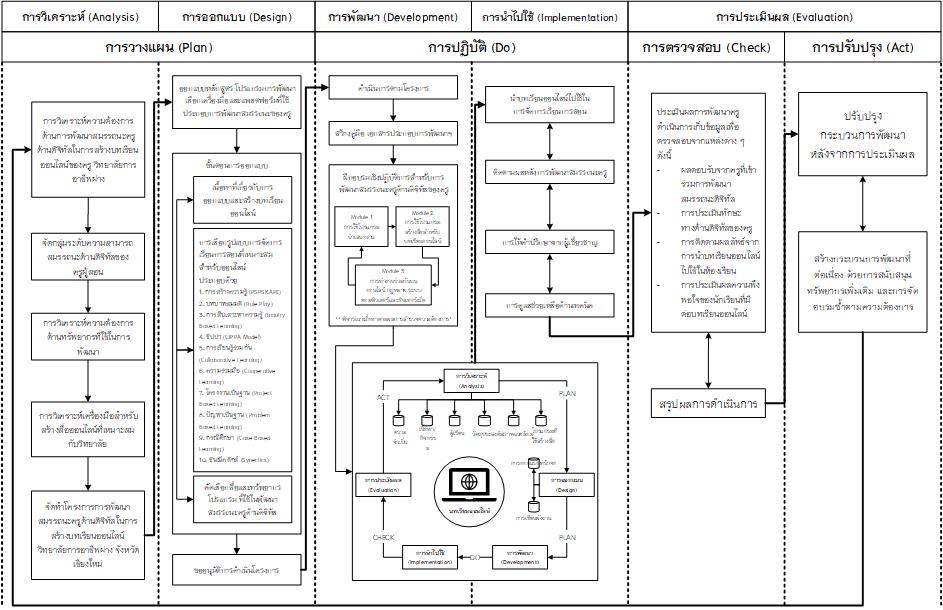
ผลการวิจัยพบว่า 1) การศึกษาสภาพปัจจุบัน สภาพที่พึงประสงค์ และความต้องการจำเป็นของสมรรถนะครูด้านดิจิทัลที่ใช้ในการสร้างบทเรียนออนไลน์ ภาพรวมของสภาพปัจจุบันมีค่าเฉลี่ยอยู่ในระดับปานกลาง (I = 3.78) สภาพที่พึงประสงค์มีค่าเฉลี่ยระดับมาก (D = 4.45) และค่าดัชนีลำดับความสำคัญของความต้องการจำเป็น (PNIModified) เท่ากับ 0.67 2) การศึกษาแนวปฏิบัติที่เป็นเลิศในการพัฒนาสมรรถนะด้านดิจิทัล พบว่าผู้บริหารควรมุ่งเน้นการสนับสนุนให้ครูสร้างการเรียนรู้ตลอดชีวิตผ่านบทเรียนออนไลน์ที่เข้าถึงง่ายและตอบสนองต่อผู้เรียน ใช้ AI เพิ่มประสิทธิภาพการสอน การออกแบบบทเรียนมีเป้าหมายชัดเจน และมีการประเมินผลอย่างต่อเนื่อง 3) การจัดทำและตรวจสอบแนวทางฯ พบว่าการจัดทำแนวทางจัดทำตามแนวปฏิบัติที่เป็นเลิศที่ดี กระบวนการ PDCA และ ADDIE Model การประเมินความถูกต้องและเหมาะสมของแนวทางฯ โดยผู้เชี่ยวชาญ พบว่าความเหมาะสมมีค่าเฉลี่ยอยู่ในระดับมาก และความถูกต้องมีค่าเฉลี่ยอยู่ในระดับมาก และ การประเมินความพึงพอใจของแนวทางฯ อยู่ในระดับมากที่สุด
Downloads
Article Details

อนุญาตภายใต้เงื่อนไข Creative Commons Attribution-NonCommercial-NoDerivatives 4.0 International License.
เอกสารอ้างอิง
Al-Fraihat, D., Joy, M., & Sinclair, J. (2020). Evaluating e-learning systems success: An empirical study. Education and Information Technologies, 25(5), 5711–5736. https://doi.org/10.1007/s10639-020-10204-2
Amemasor, S. K., Oppong, S. O., Ghansah, B., Benuwa, B.-B., & Essel, D. D. (2025). A systematic review on the impact of teacher professional development on digital instructional integration and teaching practices. Frontiers in Education, 10, 1-14. https://doi.org/10.3389/feduc.2025.1541031
Chongcharoen, K. (2024). Digital school management: A case study of successful schools for integrating digital technology to develop the quality of learners. Journal of Graduate Research, 12(2), 13-26. [In Thai]
Deming, E. W. (1986). Out of the crisis. Massachusetts: Center for Advanced Engineering Study.
Fang Industrial and Community Education College. (2022). Self-assessment report: Sar 2022. Chiang Mai: Fang Industrial and Community Education College. [In Thai]
Ghafar, Z. N. (2024). A learner-centered approach to learning: Students from diverse professional backgrounds. Journal of Digital Learning and Distance Education, 3(2), 958-966. https://doi.org/10.56778/jdlde.v3i2. 302.
Herrera, A. M. N., Guzman, B. L. M., Freire, G., Campos, R. C. A., Cabezas, P. C. M., Guevara, A. G. E., & Fourney, L. S. A. (2023). Teaching competencies in education for sustainable development: A study from action research. Migration Letters, 20(11), 779–787. https://doi.org/10.59670/ml.v20iS11.5764
Insa-ard, S. (2018). The Design of e-learning to develop higher-order thinking skills. Bangkok: SE-ED. [In Thai]
Intachum, P., Wangcham, S., & Yomsoongnern, J. (2023). The development guidelines of technology utilization for learning management of Ban Hong Rattana Wittaya School in Lamphun Province. Journal of Graduate Research, 14(1), 99-112. [In Thai]
Kesonsuriwong, P. & Chaowachai, S. (2023). Guidelines development of English teachers’ learning management competency in the digital age under the Office of Nakhon Sawan Primary Educational Service Area Office 2. Journal of Graduate Research, 14(1), 81-97. [In Thai]
Lirayapong, P. (2022). Guidelines for teacher digital competence development: Application of mixed method research. (Master thesis, Industrial Education and Technology, King Mongkut's Institute of Technology Ladkrabang). [In Thai]
Ministry of Education. (2023). Announcement of the Ministry of Education on policies and key focus areas for the Fiscal Year 2023. Bangkok: Ministry of Education. [In Thai]
Müller, C., Mildenberger, T., & Steingruber, D. (2023). Learning effectiveness of a flexible learning study programme in a blended learning design: Why are some courses more effective than others?. International Journal of Educational Technology in Higher Education, 20(10). https://doi.org/10.1787/c74f03de-en
Office of the Basic Education Commission. (2010). Teacher competency assessment manual. Bangkok: Office of the Basic Education Commission. [In Thai]
Office of the Teacher Civil Service and Educational Personnel Commission. (2020). Digital skills development for teachers and educational personnel. Bangkok: Office of the Teacher Civil Service and Educational Personnel Commission. [In Thai]
Office of the Vocational Education Commission. (2019). Guidelines and practices for managing vocational education at the Diploma and Higher Vocational Certificate Levels. Bangkok: Minburi Technical College. [In Thai]
Prasojo, L. D., Habibi, A., & Mukminin, A. (2020). Integrating technology into instruction: The implementation of Google Classroom in Indonesia. Education and Information Technologies, 25(6), 4781–4796. https://doi.org/10.1007/s10639-020-10127-9
Promsuwan, K. & Kuroda, A. (2021). The development of a training course enhancing competency in classroom management through contemplative education of the pre-service teachers. Journal of MCU Peace Studies, 9(3), 1075-1090. [In Thai]
Sanchai, J. & Koomkhainam, T. (2023). Guidelines for developing digital skills of school’s administrators under the Buengkan Secondary Educational Service Area Office. Journal of Graduate Research, 14(2), 99-114. [In Thai]
Sriduangkam, W. (2023). Main operations manual: Recruitment of university support personnel at University of Phayao. Phayao: University of Phayao. [In Thai]
Srichan, T. & Kosolkittiamporn, S. (2023). The 20 years of national strategy for the development of Thailand. Journal of Modern Learning Development, 8(1), 414-435. [In Thai]
Tedpol, K. & Wannasri, J. (2021). The relationships between the school administrator’s digital literacy and information technology management in school under Uttaradit Primary Educational Service Area Office 1. Education Journal, 5(1), 77-88. [In Thai]
Thila, M. (2024). Guidelines for developing digital competencies of teachers attached to office of the vocational education commission, Chiang Mai Province. (Master thesis, Education Administration, Chiang Mai University). [In Thai]
Weskavee, S., Sangsvang, C., & Kitipichetsan, J. (2024). The development of digital skills of vocational college students under the Office of the Vocational Education Commission. Journal of Association of Professional Development of Educational Administration of Thailand, 6(3), 438-450. [In Thai]
Westerman, G., Bonnet, D., & McAfee, A. (2014). Leading digital: Turning technology into business transformation. Boston: Harvard Business Review Press.
Zhang, X., Sazalli, N. A. H., & Miskam, N. N. (2024). Improving teachers' digital competence in higher education: A systematic literature review. International Journal of Academic Research in Progressive Education and Development, 13(1), 967-979. http://dx.doi.org/10.6007/IJARPED/v13-i1/20560
