
การพัฒนาแบบประเมินทักษะการทำโครงงานสีเขียวสำหรับกิจกรรมการเรียนรู้ตามแนวคิดสะตีมศึกษาเน้นโครงงานเป็นฐานด้วยการบูรณาการโมเดลเศรษฐกิจบีซีจี
Article Sidebar
Main Article Content
บทคัดย่อ
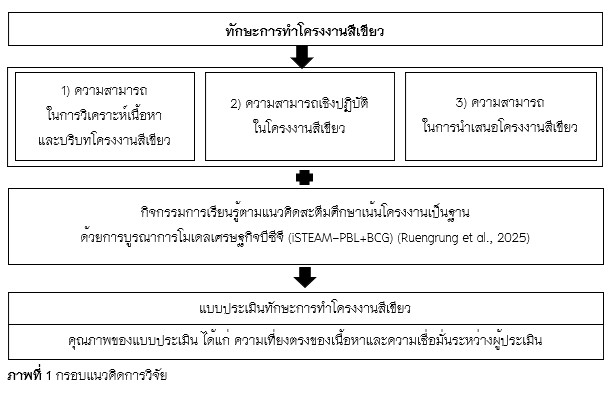
การวิจัยนี้มีวัตถุประสงค์เพื่อ 1) สังเคราะห์องค์ประกอบของทักษะการทำโครงงานสีเขียว และ 2) พัฒนาและตรวจสอบคุณภาพของแบบประเมินทักษะการทำโครงงานสีเขียวสำหรับกิจกรรมการเรียนรู้ตามแนวคิดสะตีมศึกษาเน้นโครงงานเป็นฐานด้วยการบูรณาการโมเดลเศรษฐกิจบีซีจี กลุ่มเป้าหมาย ได้แก่ 1) กลุ่มผู้ทรงคุณวุฒิ จำนวน 9 คน ซึ่งจบการศึกษาระดับปริญญาเอก สาขาวิทยาศาสตร์ศึกษา การวิจัยและพัฒนาหลักสูตร การวัดผลและประเมินผลการศึกษา และมีผลงานวิจัยด้านสะเต็มหรือสะตีมศึกษา และ 2) กลุ่มผู้ประเมินโครงงาน จำนวน 2 คน ซึ่งจบการศึกษาระดับปริญญาตรี และมีประสบการณ์เป็นครูที่ปรึกษาโครงงานวิทยาศาสตร์และโครงงานอาชีพ ไม่ต่ำกว่า 5 ปี เครื่องมือการวิจัย ได้แก่ 1) แบบสังเคราะห์เอกสาร 2) แบบตรวจสอบความเที่ยงตรงของเนื้อหา และ 3) แบบประเมินทักษะการทำโครงงานสีเขียว (ฉบับทดลองใช้) ซึ่งเครื่องมือการวิจัยข้างต้นผ่านการตรวจสอบคุณภาพเบื้องต้นจากคณะกรรมการที่ปรึกษาวิทยานิพนธ์จำนวน 3 คน และเก็บรวบรวมข้อมูลจากการสังเคราะห์และนิยามองค์ประกอบของทักษะการทำโครงงานสีเขียว โดยวิเคราะห์ความถี่ของคำสำคัญ และวิเคราะห์ข้อมูลเพื่อตรวจสอบคุณภาพของแบบประเมินจากผู้ทรงคุณวุฒิและผู้ประเมินโครงงาน ได้แก่ ความเที่ยงตรงของเนื้อหาและความเชื่อมั่นระหว่างผู้ประเมิน
ผลการวิจัยพบว่า 1) องค์ประกอบของทักษะการทำโครงงานสีเขียว มี 3 องค์ประกอบ ได้แก่ (1) ความสามารถในการวิเคราะห์เนื้อหาและบริบทโครงงานสีเขียว (2) ความสามารถเชิงปฏิบัติในโครงงานสีเขียว และ (3) ความสามารถในการนำเสนอโครงงานสีเขียว และ 2) แบบประเมินทักษะการทำโครงงานสีเขียวเป็นแบบประเมินมีเกณฑ์ประมาณค่า 3 ระดับ ตามแบบเกณฑ์การให้คะแนนแบบแยกส่วน มีทั้งหมด 21 รายการประเมิน มีความเที่ยงตรงของเนื้อหาที่สามารถนำไปใช้ได้ โดยมีค่าดัชนีความเที่ยงตรงของเนื้อหา อยู่ระหว่าง 0.78-1.00 และค่าเฉลี่ยดัชนีความตรงเชิงเนื้อหาของเครื่องมือวิจัยทั้งชุด (S-CVI/Ave) เท่ากับ 0.91 สูงกว่าเกณฑ์ขั้นต่ำที่ยอมรับได้ 0.90 ด้านความเชื่อมั่นใช้วิธีหาความสอดคล้องภายในโดยการพิจารณาความเชื่อมั่นระหว่างผู้ประเมิน 2 ท่าน มีค่าสัมประสิทธิ์โคเฮนแคปปา (Cohen’s Kappa Coefficient) เท่ากับ 0.78 ซึ่งมีระดับความสอดคล้องระหว่างผู้ประเมินระดับปานกลาง และมีร้อยละของความเชื่อมั่นเท่ากับ 36 – 63
Downloads
Article Details

อนุญาตภายใต้เงื่อนไข Creative Commons Attribution-NonCommercial-NoDerivatives 4.0 International License.
เอกสารอ้างอิง
Anchana, C., & Haemaprasith, S. (2020). Development of innovative thinking activity packages to promote science project performing and teamwork abilities of seventh grade students. Journal of Industrial Education, 19(3), 53–62. https://ph01.tci-thaijo.org/index.php/JIE/article/view/241688 [In Thai]
Anderson, L. W., & Krathwohl, D. R. (2001). The cognitive process dimension. In L. W. Anderson & D. R. Krathwohl (Eds.), A taxonomy for learning, teaching, and assessing: A revision of Bloom's taxonomy of educational objectives (pp. 63-92). Longman.
Başaran, M., & Erol, M. (2021). Recognizing aesthetics in nature with STEM and STEAM education. Research in Science & Technological Education, 41(1), 326–342. https://doi.org/10.1080/02635143.2021.1908248
Boontangeen, J., Yoomee, P., & Vijaranakul, U. (2018). Development of local scientific activity modules on the application of an ebony fermented solution to enhance the science project ability of Mathayom 2 students. Journal of Graduate Research, 9(2), 21–41. https://so02.tci-thaijo.org/index.php/banditvijai/article/download/134766/117601/ [In Thai]
Bybee, R. W. (2013). The case for STEM education: Challenges and opportunities. NSTA Press.
Charoenphon, S., & Sungthong, A. (2020). The results of using digital media in learning management by using project-based learning in physics for grade-11 students. Journal of Science and Science Education (JSSE), 3(1), 19–29. https://so04.tci-thaijo.org/index.php/JSSE/article/view/231688 [In Thai]
Chumwong, A., & Mangkhang, C. (2023). Development of skill in geography project using project-based learning through 5Es instructional model of secondary school students in year 1, Ban Buakkrognoi Community School. Journal of Academic for Eastern Institute of Technology Suvarnabhumi, 2(2), 92–104. https://so09.tci-thaijo.org/index.php/JEITS/article/view/1566 [In Thai]
Chung, C. C., Huang, S. L., Cheng, Y. M., & Lou, S. J. (2022). Using an iSTEAM project-based learning model for technology senior high school students: Design, development, and evaluation. International Journal of Technology and Design Education, 32, 905–941. https://link.springer.com/article/10.1007/s10798-020-09643-5
Chupukdee, B. (2024). Career project-based learning management model combined with learning activity packets to develop learning achievement and vocational skills of Grade 12 students, Sichompusuksa School. Learning Encouragement Journal, 4(4), 1–14. https://so06.tci-thaijo.org/index.php/LAEJ/article/view/277090 [In Thai]
Faikhamta, C., Suknarusaithagul, N., Yokyong, S., Panyanukit, P., Prasoplarb, T., Muangsong, K., Ninubon, J., & Nuamcharoen, N. (2022). A conceptualization of STEM–BCG for education. Journal of Research in Unit for Science, Technology, and Environmental Learning, 13(2), 344–362. https://ejournals.swu.ac.th/index.php/JSTEL/article/view/14452/12143 [In Thai]
Fleiss, J. L., Levin, B., & Paik, M. C. (2003). Statistical methods for rates and proportions (3rd ed.). John Wiley & Sons.
Hallgren, K. A. (2012). Computing inter-rater reliability for observational data: An overview and tutorial. Tutorials in Quantitative Methods for Psychology, 8(1), 23–34. https://doi.org/10.20982/tqmp.08.1.p023
Janprasert, B., Lawthong, N., & Ngudgratoke, S. (2020). Inter-rater reliability of alignment between science items and indices. Journal of Education Studies, 48(3), 146–163. https://digital.car.chula.ac.th/educujournal/vol48/iss3/9 [In Thai]
Kalla, M., Jerowsky, M., Howes, B., & Borda, A. (2022). Expanding Formal School Curricula to Foster Action Competence in Sustainable Development: A Proposed Free-Choice Project-Based Learning Curriculum. Sustainability, 14(23), 16315. https://doi.org/10.3390/su142316315
Ladachart, L., Phothong, W., Rittikoop, W., & Ladachart, L. (2019). Teachers’ understanding and views about STEM education and engineering design. Journal of Education, Burapha University, 39(3), 133–149. https://so05.tci-thaijo.org/index.php/sujthai/article/view/122924 [In Thai]
Landis, J. R., & Koch, G. G. (1977). The measurement of observer agreement for categorical data. Biometrics, 33(1), 159–174. https://doi.org/10.2307/2529310
Larmer, J., Mergendoller, J., & Boss, S. (2015). Setting the standard for project-based learning. ASCD. https://files.ascd.org/staticfiles/ascd/pdf/siteASCD/publications/books/Setting-the-Standard-for-PBL-sample-chapters.pdf
Luthanakul, T., Promkawee, C., Tangchiangmai, P., Palee, P., Jungjai, P., Boonnark, P., Thamvivornkul, P., Boontangeen, J., & Intalor, P. (2023). Development of local science learning activity sets to promote science projects for Grade 6 students under the project "Elders Teach Younger Siblings" Wat Pao Sam Kha School, Mae on District, Chiang Mai Province. Procedia of Multidisciplinary Research, 1(9), 32. https://so09.tci-thaijo.org/index.php/PMR/article/view/3197/1932 [In Thai]
Lynn, M. R. (1986). Determination and quantification of content validity. Nursing Research, 35(6), 382–385. https://doi.org/10.1097/00006199-198611000-00017
Maowtub, P. (2020). Learning project-based learning along with questioning based on sufficiency economy philosophy to enhance project proceeding abilities for secondary 3 (Grade 9) students [Master’s thesis, Rajamangala University of Technology Thanyaburi]. Intellectual Repository at Rajamangala University of Technology Thanyaburi. http://www.repository.rmutt.ac.th/xmlui/handle/123456789/4113 [In Thai]
McHugh, M. L. (2012). Interrater reliability: The Kappa statistic. Biochemia Medica, 22(3), 276 - 282. https://pmc.ncbi.nlm.nih.gov/articles/PMC3900052/
Nasaree, N., Sangjakrawan, A., & Roongwitwathunyoo, K. (2020). A study of the ability to implement STEM education project, group process, project presentation skill, and project quality through lesson plans under the concept of assessment for learning of Mathayom 5 students. Journal of Education, Prince of Songkla University, Pattani Campus, 30(3), 93–104. https://so02.tci-thaijo.org/index.php/edupsu/article/view/233817/160809 [In Thai]
National Science and Technology Development Agency. (2020, December 16). What is the BCG economy model. NSTDA BCG Knowledge Repository. https://www.nstda.or.th/home/knowledge_post/what-is-bcg-economy-model [In Thai]
Pérez Torres, M., Couso Lagarón, D., & Marquez Bargalló, C. (2024). Evaluation of STEAM project-based learning (STEAM PBL) instructional designs from the STEM practices perspective. Education Sciences, 14(1), 53. https://doi.org/10.3390/educsci14010053
Photeng, K., & Uamcharoen, S. (2017). Development of communication skills and project ability of vocational students taught by project approach. Silpakorn Educational Research Journal, 9(2), 162-175. https://so05.tci-thaijo.org/index.php/suedureasearchjournal/article/view/62867/88566 [In Thai]
Picaud-Bello, K., Schiele, H., Koch, V., & Francillette, M. (2024). Innovation through sustainability: Identifying purchaser skills fostering green innovation. Cleaner Logistics and Supply Chain, 10, 100136. https://doi.org/10.1016/j.clscn.2023.100136
Polit, D. F., & Beck, C. T. (2006). Essentials of nursing research: Methods, appraisal, and utilization (6th ed.). Lippincott Williams & Wilkins.
Pongpimai, K., Ngamsiri, R., & Kittawee, Y. (2023). The effect of learning management by using historical methods together with context-based learning to develop project implementation capabilities of grade 6 students. Journal of Humanities and Social Sciences Mahamakut Buddhist University Isan Campus, 4(2), 1–11. https://so06.tci-thaijo.org/index.php/jhsmbuisc/article/view/264969 [In Thai]
Prapasanobol, V., Thongkam, S., Singchai, B., & Chaocharoen, W. (2024). The development of instructional processes by using project-based learning to enhance pre-service teachers’ creative innovation ability. Academic Journal of Phetchaburi Rajabhat University, 14(1), 1–7. https://so03.tci-thaijo.org/index.php/ajpbru/article/view/263936 [In Thai]
Prasoplarb, T., Pootawee, J., & Lertdechapat, K. (2024). Development of a BCG economy model-integrated STEM learning activities. Journal of Education Studies, 52(1), 1–15. https://doi.org/10.14456/educu.2024.8 [In Thai]
Ruengrung, S., Lateh, A., Wuttisela, K., & Wuttiprom, S. (2025). A learning activity management model based on STEAM education focused on project-based learning by integrating the BCG economic model synthesis. Journal of Education and Innovative Learning, 5(2), 1-16. https://so06.tci-thaijo.org/index.php/jeil/article/view/278413 [In Thai]
Sern, L. C., Zaime, A. F., & Foong, L. M. (2018). Green skills for green industry: A review of literature. Journal of Physics: Conference Series, 1019(1), 012030. https://doi.org/10.1088/1742-6596/1019/1/012030
Sinthuwongsanont, M., Boonkongsaen, N., & Wangtomklang, K. (2023). Education and sustainable development goals (SDGs). Journal of Mani Chettha Ram Wat Chommani, 5(6), 527-544. https://so07.tci-thaijo.org/index.php/JMCR/article/view/3355 [In Thai]
Somsamai, A., Unkong, T., & Srisarakorn, S. (2022). Learning management skills vocational skills using the learning management process by the teachers of Wat Amat Wittaya School. Education Journal, Faculty of Education, Nakhon Sawan Rajabhat University, 5(1), 100–112. https://so02.tci-thaijo.org/index.php/edunsrujo/article/view/251148 [In Thai]
Songkrut, N., Haemaprasith, S., & Pratoomtoong, W. (2022). Effects of project-based and research-based learning on the ability in doing science projects and self-esteem of tenth grade students. KKU Research Journal of Humanities and Social Sciences (Graduate Studies), 10(1), 82–96. https://so04.tci-thaijo.org/index.php/gskkuhs/article/download/248634/175066/958227 [In Thai]
Sopakool, A., Tanunchubutra, P., & Termtachatipongsa, P. (2023). Activities curriculum development to enhance creative innovation abilities integrated local wisdom of secondary students’ Nongbualumphu Province. Journal of Education Naresuan University, 25(2), 317–326. https://so06.tci-thaijo.org/index.php/edujournal_nu/article/download/247788/176728 [In Thai]
Taylor, P. C. (2020). Transformative STE(A)M education for a sustainable world. In Proceedings of the International Joint Conference on Arts and Humanities (IJCAH 2020): Advances in Social Science, Education and Humanities Research, Vol. 491 (pp. 1–3). Atlantis Press. https://doi.org/10.2991/assehr.k.201201.001
Thamphattharakun, S., Charoensuk, O., & Suwathanpornkul, I. (2021). Development of competency in science projects with scaffolding learning processes for grade six students by applying design-based research. Academic MCU Buriram Journal, 6(2), 198–212. https://so06.tci-thaijo.org/index.php/ambj/article/download/249340/171233/915966 [In Thai]
Thepprasit, R., Sanrach, C., & Srisomphan, J. (2024). The effect of instructional model using project-based learning with graphic organizers to enhance for secondary students’ computational thinking. Journal of Multidisciplinary in Humanities and Social Sciences, 7(3), 1673–1687. https://so04.tci-thaijo.org/index.php/jmhs1_s/article/view/271532 [In Thai]
United Nations Educational, Scientific and Cultural Organization. (2017). Education for sustainable development goals: Learning objectives. United Nations Educational, Scientific and Cultural Organization.
Wancham, K., & Tangdhanakanond, K. (2023). Development of the double-layer scoring rubric for scoring physics problem-solving performance. Journal of Graduate Studies, Valaya Alongkorn Rajabhat University, 17(1), 16–31. https://so02.tci-thaijo.org/index.php/JournalGradVRU/article/view/248858/175746 [In Thai]
Wattanakool, W. (2024). Public policy development and Thai education 4.0. Journal of Interdisciplinary Innovation Review, 7(1), 383-395. https://so04.tci-thaijo.org/index.php/jidir/article/view/260834 [In Thai]
Wongchinda, T., Tanchai, S., & Romsri, S. (2024). Competency-based learning assessment: Approaches and conceptual framework. Journal of Kwan Phayao, 1(4), 53–63. https://so11.tci-thaijo.org/index.php/jkp/article/view/1465/344 [In Thai]
Wongyai, V., & Patphol, M. (2019). Green innovation skills: Creative innovation skills that are friendly to society and the environment. Center for Curriculum and Learning Innovation. http://www.curriculumandlearning.com/upload/Books/Green%20Skill_1571275628.pdf [In Thai]
