
Development of an Assessment Rubric for Science Communication Writing Skills Among Pre-Service Science Teachers
Article Sidebar
Main Article Content
Abstract
Effective science communication is a fundamental foundation of science education, as it enables teachers and students to convey scientific concepts in ways that are accessible, comprehensible, engaging, and responsive to diverse audiences. This study aimed to develop and examine the content validity of an assessment rubric for evaluating scientific communication through writing, specifically designed for pre-service science teachers. The rubric was developed based on theoretical frameworks and empirical evidence, guided by the dialogic model of science communication. The research instrument was a science communication writing rubric consisting of six components. The rubric was validated for content validity by three experts with an index of item-objective congruence ranging from 0.67 to 1.00. Data were analyzed using descriptive statistics, including frequency and percentage.
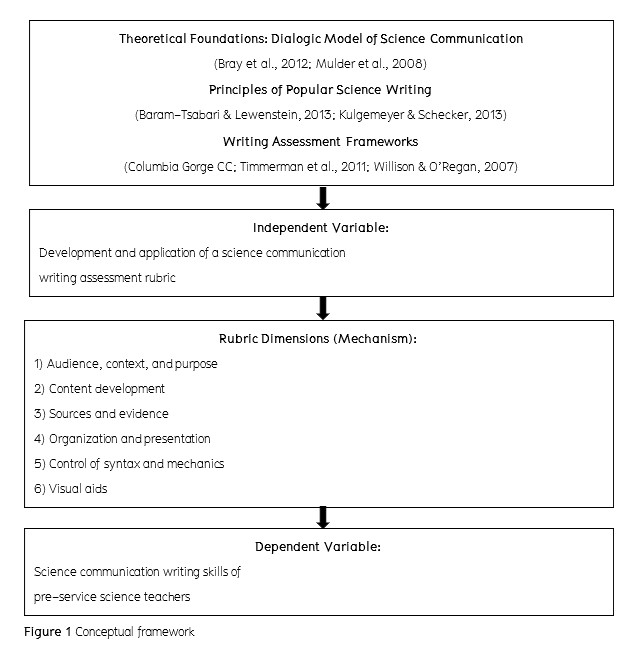
The findings revealed that rubric comprises six key components: (1) audience, context, and purpose; (2) content development; (3) sources and evidence; (4) organization and presentation of information; (5) grammatical accuracy and language use; and (6) use of supporting media. The rubric was adapted from the written communication VALUE rubric developed by the Association of American Colleges and Universities and was validated by three experts to ensure its relevance and appropriateness for assessing overall science communication. The pilot implementation of the rubric in evaluating student-generated scientific handouts indicated strengths in grammatical accuracy and the use of visual elements. However, areas for improvement were identified in terms of content coherence, alignment with real-life contexts, and the credibility of information sources. These findings highlight the importance of having a systematic assessment tool to enhance scientific communication skills and provide a reliable instrument to support the development of science teachers capable of effectively communicating scientific knowledge to the public. Future research should expand the sample size and explore the applicability of the rubric across different educational levels and academic disciplines.
Downloads
Article Details

This work is licensed under a Creative Commons Attribution-NonCommercial-NoDerivatives 4.0 International License.
References
Amin, A. M., Karmila, F., Pantiwati, Y., Adiansyah, R., & Yani, A. (2022). The communication skills profile of pre-service biology teachers. Jurnal Penelitian Pendidikan IPA, 8(4), 1814-1819. https://doi.org/10.29303/jppipa.v8i4.1825
Baram-Tsabari, A., & Lewenstein, B. V. (2013). An instrument for assessing scientists’ written skills in public communication of science. Science Communication, 35(1), 56-85. https://doi.org/10.1177/1075547012440634
Besley, J. C., Dudo, A., Yuan, S., & AbiGhannam, N. (2021). Qualitative interviews with science communication trainers about communication objectives and goals. Science Communication, 43(1), 3–28. https://journals.sagepub.com/doi/abs/10.1177/1075547016645640
Bobek, E., & Tversky, B. (2016). Creating visual explanations improves learning. Cognitive Research: Principles and Implications, 1(27), 1–14. https://doi.org/10.1186/s41235-016-0031-6
Bray, B., France, B., & Gilbert, J. K. (2012). Identifying the essential elements of effective science communication: What do the experts say?. International Journal of Science Education, Part B, 2(1), 23-41. https://doi.org/10.1080/21548455.2011.611627
Burns, T. W., O'Connor, D. J., & Stocklmayer, S. M. (2003). Science communication: A contemporary definition. Public Understanding of Science, 12(2), 183-202. https://doi.org/10.1177/09636625030122004
Columbia Gorge Community College. (n.d.). Written communication rubrics. https://www.cgcc.edu/sites/default/files/institutional-assessment/core-learning-outcomes-assessment/2018-19/WRITTEN%20COMMUNICATION%20RUBRIC%202015-2016.pdf
Elvianasti, M., Festiyed, Yerimadesi, Kartikawati, E., & Zulherman. (2022). Research trends in PjBL (Project-Based Learning) at Indonesian Journal of Biology Education. Jurnal Iqra': Kajian Ilmu Pendidikan, 7(2), 105-119. https://doi.org/10.25217/ji.v7i2.2464
Kelly, G. J., & Takao, A. (2002). Epistemic levels in argument: An analysis of university oceanography students' use of evidence in writing. Science education, 86(3), 314-342. https://doi.org/10.1002/sce.10024
Kulgemeyer, C., & Schecker, H. (2013). Students explaining science—Assessment of science communication competence. Research in Science Education, 43, 2235-2256. https://doi.org/10.1007/s11165-013-9354-1
Liskauskas, S., Ribeiro, M. D., & Vasconcelos, S. M. (2019). Changing times for science and the public. The EMBO Reports, 20, EMBR201947906. https://doi.org/10.15252/embr.201947906
McGrew, S., Breakstone, J., Ortega, T., Smith, M., & Wineburg, S. (2018). Can students evaluate online sources? Learning from assessments of civic online reasoning. Theory & Research in Social Education, 46(2), 165–193. https://doi.org/10.1080/00933104.2017.1416320
Moemeke, C. D. (2023). Integrating scientific literacy and communication in the curriculum: A pathway to bridging the science-society gap. Zamfara IJOH, 2(1), 1-17. DOI:10.36349/zamijoh.2023.v02i01.001
Mulder, H. A., Longnecker, N., & Davis, L. S. (2008). The state of science communication programs at universities around the world. Science Communication, 30(2), 277-287. https://doi.org/10.1177/1075547008324878
National Academies of Sciences, Engineering, and Medicine. (2017). Review of NASA's evidence reports on human health risks: 2016 letter report. National Academies Press
Taranum, S. (2021). Social media, communication challenges, and the role of a scientific writer in standing up for science. Medical Writing, 30(1), 52-55.
Tariq, V. N., Stefani, L. A., Butcher, A. C., & Heylings, D. J. (1998). Developing a new approach to the assessment of project work. Assessment & Evaluation in Higher Education, 23(3), 221-240. https://doi.org/10.1080/0260293980230301
Timmerman, B. E. C., Strickland, D. C., Johnson, R. L., & Payne, J. R. (2011). Development of a ‘universal’ rubric for assessing undergraduates' scientific reasoning skills using scientific writing. Assessment & Evaluation in Higher Education, 36(5), 509-547. https://doi.org/10.1080/02602930903540991
Van der Sanden, M. C., & Meijman, F. J. (2008). Dialogue guides awareness and understanding of science: An essay on different goals of dialogue leading to different science communication approaches. Public Understanding of Science, 17(1), 89-103. https://doi.org/10.1177/0963662506067376
Willison, J., & O’Regan, K. (2007). Commonly known, commonly not known, totally unknown: A framework for students becoming researchers. Higher Education Research & Development, 26(4), 393-409. https://doi.org/10.1080/07294360701658609
Yuan, S., Oshita, T., AbiGhannam, N., Dudo, A., Besley, J. C., & Koh, H. E. (2017). Two-way communication between scientists and the public: A view from science communication trainers in North America. International Journal of Science Education, Part B, 7(4), 341-355. https://doi.org/10.1080/21548455.2017.1350789
