
การพัฒนาเกณฑ์การประเมินวัดความสามารถการเขียนสื่อสารทางวิทยาศาสตร์ สำหรับนักศึกษาครูวิทยาศาสตร์
Article Sidebar
Main Article Content
บทคัดย่อ
การสื่อสารทางวิทยาศาสตร์อย่างมีประสิทธิภาพถือเป็นรากฐานสำคัญของการศึกษาวิทยาศาสตร์ เนื่องจากช่วยให้ครูและนักเรียนสามารถถ่ายทอดแนวคิดทางวิทยาศาสตร์ได้อย่างเข้าถึง เข้าใจง่าย น่าสนใจ และสอดคล้องกับผู้รับสารหลากหลายกลุ่ม งานวิจัยนี้มีวัตถุประสงค์เพื่อพัฒนาและตรวจสอบ ความตรงเชิงเนื้อหาของเกณฑ์ประเมินสำหรับประเมินความสามารถในการสื่อสารผ่านการเขียนเชิงวิทยาศาสตร์ ซึ่งออกแบบเฉพาะสำหรับนักศึกษาครูวิทยาศาสตร์ โดยอาศัยกรอบแนวคิดทางทฤษฎีและข้อมูลเชิงประจักษ์ ตามรูปแบบการสื่อสารทางวิทยาศาสตร์แบบสนทนา (Dialogic Model of Science Communication) กลุ่มตัวอย่างเป็นนักศึกษาครูวิทยาศาสตร์ชั้นปีที่ 3 จำนวน 60 คน โดยใช้วิธีการเลือกแบบทั้งประชากร เครื่องมือที่ใช้ในการวิจัยคือเกณฑ์ประเมินการเขียนสื่อสารทางวิทยาศาสตร์ที่พัฒนาขึ้น ซึ่งประกอบด้วย 6 องค์ประกอบ และผ่านการตรวจสอบความตรงเชิงเนื้อหาโดยผู้เชี่ยวชาญ 3 คน (IOC = 0.67–1.00) การวิเคราะห์ข้อมูลใช้สถิติเชิงพรรณนา ได้แก่ ความถี่และร้อยละ
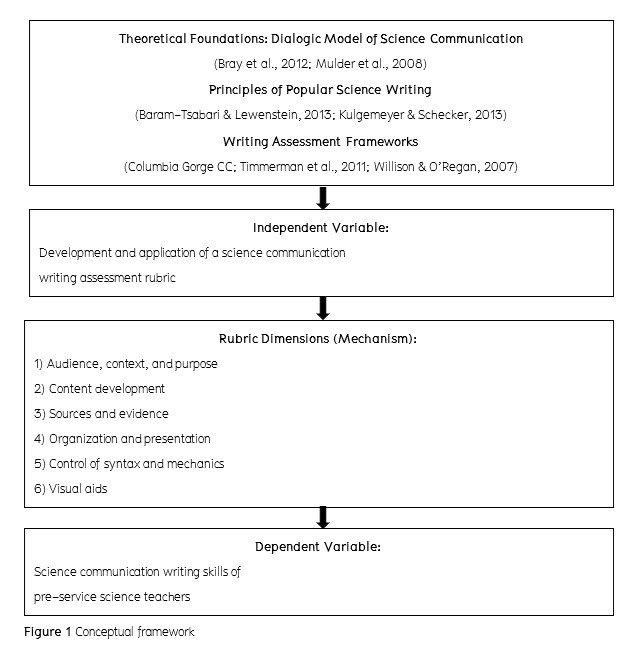
ผลการวิจัยพบว่า เกณฑ์ประเมินฉบับนี้ประกอบด้วยองค์ประกอบสำคัญ 6 ด้าน ได้แก่ 1) กลุ่มเป้าหมาย บริบท และวัตถุประสงค์ 2) การพัฒนาสาระเนื้อหา 3) แหล่งข้อมูลและหลักฐานอ้างอิง 4) การจัดลำดับและนำเสนอข้อมูล 5) ความถูกต้องของไวยากรณ์และการใช้ภาษา และ 6) การใช้สื่อประกอบ โดยปรับปรุงจากเกณฑ์ประเมินต้นแบบการสื่อสารด้วยการเขียนของวิทยาลัยชุมชนโคลัมเบียจอร์จและผ่านกระบวนการตรวจสอบจากผู้เชี่ยวชาญ จำนวน 3 คน เพื่อให้มั่นใจในความตรงและความเหมาะสมสำหรับการใช้ประเมินการสื่อสารทางวิทยาศาสตร์ในภาพรวม การทดลองใช้เกณฑ์ประเมินกับการประเมินใบความรู้ทางวิทยาศาสตร์ที่นักศึกษาจัดทำขึ้น พบจุดแข็งด้านความถูกต้องทางภาษาและการนำเสนอภาพประกอบ แต่ยังต้องปรับปรุงด้านความเชื่อมโยงของเนื้อหา ความสอดคล้องกับบริบทชีวิตจริง และความน่าเชื่อถือของแหล่งข้อมูล ผลการวิจัยนี้สะท้อนถึงความสำคัญของการมีเกณฑ์ประเมินที่เป็นระบบในการเสริมสร้างทักษะการสื่อสารทางวิทยาศาสตร์ และเสนอเครื่องมือประเมินที่มีความน่าเชื่อถือเพื่อสนับสนุนการพัฒนาครูวิทยาศาสตร์ที่สามารถถ่ายทอดองค์ความรู้สู่สาธารณชนได้อย่างมีประสิทธิภาพ งานวิจัยในอนาคตควรขยายขนาดกลุ่มตัวอย่าง และศึกษาความเหมาะสมในการประยุกต์ใช้ในระดับการศึกษาและสาขาวิชาอื่นต่อไป
Downloads
Article Details

อนุญาตภายใต้เงื่อนไข Creative Commons Attribution-NonCommercial-NoDerivatives 4.0 International License.
เอกสารอ้างอิง
Amin, A. M., Karmila, F., Pantiwati, Y., Adiansyah, R., & Yani, A. (2022). The communication skills profile of pre-service biology teachers. Jurnal Penelitian Pendidikan IPA, 8(4), 1814-1819. https://doi.org/10.29303/jppipa.v8i4.1825
Baram-Tsabari, A., & Lewenstein, B. V. (2013). An instrument for assessing scientists’ written skills in public communication of science. Science Communication, 35(1), 56-85. https://doi.org/10.1177/1075547012440634
Besley, J. C., Dudo, A., Yuan, S., & AbiGhannam, N. (2021). Qualitative interviews with science communication trainers about communication objectives and goals. Science Communication, 43(1), 3–28. https://journals.sagepub.com/doi/abs/10.1177/1075547016645640
Bobek, E., & Tversky, B. (2016). Creating visual explanations improves learning. Cognitive Research: Principles and Implications, 1(27), 1–14. https://doi.org/10.1186/s41235-016-0031-6
Bray, B., France, B., & Gilbert, J. K. (2012). Identifying the essential elements of effective science communication: What do the experts say?. International Journal of Science Education, Part B, 2(1), 23-41. https://doi.org/10.1080/21548455.2011.611627
Burns, T. W., O'Connor, D. J., & Stocklmayer, S. M. (2003). Science communication: A contemporary definition. Public Understanding of Science, 12(2), 183-202. https://doi.org/10.1177/09636625030122004
Columbia Gorge Community College. (n.d.). Written communication rubrics. https://www.cgcc.edu/sites/default/files/institutional-assessment/core-learning-outcomes-assessment/2018-19/WRITTEN%20COMMUNICATION%20RUBRIC%202015-2016.pdf
Elvianasti, M., Festiyed, Yerimadesi, Kartikawati, E., & Zulherman. (2022). Research trends in PjBL (Project-Based Learning) at Indonesian Journal of Biology Education. Jurnal Iqra': Kajian Ilmu Pendidikan, 7(2), 105-119. https://doi.org/10.25217/ji.v7i2.2464
Kelly, G. J., & Takao, A. (2002). Epistemic levels in argument: An analysis of university oceanography students' use of evidence in writing. Science education, 86(3), 314-342. https://doi.org/10.1002/sce.10024
Kulgemeyer, C., & Schecker, H. (2013). Students explaining science—Assessment of science communication competence. Research in Science Education, 43, 2235-2256. https://doi.org/10.1007/s11165-013-9354-1
Liskauskas, S., Ribeiro, M. D., & Vasconcelos, S. M. (2019). Changing times for science and the public. The EMBO Reports, 20, EMBR201947906. https://doi.org/10.15252/embr.201947906
McGrew, S., Breakstone, J., Ortega, T., Smith, M., & Wineburg, S. (2018). Can students evaluate online sources? Learning from assessments of civic online reasoning. Theory & Research in Social Education, 46(2), 165–193. https://doi.org/10.1080/00933104.2017.1416320
Moemeke, C. D. (2023). Integrating scientific literacy and communication in the curriculum: A pathway to bridging the science-society gap. Zamfara IJOH, 2(1), 1-17. DOI:10.36349/zamijoh.2023.v02i01.001
Mulder, H. A., Longnecker, N., & Davis, L. S. (2008). The state of science communication programs at universities around the world. Science Communication, 30(2), 277-287. https://doi.org/10.1177/1075547008324878
National Academies of Sciences, Engineering, and Medicine. (2017). Review of NASA's evidence reports on human health risks: 2016 letter report. National Academies Press
Taranum, S. (2021). Social media, communication challenges, and the role of a scientific writer in standing up for science. Medical Writing, 30(1), 52-55.
Tariq, V. N., Stefani, L. A., Butcher, A. C., & Heylings, D. J. (1998). Developing a new approach to the assessment of project work. Assessment & Evaluation in Higher Education, 23(3), 221-240. https://doi.org/10.1080/0260293980230301
Timmerman, B. E. C., Strickland, D. C., Johnson, R. L., & Payne, J. R. (2011). Development of a ‘universal’ rubric for assessing undergraduates' scientific reasoning skills using scientific writing. Assessment & Evaluation in Higher Education, 36(5), 509-547. https://doi.org/10.1080/02602930903540991
Van der Sanden, M. C., & Meijman, F. J. (2008). Dialogue guides awareness and understanding of science: An essay on different goals of dialogue leading to different science communication approaches. Public Understanding of Science, 17(1), 89-103. https://doi.org/10.1177/0963662506067376
Willison, J., & O’Regan, K. (2007). Commonly known, commonly not known, totally unknown: A framework for students becoming researchers. Higher Education Research & Development, 26(4), 393-409. https://doi.org/10.1080/07294360701658609
Yuan, S., Oshita, T., AbiGhannam, N., Dudo, A., Besley, J. C., & Koh, H. E. (2017). Two-way communication between scientists and the public: A view from science communication trainers in North America. International Journal of Science Education, Part B, 7(4), 341-355. https://doi.org/10.1080/21548455.2017.1350789
