
Needs Assessment for the Development of Soft Skills to Enhance Essential Soft Skills for Work in the Aviation Industry: A Case Study of Aviation Business Management Students at Chiang Mai Rajabhat University
Article Sidebar
Main Article Content
Abstract
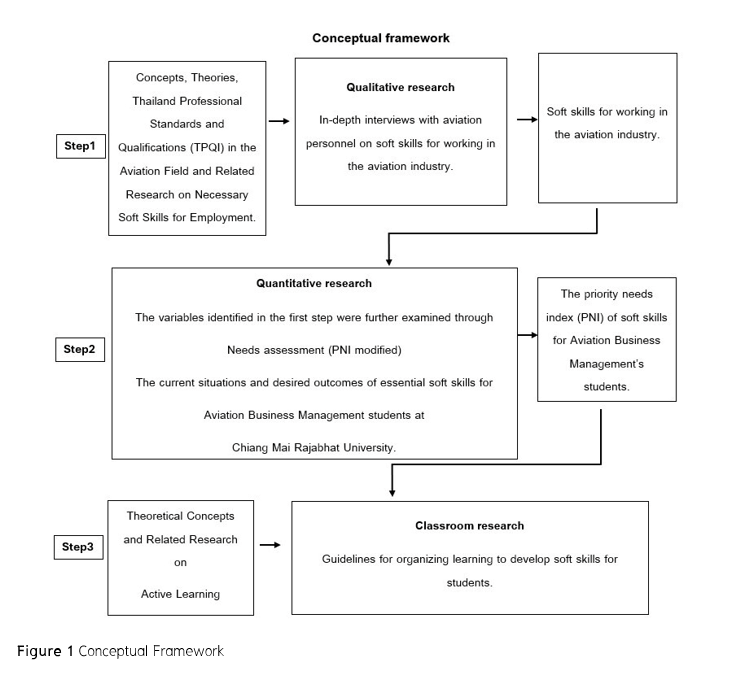
Hard skills and soft skills play a crucial role in workforce efficiency in the modern aviation industry, which has been significantly impacted by digital technology and the COVID-19 pandemic. As a result, the remaining job positions increasingly require soft skills, which technology cannot replace. The development of soft skills should begin at the university level. Although soft skills are considered essential for work, research on soft skills in the aviation industry and student development remains limited. This study aimed to: 1) identify the soft skills necessary for working in the aviation industry; 2) conduct a needs assessment to prioritize the ranking of soft skills required for working in the aviation industry among students in the Aviation Business Management Program at Chiang Mai Rajabhat University; and 3) propose active learning methods to enhance students' soft skills based on prioritized needs. A mixed-method research design was employed, consisting of three phases: 1) qualitative research involving with a literature review to identify the necessary soft skills for work, followed by in-depth interviews with airline and airport service personnel to determine the essential soft skills required in the aviation industry; 2) quantitative research using the Modified Priority Needs Index and paired t-test to assess and rank students' soft skill needs; and 3) classroom research proposing active learning management methods to enhance students' soft skills. Research instruments included interviews, questionnaires, pre-tests and post-test, and the 6-step process of problem-based learning management. The quantitative data were analyzed using descriptive statistics including percentage, mean, and standard deviation. Inferential statistics included pair t-tests, and the Modified Priority Needs Index.
The findings revealed the top five essential soft skills in the aviation industry: 1) communication, 2) leadership, 3) creativity, 4) complex problem-solving, and 5) teamwork. The Priority Needs Index (PNI) analysis showed students' top five soft skills development needs as 1) complex problem-solving, 2) communication, 3) leadership, 4) creativity, and 5) teamwork. Implementation of the problem-based learning model showed a significant difference between pre-test and post-test scores at the .05 significance level, indicating its effectiveness in developing students' complex problem-solving skills. The research results can be applied as a guideline for curriculum development, student preparation for the workforce, and development in the aviation industry personnel.
Downloads
Article Details

This work is licensed under a Creative Commons Attribution-NonCommercial-NoDerivatives 4.0 International License.
References
Abuan, O., Corpuz, R. R., Cruz, R., & Deles, E. (2023). Perceived competence of ground staff in dealing with unruly passenger behavior at Manila International Airport Authority Airports. International Journal of Applied Research and Sustainable Sciences, 1(3), 167–186. https://doi.org/10.59890/ijarss.v1i3.760
Atama, T. (2020). Soft skills affecting work performance success of private company employees: A case study of private company employees in Bangkok and metropolitan area. (Master thesis, Business Administration Program in Management, Ramkhamhaeng University). [In Thai]
Ayres, J. & Malouff, J. M. (2007). Problem-solving training to help workers increase positive affect, job satisfaction, and life satisfaction. European Journal of Work and Organizational Psychology, 16(3), 279–294. https://doi.org/10.1080/13594320701391804
Bangkok Biz News. (2023). "Happy U" University of the Thai Chamber of Commerce, the University of Happiness, answering the life needs of Gen Z. Retrieved from https://www.bangkokbiznews.com/health/education/1050701
Chinwongamorn, N. (2015). Airline service quality strategies affecting decision making in choosing international airlines at Suvarnabhumi Airport. (Master thesis, Business Administration, Bangkok University). [In Thai]
Cronbach, L. J. (1970). Essentials of psychological testing. New York: Harper & Row.
Duch, B. J., Groh, S. E., & Allen, D. E. (Eds.). (2001). The power of problem-based learning: A practical "how to" for teaching undergraduate courses in any discipline. Sterling, VA: Stylus.
Ferreira, C. C. & Gomes, C. F. S. (2018). A study on the identification of the relevance of soft skills for professionals in the aeronautical sector. Revista de Gestão dos Países de Língua Portuguesa, 17(2), 67-83. https://doi.org/10.12660/rgplp.v17n2.2018.78651
Jackson, D. (2013). The contribution of work-integrated learning to undergraduate employability skill outcomes. Asia-Pacific Journal of Cooperative Education, 14(2), 99-115.
Kanlayanamit, K. (2021). Essential skills for future work in the post-COVID-19 era. MCU Buddhabanya Review, 6(3), 163-176. [In Thai]
Kasikorn Research Center. (2021). "Gen Z" first jobbers: The new generation, understanding the "differences". Retrieved from https://www.kasikornresearch.com/th/analysis/k-social-media/Pages/Gen-Z-11-08-21.aspx
Lee, C. M. & Yun, S. H. (2018). A study on the effects of followership and leadership of flight attendants on job satisfaction and team commitment. Journal of the Korean Society for Quality Management, 46(4), 939–958. https://doi.org/10.7469/jksqm.2018.46.4.939
Littlepage, G. E., Hein, M. B., Moffett, R. G., Craig, P. A., & Georgiou, A. M. (2016). Team training for dynamic cross-functional teams in aviation. Human Factors the Journal of the Human Factors and Ergonomics Society, 58(8), 1275–1288. https://doi.org/10.1177/0018720816665200
McClelland, D. C. (1973). Testing for competence rather than for “intelligence”. American Psychology, 28(1), 1-14.
Mohamad Ali, A., Mohamed, A., AbdulKarim, N., Ismail, N., & Aziz, A. (2022). Redesign of active learning with using digital tools to develop student soft skills. Studies in Educational Management, 12, 10-25. https://doi.org/10.32038/sem.2022.12.02
Mor, S. K. (2024). Soft skills and their importance in the workplace. International Journal of Scientific Research in Engineering and Management, 08(07), 1–10. https://doi.org/10.55041/ijsrem36696
Muñoz-Marrón, D., Gil, F., & Lanero, A. (2018). Are crews empowered with all the resources needed to successfully address an inflight emergency? Checklists, a necessary but insufficient tool. Aviation, 22(3), 93–101. https://doi.org/10.3846/aviation.2018.6254
Patiwong, R. (2009). The conference of an implement competency of the develop science unit of the Sukhothai Thamathiraj University. Retrieved from http://www.stou.ac.th/Offices/rdec/Nakorn/Main/doc/km/08.doc [In Thai]
Phokao, S. (2017). The need for activities to develop work and life skills (soft skills) for regular master's degree students at the National Institute of Development Administration. National Institute of Development Administration. [In Thai]
Robles, M. M. (2012). Executive perceptions of the top 10 soft skills needed in today's workplace. Business Communication Quarterly, 75(4), 453-465.
Romanko, I. (2023). The potential of the academic discipline "history of aviation" in the formation of soft skills of students of higher education. Flight Academy of National Aviation University, 13, 141-150. doi:10.33251/2522-1477-2023-13-141-150
Rovinelli, R. J. & Hambleton, R. K. (1977). On the use of content specialists in the assessment of criterion-referenced test item validity. Tijdschrift voor Onderwijsresearch, 2(2), 49–60. Retrieved from https://eric.ed.gov/?id=ED121845
Savery, J. R. & Duffy, T. M. (1995). Problem-based learning: An instructional model and its constructivist framework. Educational Technology, 35(5), 31-38.
Security Systems Magazine. (2020). AI robots at airports and their impact on the aviation industry during the COVID-19 situation. Retrieved from https://www.securitysystems.in.th/2020/08/effect-of-airport-ai-robot-to-aviation-business-in-covid-situation/
Shillie, P. N. & Nchang, N. N. (2023). Influence of employee soft skills on job performance. Business Perspective Review, 5(1), 1–11. https://doi.org/10.38157/bpr.v5i1.530
Sinthuvanich, N. (2020). HR recommends 20 hard skills and soft skills that should be on your resume. Retrieved from https://techsauce.co/connext/get-a-job/job-skills
Spivak, V. (2024). Soft skills in the professional activities of employees of the state penitentiary service of Ukraine. Scientific Herald of Sivershchyna Series Education Social and Behavioral Sciences, 2024(2), 209–219. https://doi.org/10.32755/sjeducation.2024.02.209
Strobel, J. & van Barneveld, A. (2009). When is PBL more effective? A meta-synthesis of meta-analyses comparing PBL to conventional classrooms. Interdisciplinary Journal of Problem-Based Learning, 3(1), 44-58.
Vieira, A. M. & Santos, I. C. D. (2010). Communication skills: A mandatory competence for ground and airplane crew to reduce tension in extreme situations. Journal of Aerospace Technology and Management, 2(3), 361–370. https://doi.org/10.5028/jatm.2010.02038110
Watthanabut, B. (2020). Factors affecting the development of soft skills among Thai youth in the 21st century. The Journal of Research and Academics, 4(1), 87–94. https://doi.org/10.14456/jra.2021.8 [In Thai]
Wong, S. & Neustaedter, C. (2017). Collaboration and awareness amongst flight attendants. Retrieved from https://doi.org/10.1145/2998181.2998355
World Economic Forum. (2020). The future of jobs report 2020. World Economic Forum. Retrieved from https://www.weforum.org/reports/the-future-of-jobs-report-2020/in-full/infographics-e4e69e4de7
Yamane, T. (1973). Statistics: An introductory analysis. London: John Weather Hill, Inc.
Yang, C. H. & Chou, J. T. (2020). Exploring the competency of ground service staff: The application of interdisciplinary education in college via the DACUM analysis method. People International Journal of Social Sciences, 6(2), 310–327. https://doi.org/10.20319/pijss.2020.62.310327
Yeter, M. & Konyalilar, N. (2022). Effect of leadership behavior styles on performance a field study on civil aviation ground services. OPUS Journal of Society Research, 19(50), 863-876. https://doi.org/10.26466/opusjsr.1190250
