
การพัฒนาสมรรถนะการสื่อสารและการคิดขั้นสูงของนักเรียนชั้นมัธยมศึกษาปีที่ 3 โดยใช้การจัดการเรียนรู้แบบซินเนคติกส์ร่วมกับสื่อสังคมออนไลน์
Article Sidebar
Main Article Content
บทคัดย่อ
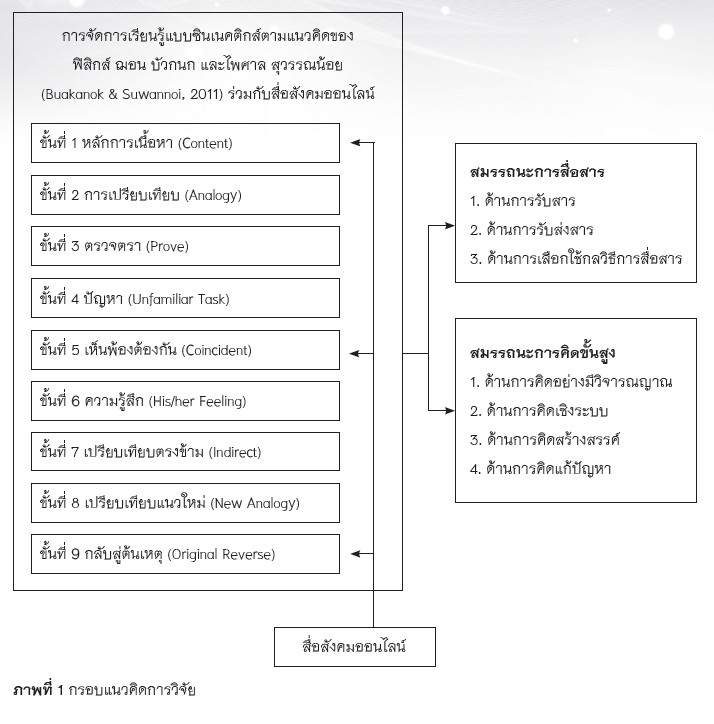
การวิจัยเชิงปฏิบัติการมีวัตถุประสงค์เพื่อพัฒนาสมรรถนะการสื่อสารและการคิดขั้นสูงของนักเรียนชั้นมัธยมศึกษาปีที่ 3 โดยใช้การจัดการเรียนรู้แบบซินเนคติกส์ร่วมกับสื่อสังคมออนไลน์ ซึ่งนักเรียนร้อยละ 80 ผ่านเกณฑ์ระดับสามารถขึ้นไป กลุ่มตัวอย่าง คือ นักเรียนชั้นมัธยมศึกษาปีที่ 3/1 ภาคการศึกษาที่ 1 ปีการศึกษา 2567 โรงเรียนสาธิตมหาวิทยาลัยขอนแก่น ฝ่ายมัธยมศึกษา (ศึกษาศาสตร์) จำนวน 35 คน ได้มาจากการสุ่มตัวอย่างแบบกลุ่ม โดยใช้ห้องเรียนเป็นหน่วยของกลุ่ม เครื่องมือที่ใช้ในการวิจัยแบ่งออกเป็น 3 ชนิด ได้แก่ 1) เครื่องมือที่ใช้ในการวิจัย แผนการจัดการเรียนรู้เพื่อพัฒนาสมรรถนะการสื่อสารและการคิดขั้นสูงของนักเรียนชั้นมัธยมศึกษาปีที่ 3 โดยใช้การจัดการเรียนรู้แบบซินเนคติกส์ร่วมกับสื่อสังคมออนไลน์ มีความเหมาะสมมากที่สุด ( = 4.91, S.D. = 0.01) 2) เครื่องมือที่ใช้สะท้อนผล (1) แบบบันทึกผลการจัดการเรียนรู้ (2) แบบสังเกตพฤติกรรมการเรียน และ (3) แบบทดสอบท้ายวงจรปฏิบัติการ มีค่าอยู่ในระดับสามารถนำไปใช้ได้ (IOC = 0.90, p = 0.78, r = 0.41, ค่าความเชื่อมั่น = 1) และ 3) เครื่องมือที่ใช้ในการประเมินผล (1) แบบประเมินสมรรถนะการสื่อสารอยู่ในเกณฑ์ที่ใช้ได้ และ (2) แบบประเมินสมรรถนะการคิดขั้นสูงอยู่ในเกณฑ์ที่ใช้ได้ สถิติที่ใช้ในการวิเคราะห์ข้อมูล ได้แก่ ค่าเฉลี่ย (μ) ส่วนเบี่ยงเบนมาตรฐาน (S.D.) และค่าร้อยละ
ผลการวิจัยพบว่า หลังจากได้รับการจัดการเรียนรู้แบบซินเนคติกส์ร่วมกับสื่อสังคมออนไลน์ นักเรียนร้อยละ 91.43 มีสมรรถนะการสื่อสารผ่านเกณฑ์ระดับเหนือความคาดหวัง และนักเรียนร้อยละ 94.29 มีสมรรถนะการคิดขั้นสูงผ่านเกณฑ์เหนือความคาดหวัง ผลการวิจัยสะท้อนให้เห็นว่า การจัดการเรียนรู้แบบซินเนคติกส์เป็นรูปแบบการจัดการเรียนรู้ที่สามารถใช้เพื่อพัฒนาสมรรถนะการสื่อสารและสมรรถนะการคิดขั้นสูงซึ่งเป็นทักษะที่สำคัญสำหรับการเรียนและการทำงานในศตวรรษที่ 21 ได้ รวมถึงการใช้สื่อสังคมออนไลน์มาร่วมในการจัดการเรียนการสอนเป็นอีกหนึ่งกลยุทธ์สำคัญสำหรับการสร้างบรรยากาศและจูงใจนักเรียนในการจัดการเรียนการสอนในห้องเรียนอีกด้วย
Downloads
Article Details

อนุญาตภายใต้เงื่อนไข Creative Commons Attribution-NonCommercial-NoDerivatives 4.0 International License.
เอกสารอ้างอิง
Buakanok, F. & Suwannoi, P. (2011). Development of synectics model on web-based instruction in advertising creative strategy course to enhance creative thinking of undergraduate students. Khon Kaen University Journal (Graduate Studies). 11(3), 71-80. [In Thai]
Cronbach, L. J. (1947). Test "reliability": Its meaning and determination. Psychometrika, 12, 1-16.
Gil-Galván, R., Martín-Espinosa, I., & Gil-Galván, F. J. (2023). The learning contract as a strategy to foster communication competencies. REICE. Ibero-American Journal on Quality, Effectiveness and Change in Education, 22(1), 27–44.
Gordon, W. (1972). Synectics: The Development of Creative Capacity. New York: Harper & Row Publishers.
Kaewkalong, K. (2020). Effects of Synectics Instructional Model on Learning Achievement and Creative Writing Ability of Grade 11 student. (Master thesis, Curriculum and Instruction, Mahasarakham University). [In Thai]
Kanjanachumabarop, K. (2021). Development of competency-based learning based on project-based learning and social media to enhance learning achievement of health education and digital literacy of primary school students. (Master thesis, Health and Physical Education, Chulalongkorn University. [In Thai]
Kemmis, S. & McTaggart, R. (1988). The action research planner. (3rd ed.). Geelong: Deakin University Press.
Khon Kaen University, Demonstration School. (2023). Result of the ordinary national educational test: (O-NET) for Matthayomseuksa 3, Academic Year 2023. Bangkok: National Institute of Education Testing Service (Public Organization). [In Thai]
Khumting, T., Sangkhaphanthanon, T., & Rodsap, N. (2020). The status of research in Thai language conditions and problem usage. Journal of Liberal Arts, Ubon Ratchathani University, 16(1), 71-97. [In Thai]
Likert, R. (1967). The human organization: Its management and values. Retrieved from https://www.scribd.com/document/402017152/Rensis-Likert-The-human-organization-its-management-and-value-1967-McGraw-Hill-pdf
McKay, A. S. & Reiter-Palmon, R. (2023). Leadership, interventions, and macro level issues (Eds.), Handbook of Organizational Creativity (pp. 193-206). https://doi.org/10.1016/B978-0-323-91841-1.00018-X
Ministry of Education. (2008). Basic Education Core Curriculum B.E. 2551. Bangkok: The Agricultural Co-Operative Federation of Thailand, LTD. (ACFT). [In Thai]
Ninaubon, C., Pimthong, P., & Triwaranyu, C. (2023). The development of grade 1 students, collaboration and teamwork and communication competency using STEM inquiry-based learning. The 61st Kasetsart university annual conference (pp. 13 - 26). Bangkok: Kasetsart University.
Office of the Education Council. (2017). The National Education Plan (2017-2036). Bangkok. Office of the Education Council. [In Thai]
Office of the Education Council (2021). Core competencies of learners at basic. Bangkok: Office of the Education Council. [In Thai]
Pasunon, P. (2015). Validity of questionnaire for social science research. Journal of Social Sciences Srinakharinwirot University, 18, 375-396. Retrieved from https://ejournals.swu.ac.th/index.php/JOS/article/view/7044/6558 [In Thai]
Pimpalub, P. (2022). Learning management for synectics instruction model to promote creative writing ability of grade 5 students. (Master thesis, Curriculum and Instruction, Mahasarakham University). [In Thai]
Pongputthachat, Y., Thammetar, T., & Ruangrit, N. (2021). The effect of E-book with synectics instructional model on the creative thinking of sixth-grade students with different learning styles. Silpakorn Educational Research Journal, 13(2), 21-37. Retrieved from https://so05.tcithaijo.org/index.php/suedureasearchjournal/article/view/250641/172502. [In Thai]
Prawanna, C. & Art-in, A. (2024). The development of creative thinking and competency teamwork by creative-based learning (CBL) together with social media of Mathayomsuksa 6 students. Journal of Roi Kaensarn Academi, 9(5), 475–491. Retrieved from https://so02.tci-thaijo.org/index.php/JRKSA/article/view/ 267300/180289 [In Thai]
Purvis, A. J., Rodger, H. M., & Beckingham, S. (2020). Experiences and perspectives of social media in learning and teaching in higher education. International Journal of Educational Research Open, 1, 100018. https://doi.org/10.1016/j.ijedro.2020.100018
Rovinelli, R. J. & Hambleton, R. K. (1977). On the use of content specialists in the assessment of criterion-referenced test item validity. Tijdschrift voor Onderwijsresearch, 2(2), 49-60. Retrieved from https://scispace.com/pdf/on-the-use-of-content-specialists-in-the-assessment-of-4ym9syx9ph.Pdf.
Runco, M. A. (2023). Research, development, and practice (Eds.), Creativity (pp. 379-434). https://doi.org/10.1016/B978-0-08-102617-5.00010-2
Sahoo, P. K., Pany, S., Mohanty, S. P., Dash, K. R., & Rana, S. (2023). Dialogue embedded synectics model of teaching: A hybrid model for promotion of creativity. Journal of Research in Innovative Teaching & Learning, 18(2), 366–378. https://doi.org/10.1108/JRIT-08-2023-0117
Srisa - ard, B. (2011). Introduction to research. Bangkok: Suveeriyasarn. [In Thai]
Suratno, S., Komaria, N., Yushardi, Y., Dafik, D., & Wicaksono, I. (2019). The effect of using synectics model on creative thinking and metacognition skills of junior high school students. International Journal of Instruction, 12(3), 133-150. https://doi.org/10.29333/iji.2019.1239a
Yongthai, J. (2018). Development of critical thinking skills and 21st Century. Journal of Educational Administration Silpakorn University, 9(2), 344-356. [In Thai]
