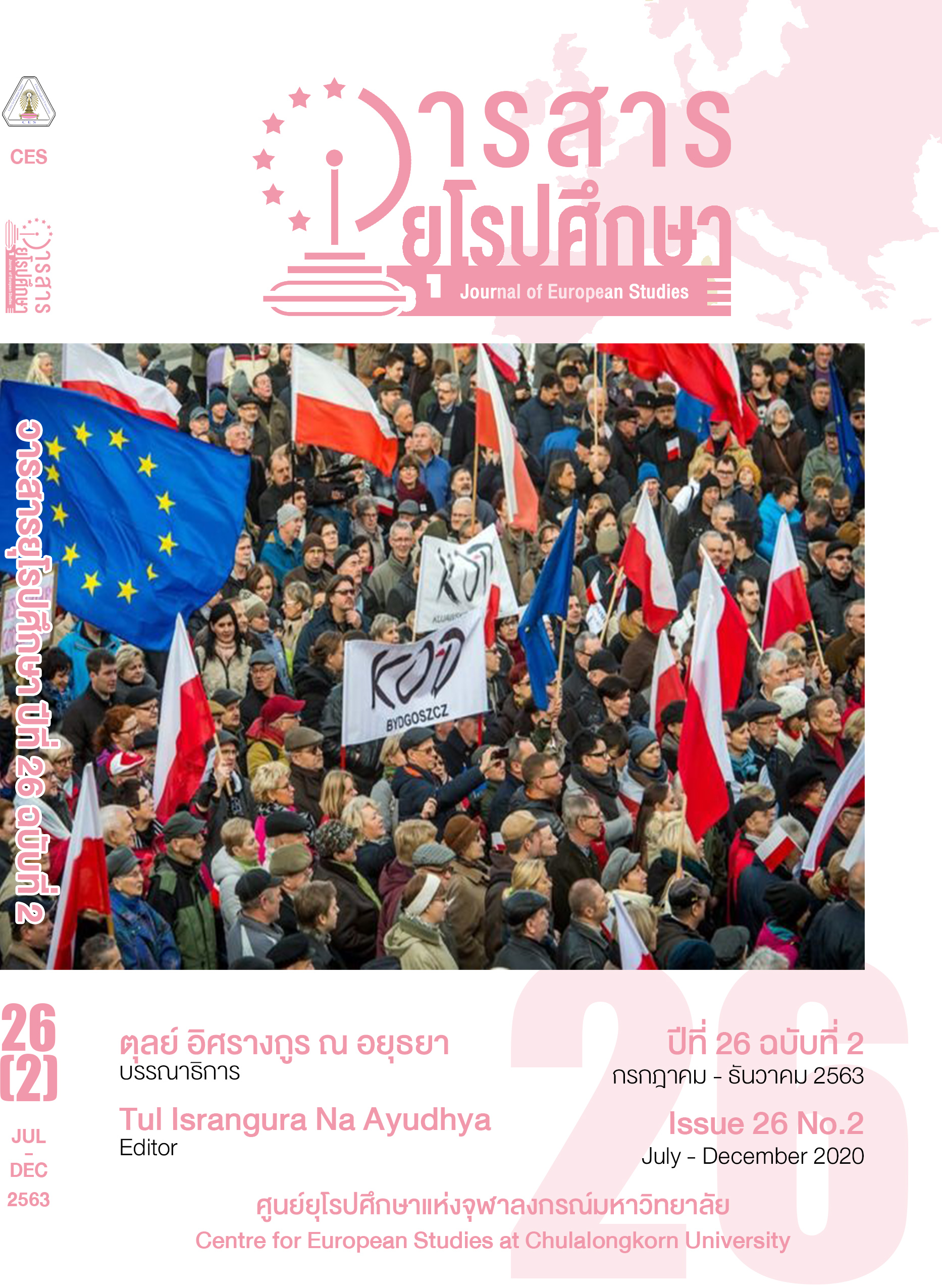
The Discourses of “The Europe of Nations”
Euroscepticism in the Light of the European Union Crises: the Cases of Law and Justice in Poland and Fidesz in Hungary
Keywords:
European Integration, Euroscepticism, Hungary, Poland, Fidesz, Law and Justice, PiS, Europe of NationsAbstract
This article aims to examine, analyse and discuss the transformation of the discourses of “the Europe of Nations”of the incumbent national populist Eurosceptic Law and Justice (PiS) in Poland and Fidesz in Hungary undergone in the light of the European Union crises, notably European debt crisis, European immigration crisis and the epitome of Eurosceptic sentiment known as ‘Brexit’. The discourse analysis shows that the European Union crises do not transform Law and Justice’s and Fidesz’s Eurosceptic vision and ideology, which are fused and constructed on the basis of conservative nationalism, at their ideological core, but the crises do impact how the parties’ discursive formation. In the light of the crises, Law and Justice and Fidesz portray the European Union crises as the crisis of national sovereignty and national identity, threatened by supranational principle and practices of the European Integration.
References
Balcer, A., Buras, P., Grpmadzki, G., and Smolar, E. Change in Poland, but what change? Assumptions of Law and Justice party foreign policy (Stefan Batory Foundation,2016), http://www.batory.org.pl/upload/files/Programy%20operacyjne/Otwarta%20Europa/Change%20in%20Poland.pdf.
Brack, Nathalie, and Startin, Nicholas. “Introduction: Euroscepticism, from the margins to the mainstream.” International Political Science Review 36, no. 3 (2015): 239-249.
Canveren, Önder, and Durakçay, Fulham A., “The Analysis of the Hungarian Government’s Discourse towards the Migration Crisis: A Combination of Securitization and Euroscepticism.” Yönetim Ve Ekonomi 24, no.3 (2017), 857-876.
Galpin, Charlotte. The Euro Crisis and European Identities, edited by (Palgrave Macmillan, 2017).
Hooghe, Liesbet, and Marks, Gary. “A Postfunctionalist Theory of European Integration: From Permissive Consensus to Constraining.” British Journal of Political Science 39, no.1 (Jan 2009): 1-23.
“How Poland’s government is wakening democracy.” The Economist, July 25, 2017, https://www.economist.com/the-economist-explains/2017/07/24/how-polands-government-is-weakening-democracy (accessed on September 20, 2020).
Kopeček, Michal. “Sovereignty, ‘Return to Europe’ and Democratic Distrust in the East after 1989 in the Light of Brexit.” Contemporary European History 28, no.1 (2019): 73-76.
Krastev, Ivan. “The Unraveling of the Post-1989 Order.” Journal of Democracy 27, no.4 (2016): 88-98.
Krzyźanowski, Michał. “Discursive Shifts in Ethno-Nationalistic Politics: On Politicization and Mediatization of the ‘Refugee Crisis’ in Poland.” Journal of Immigrant & Refugee Studies 16, no.1-2 (2018): 76 - 96.
Kucharczyk, Jacek, and Fomina, Joanna. “The Specter Haunting Europe: Populism and Protest in Poland.” Journal of Democracy 27, no.4 (2016): 58-68.
Mudde, Cas. “Populist Zeigeist.” Government and Opposition, no. 39 (2004): 541-563, doi: 10.1111/j.1477-7053.2004.00135.x
O’Neal, Molly. “The European ‘Other’ in Poland’s Conservative Identity Project.” Italian Journal of International Affairs 52, no.1 (2017): 28-45.
Orbán, Viktor. “Hungary and the Crisis of Europe.” Hungarian Review 8, no.1 (2017), http://hungarianreview.com/article/20170124_hungary_and_the_crisis_of_europe.
PiS. IV Rzeczpospolita Sprawiedliwość dla Wszystkich: Program 2005 (PiS, 2005).
PiS, Zdrowie Praca Rodzina: Program Prawa I Sprawiedliwościl (PiS, 2014).
“Polish PM to EU: Don’t lecture us.” The Politico, https://www.politico.eu/article/polish-pm-mateusz-morawiecki-to-eu-dont-lecture-us/ (accessed on September 20, 2020)
“Prime Minister Viktor Orbán’s speech on the 62nd anniversary of the 1956 Revolution and Freedom Fight.” Hungarian Government, October 24, 2018, https://www.kormany.hu/en/the-prime-minister/the-prime-minister-s-speeches/prime-minister-viktor-orban-s-speech-on-the-62nd-anniversary-of-the-1956-revolution-and-freedom-fight (accessed on September 20, 2020).
Rupnik, Jacques. “Eastern Europe: The International Context.” Journal of Democracy 11, no.2 (2000): 115-129.
Szczerbiak, Aleks. “Euroscepticism and ‘Eurorealism’ in Polish Party System.” in Opposing Europe?: The Comparative Party Politics of Euroscepticism, edited by Paul Taggart, and Aleks Szczerbiak. (Oxford University Press, 2008), 221 - 242.
Taggart, Paul and Szczerbiak, Aleks. “Putting Brexit into perspective: the effect of the Eurozone and migration crises and Brexit on Euroscepticism in European states.” Journal of European Public Policy Vol.25, No8 (2018): 1194 -1214.
“Viktor Orban: the rise of Europe’s troublemaker,” Financial Times, January 24, 2018, https://www.ft.com/content/dda50a3e-0095-11e8-9650-9c0ad2d7c5b5 (accessed on September 21, 2020).