
A Causal Model of Flexible Learning and Adaptability Influenced by Intercultural Difference and Self- Effcacy
Article Sidebar
Main Article Content
Abstract
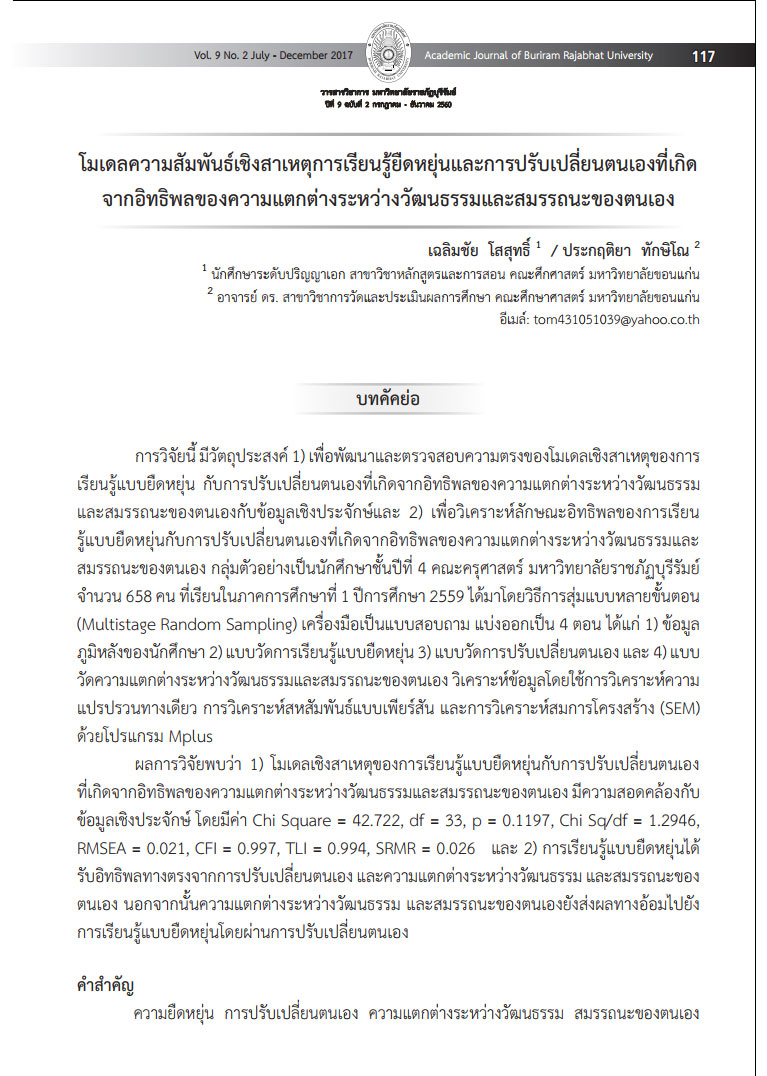
The purposes of this research were to 1) develop and check the validity of a
causal model of flexibility and adaptability was influenced by intercultural difference
and self – effcacy with empirical data and 2) analyze influence of flexible learning
and adaptation were influenced by intercultural difference and self – effcacy. The
samples were 658 the fourth students be multi – stage random sampling from the frst
semester of the academic year 2016 in faculty of education, Buriram Rajabhat University.
The instrumental research consisted of a questionnaire on 1) student background
information, 2) flexible learning test; 3) adaptation test and 4) intercultural difference
and self – effcacy test. Pearson Product Moment Correlation Analysis and structural
equation analysis (SEM) with the M plus program were used to analyze the data.
The fndings were concluded as follows 1) a causal model of flexibility and
adaptability was influenced by intercultural difference and self – effcacy was valid
with the empirical data : Chi Square = 42.722, df = 33, p = 0.1197, Chi Sq/df = 1.2946,
RMSEA = 0.021, CFI = 0.997, TLI = 0.994, SRMR = 0.026 and 2) the flexible learning was
influenced by adaptation, intercultural difference and self – effcacy directly. In addition;
the intercultural and self – effcacy were indirect to influenced to the flexible
learning through adaptation.
Article Details
- ต้นฉบับที่ได้รับการตีพิมพ์ในวารสารวิชาการ มหาวิทยาลัยราชภัฏบุรีรัมย์ สาขามนุษยศาสตร์และสังคมศาสตร์ ถือเป็นกรรมสิทธิ์ของมหาวิทยาลัยราชภัฏบุรีรัมย์ ห้ามนำข้อความทั้งหมดหรือบางส่วนไปพิมพ์ซ้ำเว้นเสียแต่ว่าจะได้รับอนุญาตจากมหาวิทยาลัยฯ เป็นลายลักษณ์อักษร
- เนื้อหาต้นฉบับที่ปรากฏในวารสารเป็นความรับผิดชอบของผู้เขียน ทั้งนี้ไม่รวมความผิดพลาด อันเกิดจากเทคนิคการพิมพ์
References
และ Creative Thinking ของผู้เรียน. สำานักพัฒนาคุณภาพการศึกษา
มหาวิทยาลัยเชียงใหม่. (มปท.).
ธีระเกียรติ เจริญเศรษฐศิลป์. (2559). การศึกษาในยุค Thailand 4.0. เชียงใหม่นิวส์
21 พฤศจิกายน (2559) : 7.
ประสาท จูมพล . (2549). การพัฒนาโมเดลเชิงสาเหตุของผลสัมฤทธิ์ทางการเรียนและความพึงพอใจใน
การเรียนรู้แบบยึดหยุ่นของนิสิตหลักสูตรวิทยาศาสตรบัณฑิต สาขาวิชาการพัฒนาซอฟต์แวร์.
กรุงเทพมหานคร : จุฬาลงกรณ์มหาวิทยาลัย.
สันติ วิจักขณาลัญฉ์. (2552). แนวคิดเกี่ยวกับความยืดหยุ่นในการเรียนรู้ Flexible Learning.
ค้นเมื่อ 8 กรกฎาคม 2560, จาก www.kku.ac.th
________. (2547). การพัฒนากิจกรรมการเรียนรู้แบบยืดหยุ่น. คณะศึกษาศาสตร์ มหาวิทยาลัยขอนแก่น.
________. (2545). การพัฒนาระบบการเรียนการสอนโดยใช้เทคโนโลยีสารสนเทศเป็นฐานสำาหรับ
นักศึกษาระดับอุดมศึกษา. วิทยานิพนธ์ปริญญาศึกษาศาสตรดุษฎีบัณฑิต สาขาหลักสูตรและ
การสอน บัณฑิตวิทยาลัย มหาวิทยาลัยขอนแก่น.
Carl, R. Roger. (1969). A Way of Being. Boston : Hougton Mifflin Company. ChungTeh
Fan. citing in Srisopa. 1977:160-161.
Gardner, Howard.(1983). Theory of Multiple Intelligences. (Online). ค้นเมื่อ 10 กรกฎาคม
2560, จาก pirun.ku.ac.th/~g521460099/fles/ทฤษฎีการเรียนรู้พหุปัญญา.doc
