
Approaches to Creating Economic Opportunities and Alleviating Poverty Through Social Capital: A Case Study of Mueang Mai Subdistrict, Chae Hom District, Lampang Province
Article Sidebar
Main Article Content
Abstract
This study aimed to examine social capital as a mechanism underlying the process of promoting tourism through the utilization of social capital in Muang Mai Sub-district, Chae Hom District, Lampang Province, and to propose an approach for leveraging social capital to create economic opportunities and alleviate community-level poverty.
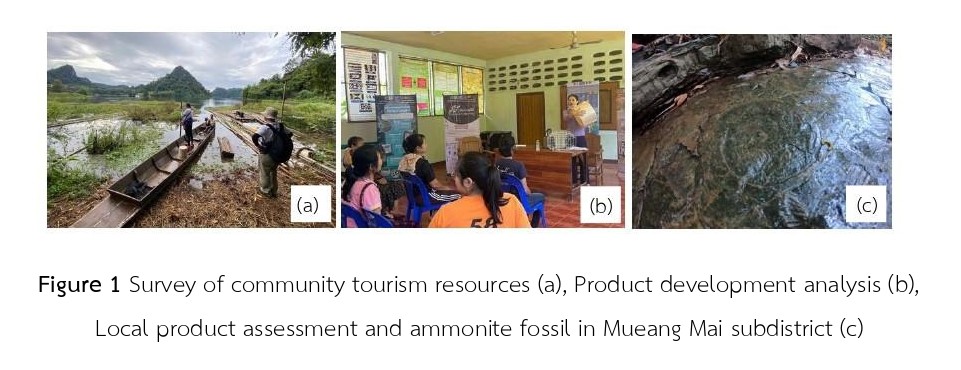
A qualitative research design was employed, with data collected through in-depth interviews, focus group discussions, and participatory action research. The target groups comprised community leaders, community enterprises, targeted low-income households within the national poverty database, and local governmental agencies, totaling 83 participants. Data were analyzed using inductive content analysis. The findings reveal that Muang Mai Sub-district effectively mobilizes social capital across multiple dimensions, including family relationships, community networks, belief systems and cultural practices, trusted community leadership, as well as natural and geological capital that can be utilized to develop integrated forms of tourism encompassing cultural, geological, and ecological dimensions. In particular, the “Muang Mai Ammonite Run” initiative showcases nature- and geology-based tourism routes alongside local community products, thereby directly generating additional income for the community. Moreover, this initiative has contributed to the establishment of a community development fund, reflecting the strategic use of social capital as a key mechanism for strengthening the local economy and serving as an effective instrument for poverty alleviation at the community level.
Article Details

This work is licensed under a Creative Commons Attribution-NonCommercial-NoDerivatives 4.0 International License.
The Editorial Board claims a right to review and correct all articles submitted for publishing
References
Aminudin, N., & Jamal, S.A. (2024). Social capital and economic mobility in tourism: a systematic literature review. Cogent Social Sciences, 10(1), 2321665. https://doi.org/10.1080/23311886.2024.2321665
Aramsri, K., Suwanna, A., Manajanyapong, J., Keatipong, K., Chaiprakong, Y., & Nimitkul, C. (2022). From practical guidelines of community enterprises based on social capital to responsible tourism in Mae Sa-Kog Ma biosphere reserve, Chiang Mai province. Journal for Community Development and Life Quality, 10(1), 1-10. https://so02.tci-thaijo.org/index.php/JCDLQ/article/view/249079
Field, J. (2003). Social Capital. Routledge, London.
Khongkun, J., Treesuk, W., Chairerk, W., Pokaew, S., Binheem, A., & Sunpawat, T. (2025). Guidelines community-based tourism development for Leam Sak tourism community, Ao-Leuk district, Krabi. Interdisciplinary Academic and Research Journal, 5(2), 495 - 512. https://so03.tci-thaijo.org/index.php/IARJ/article/view/281810
Mankong, C. (2021). Dimensions of poverty and root causes of inequality with sustainability in development. Economics and Public Policy Journal, 12(24), 18 - 48.
Mueang Mai Subdistrict Administrative Organization (2024, June 12). Annual report 2024. https://www.muangmai.go.th/web/16587/
Ngoenchan, J., Tamnanwan, P., Khiewphakdi, S., & Thawipitanun, S. (2024). Community-based tourism capacity development amidst cultural capital transformation: A case study of Had-Salaow village, Kaodin subdistrict, KaoLiao district, Nakhon Sawan province. Journal of Management Science Pibulsongkram Rajabhat University, 6(2), 1 - 17. https://so03.tci-thaijo.org/index.php/jmspsru/article/view/ 267899
Ouseng, A., & Jansuri, A. (2023). Multi-cultural tourism management using community participation process of multi-cultural tourism community, Pattani province. Journal of Vongchavalitkul University (Humanities and Social Science), 1(2), 100-120. https://so10.tci-thaijo.org/index.php/JVU_HS/article/view/659
Prasongthan, S. (2013). Social capital potentiality for creative community-based tourism: The study of Tai Puan community, Pak Plee district, Nakorn Nayok province. Journal of Social Sciences Srinakharinwirot University, 16, 234 - 245.
Program Management Unit on Area Based Development (PMU A). (2024, June 12). Practical poverty provincial connext: PPPConnext. http://www.ppaos.com/ ppaos/frontend/web/index.php?r=site%2Findex&p=
Putnam, R.D. (1993). Making Democracy Work: Civic Traditions in Modern Italy. Princeton: Princeton University Press. Princeton.
Rocca, L.H., & Zielinski, S. (2022). Community-based tourism, social capital, and governance of post-conflict rural tourism destinations: the case of Minca, Sierra Nevada de Santa Marta, Colombia. Tourism Management Perspectives, 43, 100985. https://doi.org/10.1016/j.tmp.2022.100985
Soithong, P., Suksawas, W., Khongsatjaviwat, D., & Pongpanit, A. (2024). Solving poverty under the concept of social capital: A case study of Phitsanulok province. Journal of MCU Social Science Review, 13(2), 391 - 404. https://so03.tci-thaijo.org/index.php/jssr/article/view/262317
