
Local Wisdom and Utility of Medicinal Plants from Thoh Tuemae Community Forest, Patae Subdistrict, Yaha District, Yala Province
Keywords:
Local wisdom, utilization, medicinal plants, Thoh Tuemae community forestAbstract
This This study was aimed to investigate local wisdom on the utilization of medicinal plants of the Thoh Tuemae community forest, Patae subdistrict, Yaha district, Yala province. It's mixed research by using in-depth interviews, community forums, and a questionnaire. The interview was conducted on representatives of household heads residing in the community, totaling 30 households. The statistics used for data analysis were percentage and mean scores. The results showed that out of the total of 103 medicinal plants in the survey, 10 medicinal plantswererecognized as the most effective according to the opinions of the people in the community. The herbs are used to relieve the symptoms of sprains andmuscle aches, to improve sexual stamina and to neutralize venom from insects or snakes. However, the most commonly used method of using the herbs was boiling of the plants’roots. The part of the stem is made into powder or pickled with sparkling water, leaves and shoots are eaten fresh or crushed to compress. The present study suggests that community participation should be encouraged through area-based research.
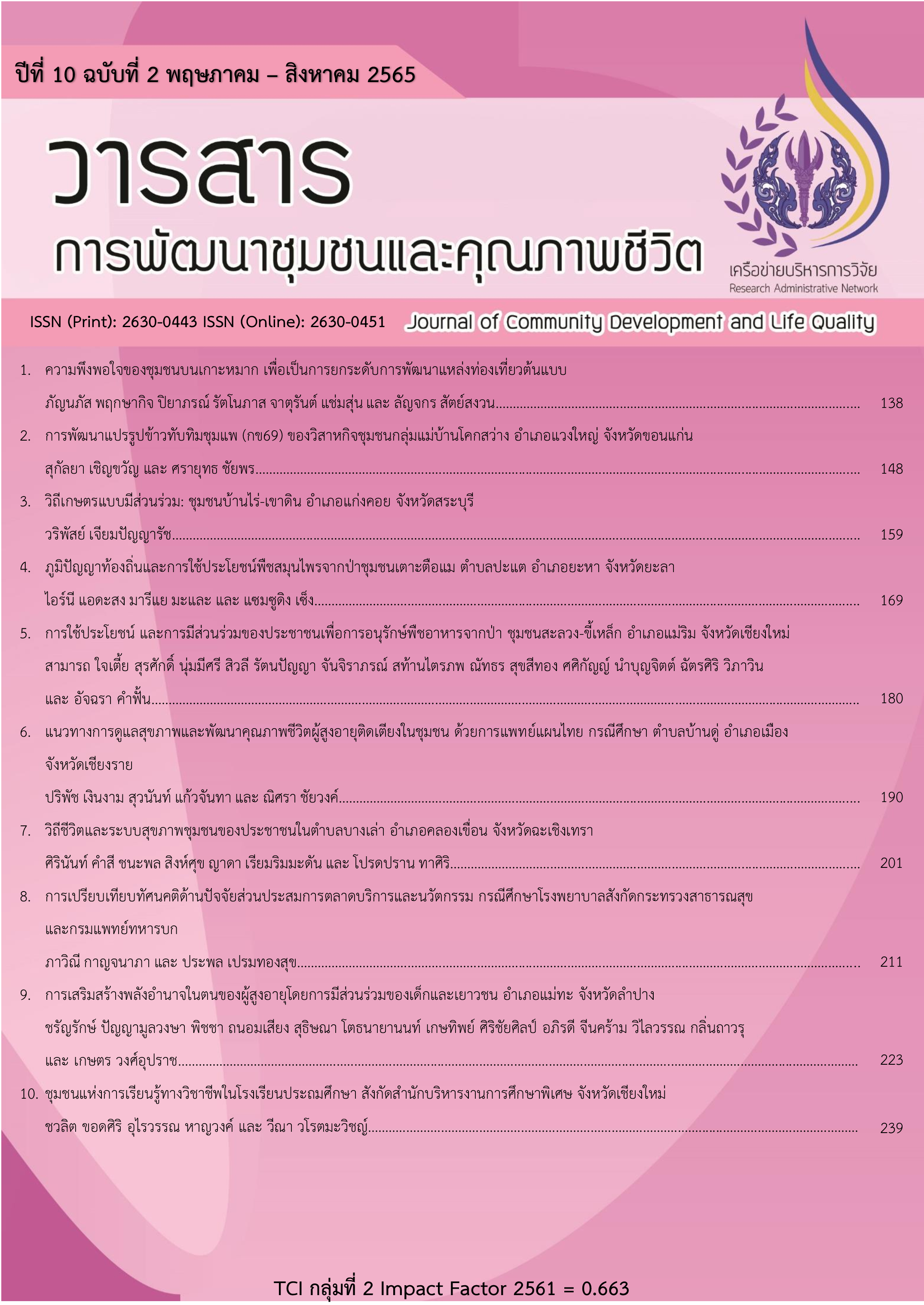
References
Chemae, R., W. Kaewtathip. and V. Rueangpan. 2015. Utilization of medicinal plants by local people around the Khao Pokyo, Bannang Sata, Yala province. Christian University of Thailand Journal 21(4): 714–728. (in Thai)
Kulsirisritrakul, N., B. Rodbumrung, P. Winairuangrid, S. Deeto and S. Kulsirisritrakul. 2016. The utilization in medical and food of the Nabot community forest plants, Wangchao district, Tak province. Research report. Rajamangala University of Technology Lanna, Tak. (in Thai)
Ndhlovu, P. T., Omotayo, A. O., Otang-Mbeng, W., & Aremu, A. O. (2021). Ethnobotanical review of plants used for the management and treatment of childhood diseases and well-being in South Africa. South African Journal of Botany, 137, 197–215. https://doi.org/10.1016/j.sajb.2020.10.012
Oyeyemi, I. T., Akinseye, K. M., Adebayo, S. S., Oyetunji, M. T., & Oyeyemi, O. T. 2019. Ethnobotanical survey of the plants used for the management of malaria in Ondo State, Nigeria. South African Journal of Botany, 124, 391–401. https://doi.org/10.1016/j.sajb.2019.06.003
Sadeghi, Z. and A. Mahmood. 2014. Ethno-gynecological knowledge of medicinal plants used by Baluch tribes, southeast of Baluchistan, Iran. Revista Brasileira de Farmacognosia 24(6): 706–715.
Srisawat, S., P. Sukchan, C. Pradabsang and S. Limchareon. 2013. Local herbal and wisdom of application in Thai traditional medicine, bordering provinces of southern Thailand. Princess of Naradhiwas University Journal 5(4): 14–27. (in Thai)
Tamang, S., Singh, A., Bussmann, R. W., Shukla, V., & Nautiyal, M. C. 2021. Ethno-medicinal plants of tribal people: A case study in Pakyong subdivision of East Sikkim, India. Acta Ecologica Sinica, January. https://doi.org/10.1016/j.chnaes.2021.08.013
Wangchuk, J., Choden, K., Sears, R. R., Baral, H., Yoezer, D., Tamang, K. T. D., Choden, T., Wangdi, N., Dorji, S., Dukpa, D., Tshering, K., Thinley, C., & Dhendup, T. 2021. Community perception of ecosystem services from commercially managed forests in Bhutan. Ecosystem Services, 50, 101335. https://doi.org/10.1016/j.ecoser.2021.101335
Downloads
Published
How to Cite
Issue
Section
License
Copyright (c) 2022 Journal of Community Development and Life Quality

This work is licensed under a Creative Commons Attribution-NonCommercial-NoDerivatives 4.0 International License.
The Editorial Board claims a right to review and correct all articles submitted for publishing


