
Development of Participatory Learning Management Model embedded Mental Intelligence - Mentoring System - Project-based Activity – Research-based Learning to Strengthening Soft Skills for Rajabhat University Student Teachers
Article Sidebar
Main Article Content
Abstract
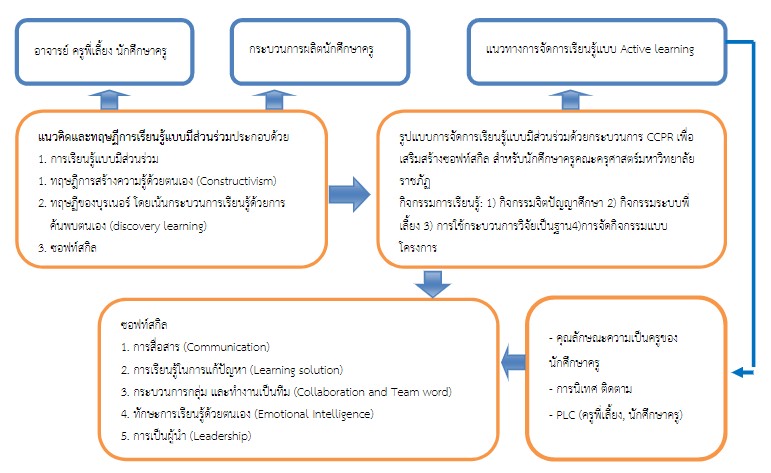
The objectives of this research were 1) To study and develop a model of participatory learning management with CCPR process to enhance SOFT SKILL skills for teachers of the Faculty of Education, Rajabhat University. 2) To create and experiment with a model of participatory learning management. 3) To assess the satisfaction of using the participatory learning management model. The research model consists of 3 steps: 1) Study the knowledge and understanding of concepts using the participatory learning management model using the CCPR process. 2) Creation and trial of participatory learning management model with CCPR process. 3) Evaluation of the use of participatory learning management model by CCPR process among students in early childhood education program The Bachelor of Education program, Year 5, Academic Year 2020 was obtained by simple random sampling, a total of 30 participants, using the One-Group Pretest-Posttest Design research model and the t-test (t-test) and percentage statistics.
The results showed that 1) Students commented on the model of participatory learning management through the CCPR process. To enhance SOFT SKILL skills, it was found that the third aspect was group process skills and teamwork. had the highest self-assessment, 63.80%. 2) The assessment of the suitability of the learning management model was at a high level (= 4.49 , SD = 0.53) and the overall results of the SOFT SKILL skills comparison before the event. The mean score was 10.57 and after the activity was the mean score was 17.67, consistent with the hypothesis set at statistical significance at .05. 3) The overall satisfaction assessment results of students towards learning management according to the model were at the highest level. (
= 4.54, SD = 0.48)
Article Details

This work is licensed under a Creative Commons Attribution-NonCommercial-NoDerivatives 4.0 International License.
References
กรมสุขภาพจิต กระทรวงสาธารณสุข. (2544). สุขภาพจิตไทย พ.ศ.2543-2544. กรุงเทพฯ : องค์การรับส่งสินค้าและพัสดุภัณฑ์.
เกรียงศักดิ์ เจริญวงศ์ศักดิ์. (2546). การคิดเชิงประยุกต์. พิมพ์ครั้งที่ 2. กรุงเทพฯ : ซัคเซสมีเดีย.
ทิศนา แขมมณี. (2548). ศาสตร์การสอน. (พิมพ์ครั้งที่ 4). กรุงเทพฯ : ด่านสุทธาการพิมพ์จำกัด.
พวงผกา ปวีณบำเพ็ญ. (2560). การจัดการเรียนรู้โดยใช้วิจัยเป็นฐาน. วารสารศึกษาศาสตร์ มหาวิทยาลัยเชียงใหม่ศึกษาศาสตร์สาร1, 2 (พ.ค.-ส.ค. 2560), 62-71
พัชรี ผลโยธิน. (2555). ขอบข่ายการวัดประเมินพัฒนาการด้านอารมณ์ จิตใจและสังคมของเด็กปฐมวัย. ใน อริศรา แก่นอ้วน (บ.ก.), แนวการศึกษาชุดวิชา หลักการและแนวคิดทางการศึกษาปฐมวัยศึกษา, (9-20). กรุงเทพฯ : มหาวิทยาลัยสุโขทัยธรรมาธิราช
มนตรี อินตา. (2562). SOFT SKILLS : ทักษะที่จำเป็นสู่ความเป็นมืออาชีพของครูยุคใหม่. วารสารวิชาการศึกษาศาสตร์, 20(1), 153-167.
มานิตา ลีโทชวลิต. (2553). การพัฒนากระบวนการจัดการเรียนรู้ตามแนวคิดจิตตปัญญาศึกษาเพื่อพัฒนาครูปฐมวัยในโรงเรียนรวม. วิทยานิพนธ์ปริญญาครุศาสตรมหาบัณฑิตจุฬาลงกรณ์มหาวิทยาลัย.
วิชัย วงษ์ใหญ่ และมารุต พัฒผล. (2557). การโค้ชเพื่อการรู้คิด. (พิมพ์ครั้งที่ 3). กรุงเทพฯ : จรัลสนิทวงศ์การพิมพ์.
วิชัย วงษ์ใหญ่ และมารุต พัฒผล. (2562). การถอดบทเรียนเพื่อการเปลี่ยนแปลง. กรุงเทพฯ : บัณฑิตวิทยาลัย มหาวิทยาลัยศรีนครินทร์วิโรฒ.
วิจารณ์ พานิช. (2556). การสร้างการเรียนรู้สู่ศตวรรษที่ 21. พิมพ์ครั้งที่ 1. กรุงเทพฯ: ส. เจริญการพิมพ์.
สมหวัง พิธิยานุวัฒน์ และทัศนีย์ บุญเติม. (2547). การสอนแบบ Research-Based Teaching ในไพฑูรย์ สินลารัตน์ (บรรณาธิการ), การเรียนการสอนที่มีการวิจัยเป็นฐาน. (พิมพ์ครั้งที่3). กรุงเทพฯ : คณะครุศาสตร์ จุฬาลงกรณ์มหาวิทยาลัย.
สุมน อมรวิวัฒน์. (2551). การประชุมวิชาการประจำปีเรื่องจิตตปัญญาศึกษา : การศึกษาเพื่อการพัฒนามนุษย์. กรุงเทพฯ : โครงการศูนย์จิตตปัญญาศึกษา.
สุวัฒนา จิตต์รัตนอรุณ. (2559). การพัฒนารูปแบบการบูรณาการแนวคิดจิตตปัญญาศึกษาในการประกันคุณภาพการศึกษาสำหรับสถานศึกษาระดับการศึกษาขั้นพื้นฐาน. ดุษฎีนิพนธ์ปรัชญาดุษฎีบัณฑิต มหาวิทยาลัยบูรพา.
สุภณิดา ปุสุรินทร์คำ. (2551). หลักการเรียนรู้แบบมีส่วนร่วม. กรุงเทพฯ : กรมสุขภาพจิตกระทรวงสาธารณสุข.
สำนักงานปลัดกระทรวงการอุดมศึกษา วิทยาศาสตร์วิจัยและนวัตกรรม. (2562). แนวปฏิบัติที่ดีในการบริหารจัดการหอพักสำหรับนักศึกษาในสถาบันอุดมศึกษา. กรุงเทพฯ : สำนักงานปลัดกระทรวงการอุดมศึกษา วิทยาศาสตร์ วิจัยและนวัตกรรม.
สำนักงานปฏิรูปการศึกษา. (2545). แนวทางบริหารและการจัดการศึกษาในเขตพื้นที่การศึกษาและสถานศึกษา. กรุงเทพฯ : สำนักงานปฏิรูปการศึกษา.
Fosnot, C.F. (1996). Constructivism : Theory, Perspectives And Practice. New York : Teacher College Press.
Hartman, A.J. (1995). Project wort : Supporting children : Supprting chidren’s need for children Education lnternational. 7(3) : 93
Kolb, D.A. (1984). Organizational Psychology : A Book of Readings. 4th ed. Englewood Cliffs, NJ : Prentice – Hall
Robles, M. M. (2012). Executive perceptions of the top 10 soft skills needed in today’s workplace. Business Communication Quarterly, 75(4), 453-465.
Thorpe, S., & Clifford, J. (2003). Coaching handbook: An action kit for trainers & manager. London: Kohan Page.
