Academic Art Creation Project: When I Asked AI What is Painting?
DOI:
https://doi.org/10.69598/sbjfa278154Keywords:
Artificial Intelligence in Art, Contemporary Painting, Aesthetic Value, Human-AI Collaborative CreationAbstract
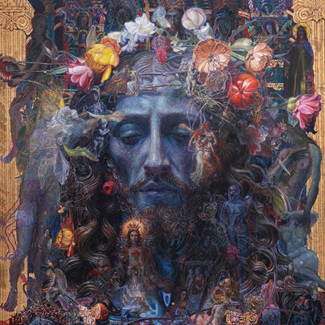
This creative research aims to explore the value and meaning of painting in an era where artificial intelligence (AI) has rapidly become highly influential in the art world. With its immense and rapid data-processing power—far beyond what any single human can achieve—AI has become a vital tool for painting creation, from researching information to composing elements, color schemes, and painting styles based on prompts. The main question of this work is: Where does the painter’s role lie, and how should painting collaborate with AI? The study employs two methodologies: first, working collaboratively with AI and subsequently creating a series of paintings, and second, analyzing the results from these artworks. The findings reveal that AI performs excellently as a reference tool, both in terms of time and research scope, and is far faster than self-directed research. AI can present unusual perspectives, though it has limitations due to the constraints of its reference sources (even if they are vast), which are rooted in Western art history textbooks and clearly defined standards of beauty. Consequently, the selection and arrangement of content are confined by these references. Creators can further challenge and develop the composition, color palette, and brushwork to introduce more instability and reflect the turbulence of the contemporary world. There are also concerns about the potential loss of diversity in the process of working with AI, as the internet may foster a “superstar commodity” culture where images, concepts, values, narratives, products, and styles become universally marketable, ultimately leading to a single global market. Continuous creation by individual artists can provide differentiation and challenge dominant forces. Nevertheless, the creative researcher maintains the belief that AI will serve as a supporter of the artist’s creative process. This research indicates that while AI plays a significant role as a facilitator and expander of creative thinking, the deeper value and meaning of painting still depend on the role of the human artist in creating, interpreting, and continuously challenging cultural frameworks.
Downloads
References
สมภาร พรมทา. (2566, 23 มิถุนายน). พุทธศาสนากับปัญญาประดิษฐ์ (AI) [Video]. YouTube. https://www.youtube.com/watch?v=m8nTWupO2B8&ab_channel=SomparnPromta
Cascone, S. (2018, June 5). New X-Ray Images Reveal Just How Carefully Picasso Worked Over His Earliest Blue Period Paintings: Researchers found 13 distinct layers in one 1902-03 canvas. Artnet News. https://news.artnet.com/art-world/picasso-secrets-x-ray-1297568
Destrée, P. (2021, December 3). Aristotle’s Aesthetics. Stanford Encyclopedia of Philosophy. https://plato.stanford.edu/entries/aristotle-aesthetics/
Google DeepMind. (n.d.). AlphaGo. Google. https://deepmind.google/research/projects/alphago/
Manovich, L. (2018). AI Aesthetics. Strelka Press. https://manovich.net/content/04-projects/173-ai-aesthetics/manovich.ai_aesthetics_2018.pdf
Manovich, L., & Arielli, E. (2024). Artificial aesthetics: Generative AI, art and visual media. https://manovich.net/index.php/projects/artificial-aesthetics
Promta, S. (2023, June 23). Buddhist & Artificial Intelligence (AI) [Video]. YouTube. https://www.youtube.com/watch?v=m8nTWupO2B8&ab_channel=SomparnPromta [in Thai]
Thipwaree, T. (2024a). Cosmology and the Sutra of Karma, Oil on canvas: Long Live Painting: AI’s Temporary Challenge [Oil on Canvas]. Number 1 Gallery, Bangkok.
______. (2024b). Crown of Light of Resurrection canvas: Long Live Painting: AI’s Temporary Challenge [Oil on Canvas]. Number 1 Gallery, Bangkok.
______. (2024c). Divine Reverie: Long Live Painting: AI’s Temporary Challenge [Oil on Canvas]. Number 1 Gallery, Bangkok.
______. (2024d). Banker, Hitler, Zionist, Moses: Long Live Painting: AI’s Temporary Challenge [Oil on Canvas]. Number 1 Gallery, Bangkok.
Downloads
Published
How to Cite
Issue
Section
License
Copyright (c) 2025 Thanarit Thipwaree

This work is licensed under a Creative Commons Attribution 4.0 International License.
The journal's editorial team does not have to agree with the views and comments in the author's article, nor are they responsible for the comments.