
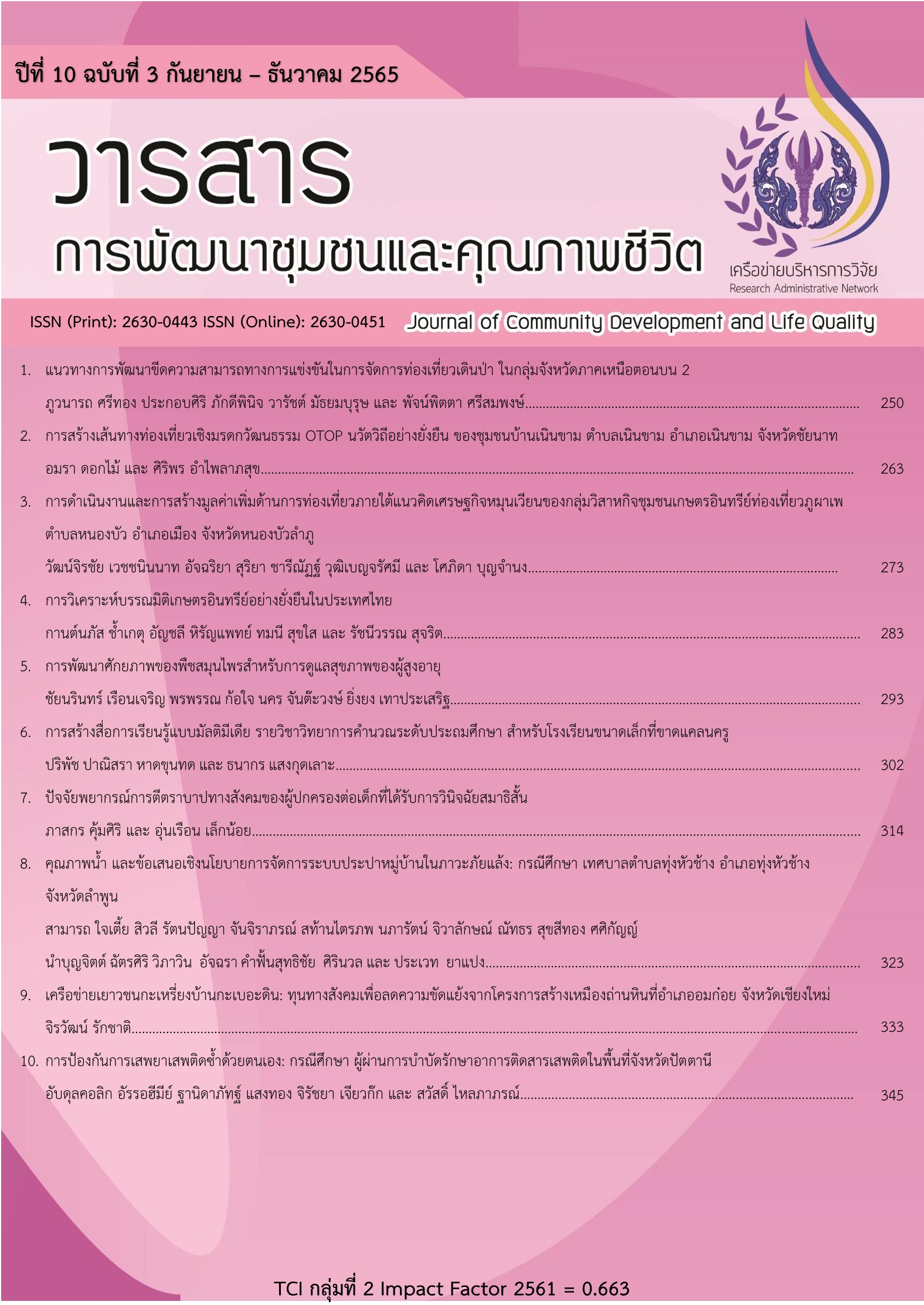
The Bibliometric Analysis of Sustainable Organic Farming in Thailand
Article Sidebar
Main Article Content
Abstract
The government has promoted agriculture sectors, which are the main source of Thai people’s income, to be sustainable for the purpose of farmers having a better quality of life. It is important that quality research results can be put into practice. For this reason, this research compiled sustainable agriculture research results from a reliable international database to analyze research results and reflected on trends and challenges driving the country. By collecting data systematically with a coding sheet of 36 articles, it integrated different fields of research results: social sciences, sciences, and engineering, which focused on environmental science. The linkage of the research results was analyzed by using bibliometric methods to reflect research issues on rice and alternative agriculture as popular subjects in the study. However, most of the research findings are not comprehensive in all regions and there is no species diversity. In addition, research issues that promoted income generation opportunities for farmers, which are urgent issues under the government policy, were not well-researched. Thus, trends and issues of sustainable agriculture research are highly recommended for future research.
Article Details

This work is licensed under a Creative Commons Attribution-NonCommercial-NoDerivatives 4.0 International License.
The Editorial Board claims a right to review and correct all articles submitted for publishing
References
Arunrat, N., Sereenonchai, S., & Wang, C. (2021). Carbon footprint and predicting the impact of climate change on carbon sequestration ecosystem services of organic rice farming and conventional rice farming: A case study in Phichit province, Thailand. Journal of Environmental Management, 289,112458. https://doi.org/10.1016/J.JENVMAN.2021.112458
Ayuttacorn, A. 2019. Social networks and the resilient livelihood strategies of Dara-ang women in Chiang Mai, Thailand. Geoforum101: 28–37.
Chanta, S., Kaweewong, J., Tongtanee, P., Laolalit, B., Yana, E., Komat, C., & Kanitpanyacharoean, W. (2020). The Driving Process for Increasing the Number of Farmers in Organic Farming by Participation in Mae Mok Community, Mae Mok Subdistrict , Thoen District , Lampang Province. Journal of Community Development and Life Quality, 8(2), 435–443. (in Thai)
Donthu, N., S. Kumar, D. Mukherjee, N. Pandey and W. M. Lim. 2021. How to conduct a bibliometric analysis: An overview and guidelines. Journal of Business Research 133: 285–296.
Hargan, K. E., Williams, B., Nuangsaeng, B., Siriwong, S., Tassawad, P., Chaiharn, C., McAdoo, B., & Los Huertos, M. (2020). Understanding the fate of shrimp aquaculture effluent in a mangrove ecosystem: Aiding management for coastal conservation. Journal of Applied Ecology, 57(4), 754–765. https://doi.org/10.1111/1365-2664.13579
Jirapornvaree, I., T. Suppadit and V. Kumar. 2021.Assessing the economic and environmental impact of jasmine rice production: Life cycle assessment and life cycle costs analysis. Journal of Cleaner Production 303: 127079, doi: 10.1016/J.JCLEPRO.2021.127079.
Kharpude, S., Patle, G. T., Kharpude, S. N., Dabral, P. P., Kumar, V., & Firuta Camelia, O. (2020). Impact of Organic Farming on Sustainable Agriculture System and Marketing Potential: A
Liao, H., M. Tang, L. Luo, C. Li, F. Chiclana and X.-J Zeng. 2018. A bibliometric analysis and visualization of medical big data research. Sustainability 10(1): 166, doi. 10.3390/su10010166.
Manida, M., & Nedumaran, G. (2021). Sustainable organic farming practices. International Journal of Agricultural Sciences and Technology, 1(1), 28–33. https://doi.org/10.51483/IJAGST.1.1.2021.28-33
Merigó, J. M. and J.-B. Yang. 2017. A bibliometric analysis of operations research and management science. Omega 73: 37–48.
Nakornthap, P. 2016. An analysis of research papers indexed in Scopus and Web of Science which authored by faculty staff of the Petroleum and Petrochemical College, Chulalongkorn University. TLA Research Journal 9(1): 23–44. (in Thai)
National Organic Agriculture Development Board. 2016. Organic agriculture strategy 2017-2021. Office of the National Economic and Social Development Council, Bangkok. (in Thai)
Nechaev, V., Mikhailushkin, P., & Alieva, A. (2018). Trends in demand on the organic food market in the European countries. MATEC Web of Conferences, 212. https://doi.org/10.1051/matecconf/201821207008
Phrommarat, B. 2019. Life cycle assessment of ground coffee and comparison of different brewing methods: A case study of organic arabica coffee in Northern Thailand. Environment and Natural Resources Journal 17(2): 96-108.
Rattanasuteerakul, K. and G.B. Thapa. 2012. Status and financial performance of organic vegetable farming in northeast Thailand. Land Use Policy 29(2): 456-463.
Santos, R., A. A Costa and A. Grilo. 2017. Bibliometric analysis and review of building information modelling literature published between 2005 and 2015. Automation in Construction 80: 118–136.
Thapa, G. B. and K. Rattanasuteerakul. 2011. Adoption and extent of organic vegetable farming in Mahasarakham province, Thailand. Applied Geography 31(1): 201–209.
Tonglad, P., & Laolalit, B. (2021). Life Quality Improvement of Farmer Group with Organic Agricultural Innovations in Wo - kaeo Subdistrict, Hang Chat District, Lampang Province. Journal of Community Development and Life Quality, 9(3): 377-389. (in Thai)
Yuttitham, M. (2019). Comparison of carbon footprint of organic and conventional farming of chinese kale. Environment and Natural Resources Journal, 17(1), 78–92. https://doi.org/10.32526/ennrj.17.1.2019.08
Wiggins, Z., & Nandwani, D. (2020). Innovations of Organic Agriculture, Challenges and Organic Certification in the United States. Sustainable Agriculture Research, 9(3): 50. https://doi.org/10.5539/sar.v9n3p50
