
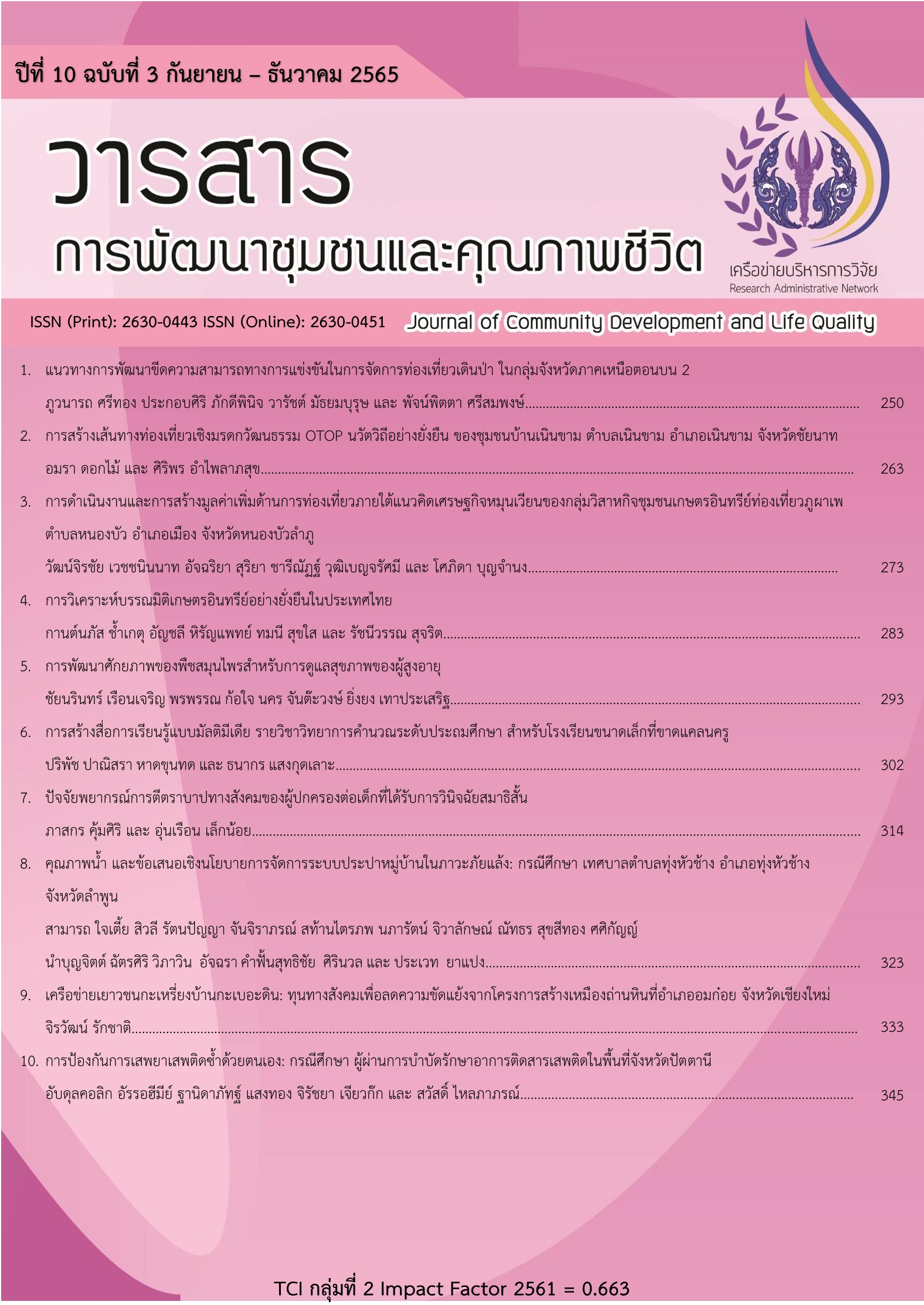
Self-prevention Against Drug Abuse Relapse: A Case Study of People Undergoing Drug Addiction Treatment in Pattani Province
Keywords:
Self-prevention, drug abuse relapse, area of Pattani provinceAbstract
This research is qualitative research aimed to study the self-prevention against drug abuse relapse among those who have undergone drug addiction treatment in Pattani province. The informants in this research consist of 30 people. There were 30 research subjects in this research selected through purposive sampling. The researcher stipulated the rules that the informant group must be relevant to this research's issues in order to obtain accurate and insightful information. The data was collected with interviews and the results were analyzed by interpreting each issue according to the research objectives. The researcher used a descriptive method to present the study results on the content of the findings. It found that the methods used in the self-prevention against drug abuse relapse were: (1) promoting knowledge, life skills, and building resilience through religious principles, (2) planning for a return to ordinary life after successful treatment of drug addiction, (3) stimulation at the subconscious level on thoughts and beliefs towards drug abuse, (4) building the self-confidence in believing that one can avoid returning to the old cycle, (5) cognitive behavior modification, also known as cognitive restructuring, as a mental process, and (6) entering into the treatment process for addiction.
References
Chainakin, C., C. Prachapiphat and A. Pumprawai. 2016. Cessation of repeated amphetamine addiction: A case study of rehabilitated persons in behavior modification camp by the therapeutic community method. Kuakarun Journal of Nursing 23(2): 248-262. (in Thai)
Chaipichitpan, N. 2013. Motivational enhancement therapy: Alternative care for drug abuse patient. Thammasat Medical Journal 13(1): 98-108. (in Thai)
Chunmanee, R., P. Hengudomsub, C. Nabkasorn and D. Vatanasin. 2015. Effects of group cognitive behavioral therapy program on perceived self-efficacy and intention to drug abstinence among male patients with amphetamine dependence. Thai Pharmaceutical and Health Science Journal (10)4: 155-162. (in Thai)
Drug Prevention and Suppression Center. 2021. Strategic plan for treatment and rehabilitation of drug patients. Ministry of Public Health, Nonthaburi. (in Thai)
Jandeang, B. 2017. Analysis of current drug situation problem. Journal of Research and Development Institute, Rajabhat Maha Sarakham University (4)2: 37-56.
Khorphon, S., J. Pankeaw T. Sarobol S. Sitthisongkram S. Chaisrisawat S. Chaisrisawat and P. Norsak. 2014. Use of Participatory Action Research (PAR) in Preventing and Solving Problems Caused by Alcohol Consumption in the Community of Nong Toa Kammai Village, Pa Phai Sub-district, San Sai District, Chiang MaiProvince. Journal of Community Development and Life Quality (2)3: 313-324. (in Thai)
Netnuanyai, R., C. Nitchanet., S. Phukong., S. Boonyapithak and D. Phukao. 2014. thai youth’s voluntary applications of drug treatment. Journal of the Association of Researchers (19)2: 36-44. (in Thai)
Office of Narcotics Control Board. 2019. Drug situation in the lower southern region. (Online). Available: https://www.oncb.go.th/ONCB_OR9/picture/Forms/Thumbnails.aspx. (August 4, 2019). (in Thai)
Pochnagone, S. 2020. The empowerment model for addicted patients and family to prevent relapse. Journal of Social Science and Buddhistic Anthropology (5)12: 305-323. (in Thai)
Princess Mother National Institute on Drug Abuse Treatment. 2012. Relapse prevention skill group. Department of Medical Services, Bangkok. (in Thai)
Prochaska, J.O. and W.F. Velicer. 1997. The transtheoretical model of health behavior change. American Journal of Health Promotion 12(1): 38-48.
Thatsananchalee, P. 2011. The process of non-becoming amphetamine addict: A case study of rehabilitated person in process of correctional system. Interdisciplinary Sripatum Chonburi Journal 1(3): 36-48. (in Thai)
Tongtub, K. and P. Uthis. 2014. The effect of coping skills training in relapse prevention program on amphetamine abstinence self-efficacy of amphetamine users. Journal of Psychiatric Nursing and Mental Health 28(2): 88-99. (in Thai)
Downloads
Published
How to Cite
Issue
Section
License
Copyright (c) 2022 Journal of Community Development and Life Quality

This work is licensed under a Creative Commons Attribution-NonCommercial-NoDerivatives 4.0 International License.
The Editorial Board claims a right to review and correct all articles submitted for publishing


