
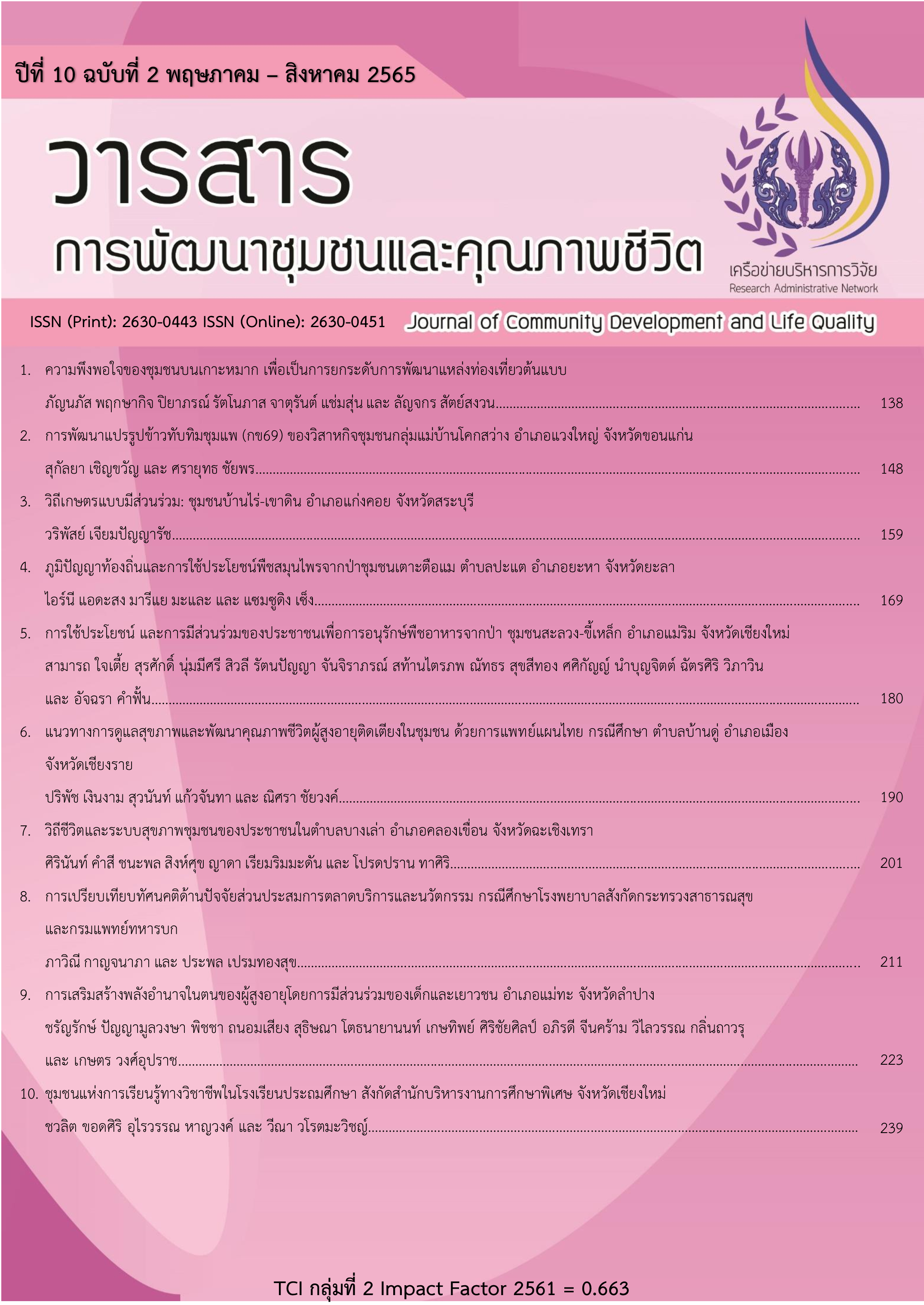
Participatory on Agriculture: Ban Rai–Khao Din Community Kaeng Khoi District, Saraburi Province
Keywords:
Participatory action research, community, attitude, agricultural waste management, economic valueAbstract
The purposes of this study were to analyze benefits of community learning and development process for farmers from Ban Rai–Khao Din community, Kaeng Khoi district, Saraburi province by participatory action research (PAR) onagricultural waste management practices. Purposive samples were collected from 24 farmers by using questionnaires and structured-interview. Due to PAR agricultural waste management practices, farmers could reduce 6-10 % of household and 20-30 % of agricultural expenditure, increase 16.64 -17.67 % in revenue, and decrease PM 2.5 value by 50 %. SWOT analysis was also used in the present study. The study showed the strength was strong community, weakness was source of investment funds, opportunity was product development and threat was access to markets. Furthermore, the community established the Ban Rai–Khao Din bio-organic rice. The results showed more than 50% of samples in the community were satisfied with PAR at a high level. This result implied that farmers had satisfaction with participation on PAR process and the PAR processcould continue to be a good development in this community.
References
Borirak, T. 2019. The crisis lessons from PM 2.5 air pollution. EAU Heritage Journal Science and Technology 13(3). 44-58. (in Thai)
Foundation for Agricultural and Environmental Conservation (Thailand). 2020. Rice production. (Online). Available: http://www.aecth.org
/upload/13823/Yg2qaxoQyg.pdf
(August 3,20200). (in Thai)
Greenwood, D.J. and M. Levin. 2003. Reconstructing the relationships between universities and society through action research. PP. 131-166. In: N.K. Denzin and Y.S. Lincoln (eds.) The Landscape of Qualitative Research: Theories and Issues. Sage Thousand Oaks.
Kemmis, S. and R. Mc Taggart. 2005. Participatory action research: Communicative action and the public PP. 559-604. sphere. In: N.K. Denzin and Y.S. Lincoln (eds.) Handbook of Qualitative Research. 3rd rd. Sage, Thousand Oaks.
Knook, V.J., E. M. Brander and D. Moran. 2020. The evaluation of a participatory extension programme focused on climate friendly farming. Journal of Rural Studies 76: 40-48.
Office of the National Economics and Social Development Council. 2018. National Strategy 2018-2037. (Online). Available: http://nscr.nesdb.go.th/wp-content/uploads/2019/10/National-Strategy-Eng-Final-25-OCT-2019.pdf (November, 2019). (in Thai)
Prapatigul, P., W. Intaruccomporn and S. Sreshthaputra. 2021. The Seeking of Roughage Sources from Agricultural Wastes in Community for Beef Cattle Raising: A Case Study of Beef Cattle Raising Group at Pua District, Nan Province. Journal of Community Development and Life Quality. 9(2): 278-288. (in Thai)
Saraburi Provincial Government. 2018. Saraburi Provincial Development Plan: 2018-2021. 2018. (Online) Available: http://www.saraburi.go.th/web2/files/com_strategy/2017-12_9c975b039c08603.pdf (August, 2020). (in Thai)
Supapunt, P.R. Kongtanajaruanun, J. Bunmark, T. Awirothananon and P. Intanoo. 2017. Optimal marketing strategies for distribution channels of organic agricultural products in Chiang Mai province. Parichart Journal, Thaksin University. 30(3): 35-44. (in Thai)
Thai Industrial Standards Institute. 2018. Charcoal. (Online). Available: http://tcps.tisi.go.th/pub/tcps657_47.pdf (December 20, 2019). (in Thai)
Than, P. and K. Suluksna. 2019. Experimental on influent parameters on wood vinegar burning process. IOP Conf. Series: Materials Science and Engineering 501: 012066, doi: 10.1088/1757-899X/501/1/012066.
Downloads
Published
How to Cite
Issue
Section
License
Copyright (c) 2022 Journal of Community Development and Life Quality

This work is licensed under a Creative Commons Attribution-NonCommercial-NoDerivatives 4.0 International License.
The Editorial Board claims a right to review and correct all articles submitted for publishing


