
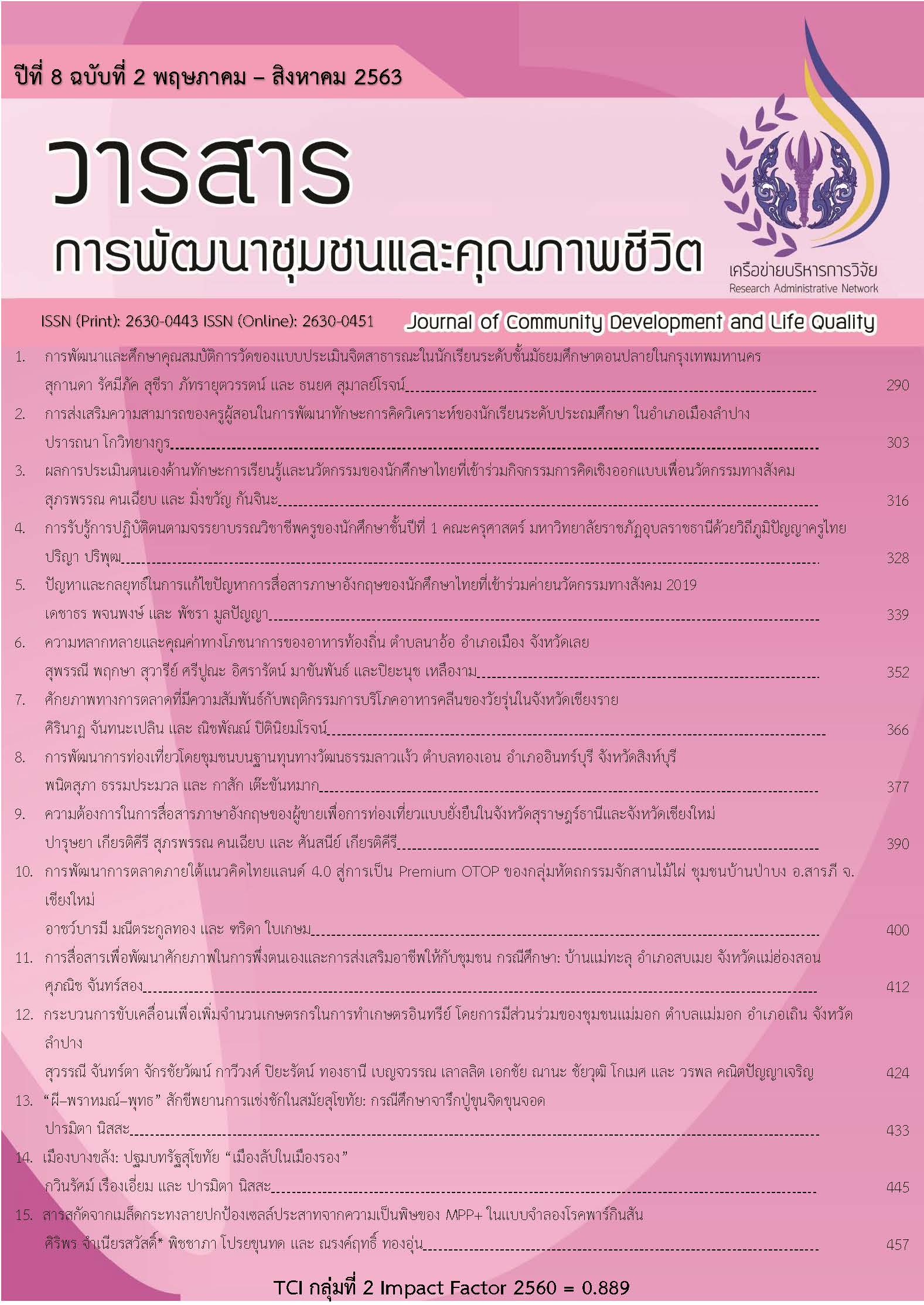
The Driving Process for Increasing the Number of Farmers in Organic Farming by Participation in Mae Mok Community, Mae Mok Subdistrict, Thoen District, Lampang Province
Abstract
The objectives of this study were to 1) study the factors affecting farmers’ demand for doing organic farming and 2) study the guidelines for increasing the number of farmers in organic farming. The research results found that the reasons why farmers would be engaged inorganic farming were as follows: 1) Health; doing organic farming would protect them from getting pesticides in their blood , 2) Economy; participation in organic farming network or group not only reduce household expenses significantly but also gives them more income from selling various organic products, 3) Municipal policy; Mae Mok Sub-district Municipality has a clear policy to push the Mae Mok subdistrict into a city of safe food. and 4) Others.
The guidelines for increasing the number of farmers in organic farming are as follows: 1) Look for a farmer who can be a role model of organic farming practice, 2) Organize knowledge and experience sharing, 3) The responsible organizations/government agencies related to organic farming policy at all levels need to look for agencies that can support organic crop production, technology, knowledge and agricultural market, as well as pushing the production and production processes to be certified organic farming standards from relevant agencies, 4) Train or create outstanding farmers in the community to be a role model and lecturer including building a community learning center. Finally, 5) Make the Organic Farming Community Agreement. From the implementation of the guidelines, it was found that the number of farmers participating in the organic farming project increased from 32 to 298.
References
Thailand. Thaksin University Journal 13(1): 78-88 (in Thai)
Jiumpanyarach, W. 2017. Sustainable
impacts on organic farmers in Thailand: lessons from small-scale farmers. Journal of Social science Srinakharinwirot University 20(20): 199-215. (in Thai)
Kawichai, P., P. Yosssuk., S. Kaewthip and C.
Boonrahong. 2015. Factors affecting development of organic agriculture policy of local administrative organization: Cases studies of Mae Tha Tambon administrative organization. Mae on district and Luang Nuae Tambon municipality, Doi Saket district, Chiangmai province. Journal of Community Development and Life Quality 5(1): 142-154 (in Thai)
Mingchai. C. and P. Yossuck, 2508. Thai
Organic farming: policy context and content analysis. Pp.461-468. In Proceedings of 46Th Kasetsart University Annual Conference: Education Humanities and Social Sciences Economics and Business Administration Agriculture and Home Economics. Kasetsart University, Bangkok. (in Thai)
National Bureau of Agricultural Commodity
and Food Standards. 1971. Organic agriculture part 1: The production, processing, labeling and marketing or produce and produce from organic agriculture. National Bureau
of Agricultural Commodity and Food Standards, Bangkok, Thailand. 77 p. (in Thai)
National organic farming development
committee. 2017. Strategy of national organic farming development. Office of Agricultural Economics. Bangkok, Thailand. 86 p. (In Thai)
Pompranee, P. 2015. The empowerment of
sustainable agriculture system by communities participation art the Kok-Chang village, Laem-Bua sub-district, Nakhon Chaisri district, Nakhon Pathom province. Area Based Development Research Journal 7(1): 59-73 (in Thai)
Yossuk, P. and P. Kawichai. 2018. Problems
and appropriate approaches to implementing organic agriculture policy in Thailand. Journal of Community Development and Life Quality 5(1): 129-141 (in Thai)
Downloads
Published
How to Cite
Issue
Section
License
The Editorial Board claims a right to review and correct all articles submitted for publishing


