
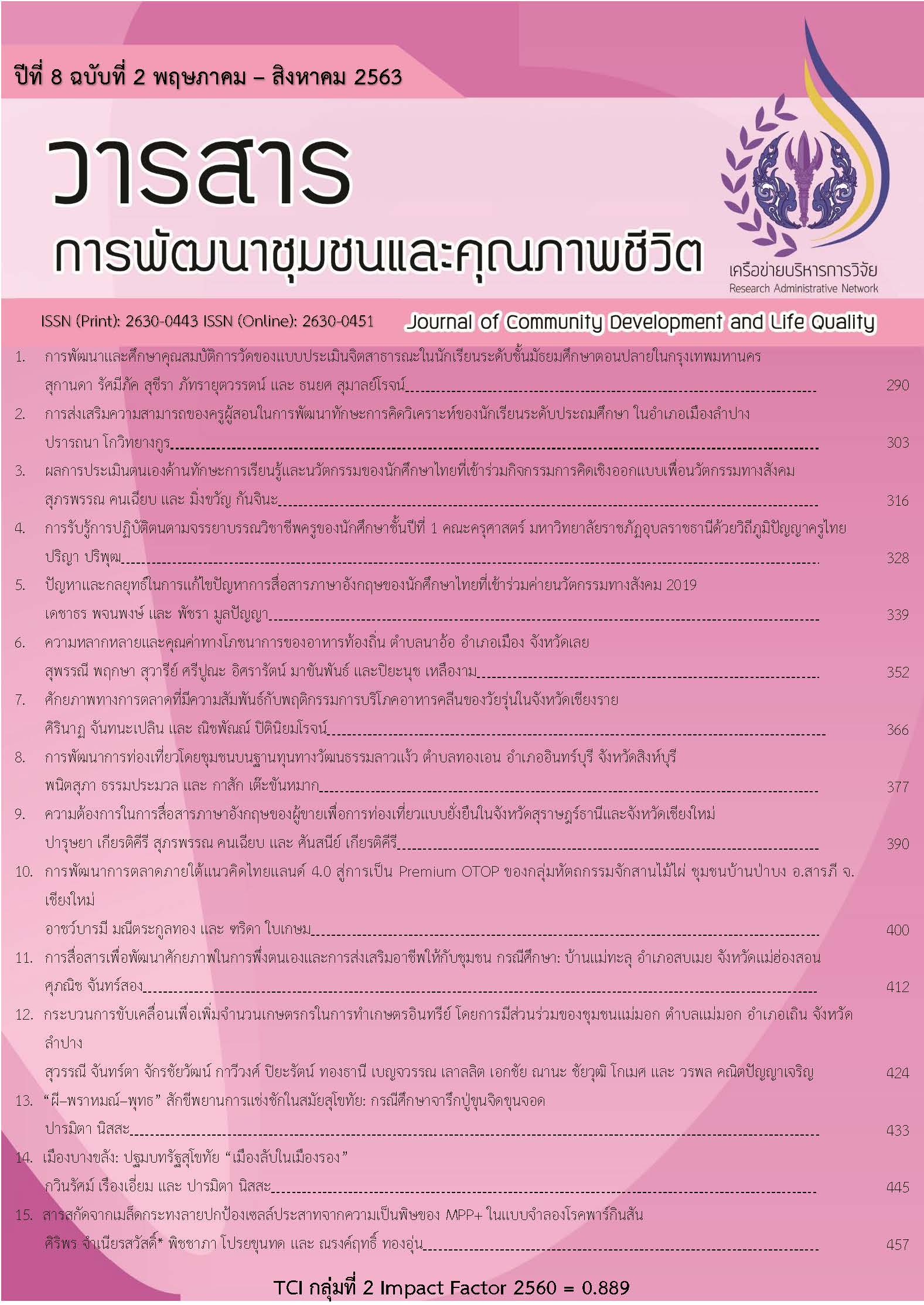
English Communication Needs of Sellers for Sustainable Tourism in Surat Thani and Chiang Mai Province
Abstract
The purpose of this study was to analyze the needs to improve English language communication of sellers and vendors in tourist destinations. Quantitative research was employed in this study. The subjects included 200 local people purposively selected from two communities: Bang Bai Mai, Mueang district, Surat Thani province and Mae Khue, Doi Saket district, Chiang Mai province. The research tool was a questionnaire in a form of checklist and 5-point Likert scale asking about problems and needs for communication with foreign customers. The results showed that participating sellers were more likely to encounter speaking difficulties than listening. They also illustrated their needs to use English language for greeting the customer, giving general information, selling their products, advertising their products, and dealing with bargaining.
References
Debois, S. 2016. 9 Advantages and disadvantages of questionnaires. (Online). Available: https://surveyanyplace.com/questionnaire-pros-and-cons/ (June 16, 2018)
Fahmongkolchai, A. 2011. Needs and problems in English speaking and listening skills of CIMB Thai Bank tellers. (M.A. Thesis), Srinakharinwirot University, Bangkok. 63 p.
Firestone, W. A. 2005. Meaning in method: The rhetoric of quantitative and qualitative research. Educational Researcher 16(7): 16-21.
Gall, J.P., M.D. Gall and W.R. Borg. 2005. Applying Educational Research: A Practical Guide. 5th ed. Pearson, Boston. 570 p.
Khamkhien, A. 2010. Thai learners’ English pronunciation competence: Lesson learned from word stress assignment. Journal of Language Teaching and Research 1(6): 757-764.
Kirkpatrick, A. 2012. Theoretical Issues. pp. 13-31. In: E.L. Low and A. Hashim (eds.). English in Southeast Asia: Features, Policy and Language in Use. John Benjamins, Amsterdam.
Lertwannawit, A., S. Serirat and S. Pholpantin. 2009. Career competencies and career success of Thai employees in tourism and hospitality sector. International Business & Economies Research Journal 8(11): 65-72.
Neuber, K.A., W.T. Atkins, J.A. Jacobson and N.A. Reuterman. 1980. Needs Assessment: A Model for Community Planning. SAGE Publications, Newburry Park. 108 p.
Nikonkittikoson, P. 2016. Development of English communicative innovation for local vendors at Koh Kret, Nonthaburi province. Journal of the Association of Researchers 21(2): 110-122. (in Thai)
Noom-ura, S. 2013. English-teaching problems in Thailand and Thai teachers’ professional development needs. English Language Teaching 6(11): 139-147.
Prachanant, N. 2012. Needs analysis on English language use in tourism industry. Prodedia Social and Behavioral Sciences 66: 117-125.
Richards, J.C. 2006. Communicative Language Teaching Today. Cambridge University Press, Cambridge. 47 p.
Richards, J. C. and T.S. Rodgers. 2001. Approaches and Methods in Language Teaching. 2nd ed. Cambridge University Press, New York. 270 p.
Tananuraksakul, N. 2017. Building up Thai EFL students’ positive attitudes toward their non-native English accented speech with the use of phonetics website. Teaching English with Technology 17(4): 52-63.
Tarone, E. 2006. Interlanguage. pp. 745-752. In: K. Brown (eds.). Encyclopedia of Language and Linguistics. Elsevier, Oxford.
UNEP and UNWTO. 2005. Making tourism
more sustainable: A guide for policy makers. (Online). Available: http://wedocs.unep.org/bitstream/h
andle/20.500.11822/8741/-Making%20Tourism%20More%20
Sustainable_%20A%20Guide%20for%20Policy%20Makers-2005445.pdf?sequence=3&isAllowed=y (February 12, 2019).
Wiersma, W. and S.G. Jurs. 2009. Research Methods in Education: An Introduction. 9th ed. Pearson, Boston. 493 p.
Wiriyachitra, A. 2002. English language teaching and learning in Thailand in this decade. Thai TESOL Focus 15(1): 4-9.
Downloads
Published
How to Cite
Issue
Section
License
The Editorial Board claims a right to review and correct all articles submitted for publishing


