
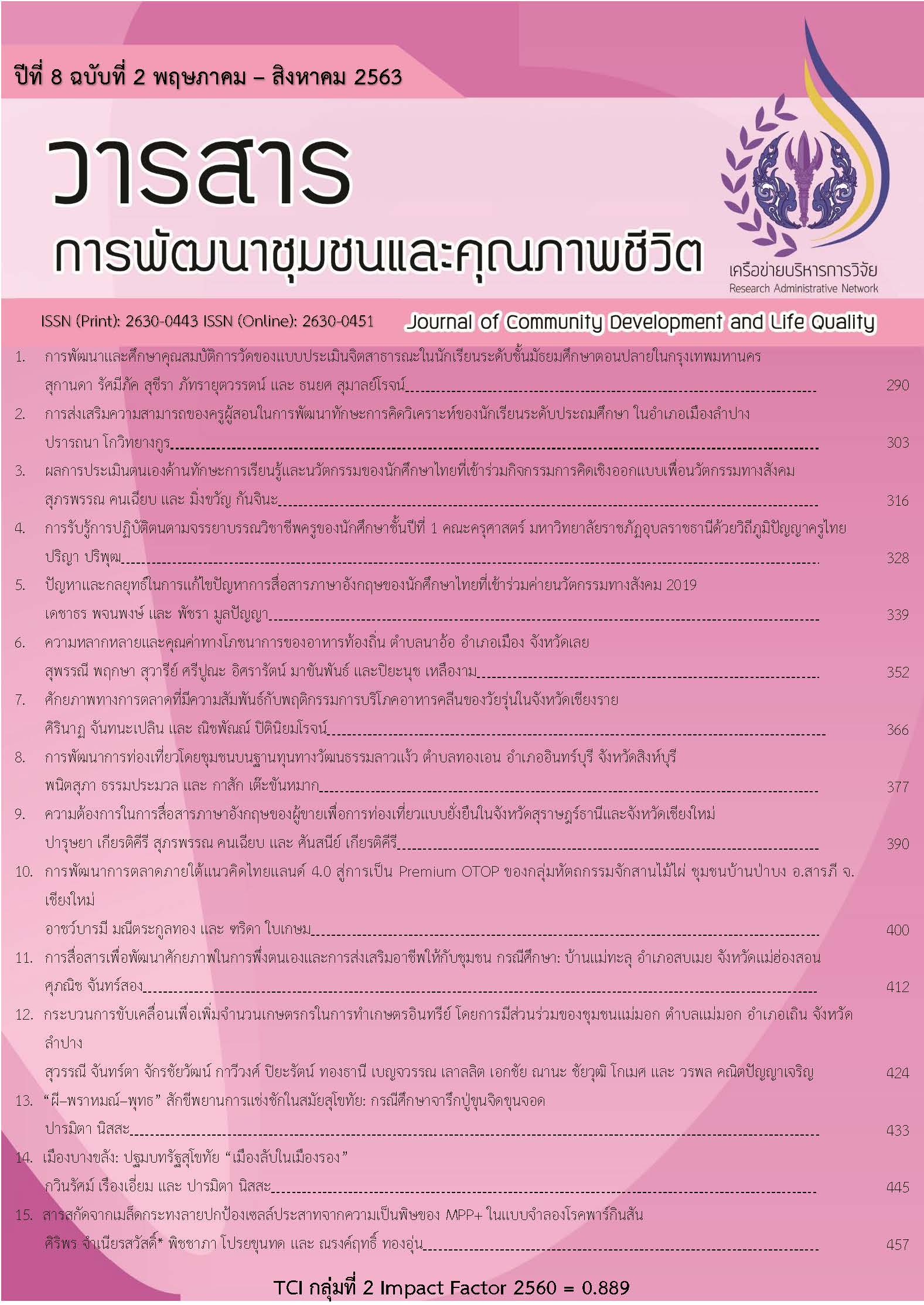
Potential of Marketing as Related to Clean Food Consumption Behavior of Teenager in Chiang Rai
Article Sidebar
Main Article Content
Abstract
This article is intended to study clean food consumption behavior and potential marketing that is related to clean food consumption behavior. This research is a quantitative research which used questionnaires as a research tool. The statistics used for data analysis was descriptive statistics consisting of percentage, mean and standard deviation. The statistics used for hypothesis testing was the analysis of the relationship between independent variables with Pearson correlation coefficient. The results showed that most of the teenagers who consumed clean food were males, aged between 21-24 years, who lived in a dormitory outside the university. Their health-related activities were exercise and gym workouts. In terms of clean food eating behavior, it was found that, the persons who participated in food consumption decision were their girlfriends. They normally consume in the evening by cooking their own dishes, or they bought clean food that they liked from the fitness center. They also studied clean food information through online media. The results of the relationship study showed that the distribution channels had the same correlation with the frequency of clean food intake. On the contrary, the food price had a negative correlation with to the amounts of money spent on theclean food consumption.
Article Details
The Editorial Board claims a right to review and correct all articles submitted for publishing
References
Khonkla A., M. Kupatipatnukul, P. Tanadkid, S. Kumyod, and S. WongJun. 2016. Marketing mix affecting product selection dietary supplements of consumers in Phayao municipality. The Journal of Pacific Institute of Management Science 2(1): 33-44. (in Thai)
Nithitantiwat P. and W. Udomsapaya. 2017. Food consumption behavior of Thai adolescents, impacts and solutions. Journal of Phrapoklao nursing college 28(1): 122-128. (in Thai)
Phatlom, T. and K. Mongkol. 2015. Consumer s’ behavior on buying clean food via E-commerce in Bangkok. Burapha Journal of Business Management Burapha University 4(2): 6-21. (in Thai)
Prayalaw, N. and L. Manmart. 2015. Factors affecting Consumers’ purchasing decision in food product of One Tambon One Product project produced in Khon Kaen province. KKU Research Journal (Graduate studies) of Humanities and Social Sciences 3(1): 38-51. (in Thai)
Pungmai A. and C. Thongjeen. 2018. Factors affecting the decision to buy clean food in Bangkok. Graduate School Conference 2018 of Suan Sunandha Rajabhat University 2(1): 983-990. (in Thai)
Ruangying J., S. Jorajit and K. Janyam. 2016. Food consumption behavior of adolescents in Songkhla Province: Synthesis of literacy and factors influencing food consumption behavior. Journal of Liberal Arts Prince of Songkla University 8(1): 245-264. (in Thai)
Saimek, M. 2016. The relationship between breakfast behavior and learning efficiency. Burapha Journal of Business Management, Faculty of Management and Tourism Burapha University 4(2): 22-33. (in Thai)
Samutachak, B. and M. Kanchanachitra. 2014. What Drives Consumerism in Thai Youth?. Thammasat Journal 33(1): 46-69. (in Thai)
Waratornpaibool, T. 2014. Consumption behavior: Consumerism food and health-conscious food. Panyapiwat Journal 5(2): 255-264. (in Thai)
Wongpoom A. and T. Noythonglek. 2016. Effect of perceived value and marketing mix toward the consumer’s buying behavior for dietary supplement in Muang district, Lampang province. Sakon Nakhon Graduate Studies Journal 13(60): 213-224. (in Thai)
