
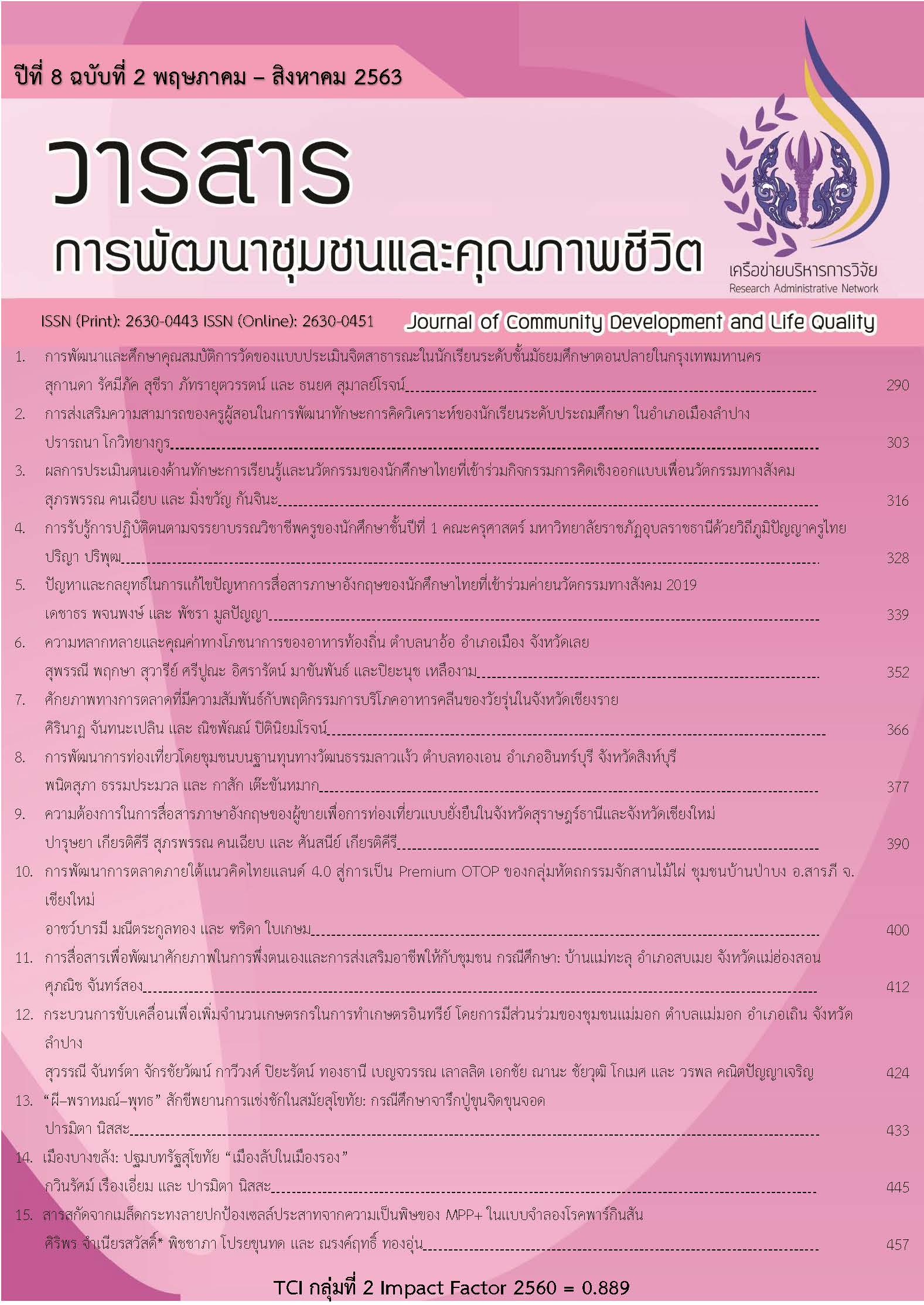
Problems-solving Strategies in English Communication of Thai Students in a Social Innovation Camp 2019
Article Sidebar
Main Article Content
Abstract
This research aims to find out English communication problems of Thai students who participated in the Learning Express program 2019 at Rajamangla University of Technology Lanna Chiang Mai, and the strategies they used in communicating with their foreign peers in English. The students were selected by the program committee using an English proficiency test as part of the selection process. The research was conducted by using a 5 Likert Scale questionnaire adapted in relation to the communication problem-solving strategy concept. The questionnaires were distributed to the students and then collected for analysis. There were also open-ended question items for them to express their opinions together with interviews with four selected students for in-depth details. It was found that the problems that the Thai students encountered most were limited vocabularies (x̄= 3.19, S.D.=0.962), incompressible pronunciation, or accent (x̄=3.07, S.D.=0.958), and the lack of proper English grammar (x̄=2.78, S.D.=1.013) respectively. For the strategies, the students reported using body language or facial expression the most at (x̄= 4.11, S.D.=1.188), followed by asking friends with better English for help at (x̄=4.00, S.D.=1.074), and using fillers to allow them to think before speaking at (x̄=3.93, S.D.=0.829). The researchers noticed that a broader range of vocabulary was vital for these students, and non-verbal communication helped fulfill their limited words. It is suggested that a preparation course for the program next year emphasize strengthening students' vocabulary and their pronunciations.
Article Details
The Editorial Board claims a right to review and correct all articles submitted for publishing
References
intercultural awareness: culture in ELT. ELT Journal, 66(1): 62-70.
Bailey, K. M., & Nunan, D. 2005. Practical
English language teaching: speaking. McGraw-Hill, New York. 199 p.
Boonpanya, M. and D. Pojchanaphong. 2018.
Communication problem solving strategies of Thai students in an exchange program in Singapore. pp.131-142. In: Proceeding of the 9th International Conference on Language Innovation, Culture, and Education. Bangkok.
Crystal, D. 2019. English as A Global
Language. 2nd Revised ed. Cambridge University Press. Cambridge. 224 p.
Dörnyei, Z. 1995. On the teachability of
communication strategies. TESOL Quarterly 29(1): 55-85.
Dörnyei, Z., & Scott, M. L. 1995.
Communication strategies: an empirical analysis with retrospection. In Deseret Language and Linguistic Society Symposium 21(1): 137-150.
Gudykunst, W.B. 2004. Bridging Differences:
Effective Intergroup Communication. 4th ed. SAGE Publications,
Thousand Oaks, CA. 425 p.
Hybels, S. and R. L. Weaver. 2009.
Communicating Effectively. 9th ed. McGraw-Hill, New York. 425 p.
Jenkins, J. 2007. English as a Lingual Franca:
Attitude and Identity. Oxford University Press, Oxford. 269 p.
Zulkurnain, N., & Kaur, S. 2014. Oral English
communication difficulties and coping strategies of diploma of hotel management students at UiTM. 3L: The Southeast Asian Journal of English Language Studies 20 (3): 93–112.
Phonhan, P. 2019. Strategies in English Oral
Communication Employed by Thai Engineering Students across Majors and Types of Academic Programs. Journal of Liberal Arts, Maejo University, 7(1), 102-118.
Rattanaphumma, R. 2011. English as a lingua
franca: Implications for English language teaching. The IELE Journal 2(2): 73-84.
Sutthinaraphan, K., and P. Wasanasomsithi.
2017. A study of English communication strategy use of undergraduate students majoring in science. The New English Teacher 11(2): 98-117.
Syamsudin, S. 2016. The use of non
linguistics means strategies as a speaking-problem solving in EFL
learning. International Journal of English Language Education 4(2): 42-49.
Thornbury, S. 2005. How to teach speaking.
(Online). Available: http://tfscale.org/about-tf-scale-temasek-foundation-specialists-community-action-leadership-exchange/ (July 4, 2017).
Ting, S.H., & Phan, G. Y. 2008. Adjusting
communication strategies to language proficiency. Australian TESOL Journal 23 (1): 28-36.
Wahyuni, S. and M. Ilyas. 2017. An
investigation of Thai students’ English language problems and their learning strategies at English study program of teacher training and education Faculty of Riau Islamic University. J-SHMIC 3(2): 81-91.
