
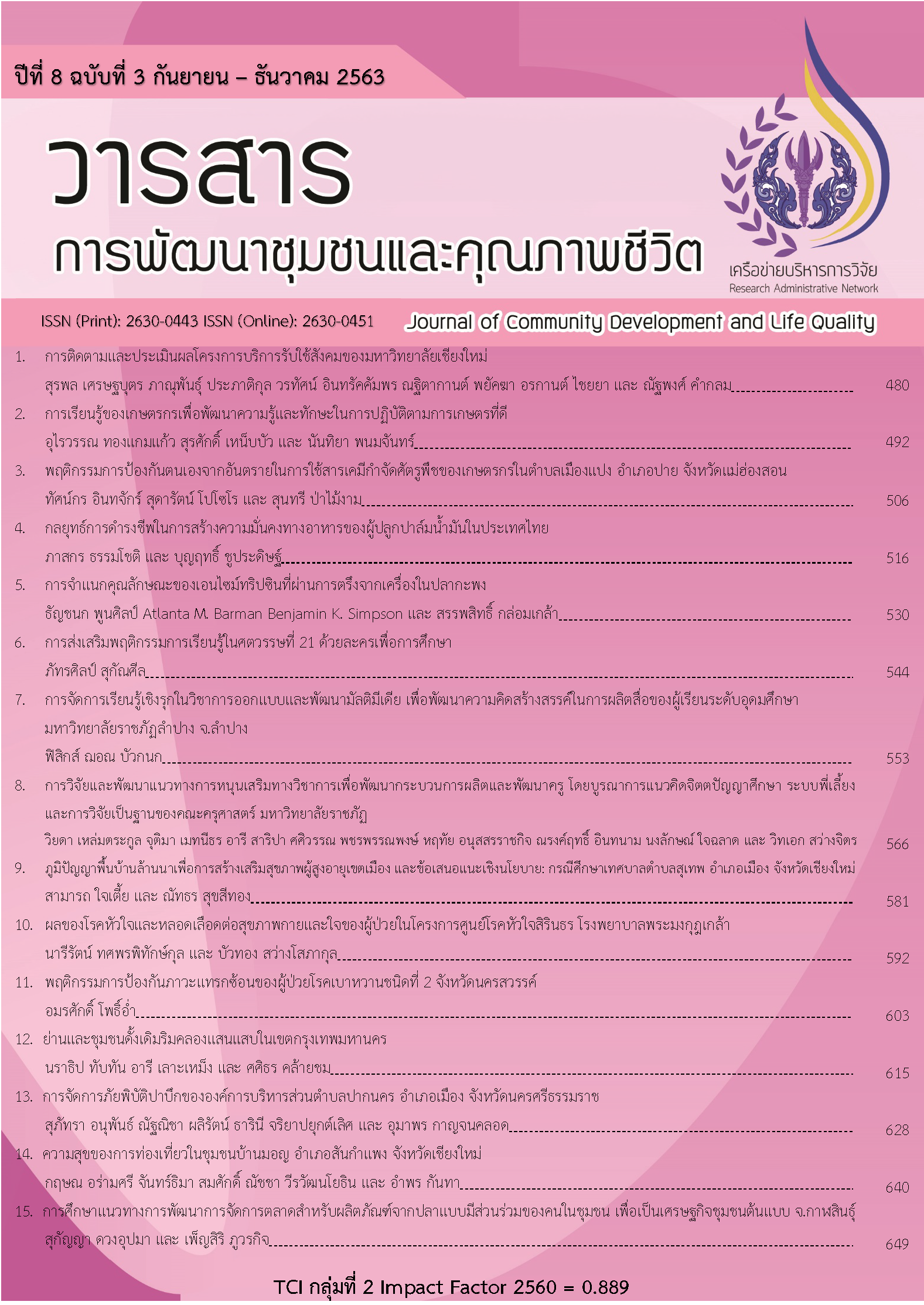
Livelihood Strategies for Building Food Security of Palm Oil Growers in Thailand
Article Sidebar
Main Article Content
Abstract
This research applied sustainable livelihood approach to analyze palm oil growers’livelihood for building food security under different production systems and investigated the relationship between livelihood outcomes, livelihood assets and livelihood strategies for building food security under different production systems. A total of 400 palm oil growers in Surat Thani province were interviewed. The result of this study revealed that fluctuation of palm oil prices, an increase in input prices, availability of water, natural diasters and climate changes were prominent factors effecting palm oil growers’ livelihood systems for all three different groups. There were statistically significant difference among three different groups of palm oil growers in livelihood assets. The exploratory factor analysis was applied to group the livelihood strategies for building food security in palm oil growers. The results showed that there were five livelihood strategies for building food security in palm oil growers. Five livelihood strategies were 1) Changing consumption pattern 2) Selling livestocks for food and using natural resources for food production 3) Food exchange and looking for low food prices 4) Earning more income and 5) Reducing household expenses. Lastly, this research found that the relationship between food security which was one of livelihood outcomes and livelihood strategies including food security building strategies were statiscially significant and different among three groups.
Article Details
The Editorial Board claims a right to review and correct all articles submitted for publishing
References
Aryee, A.N.A. and B.K. Simpson. 2012. Immobilization of lipase from grey mullet. Applied Biochemistry and Biotechnology 168(8): 2105-2122.
Atacan, K., B. Çakıroglu and M. Ozacar. 2017. Covalent immobilization of trypsin onto modified magnetite nanoparticles and its application for casein digestion. International Journal of Biological Macromolecules 97: 148-155.
Azevedo, R.D.S., I.P.G. Amaral, A.C.M. Ferreira, T.S. Espósito and R.S. Bezerra. 2018. Use of fish trypsin immobilized onto magnetic-chitosan composite as a new tool to detect antinutrients in aquafeeds. Food Chemistry 257: 302-309.
Bassan, J.C., T.M. de Souza Bezerra, G. Peixoto, C.Z.P. da Cruz, J.P.M. Galan, A.B.D.S. Vaz, S.S. Garrido, M. Filice and R. Monti. 2016. Immobilization of trypsin in lignocellulosic waste material to produce peptides with bioactive potential from whey protein. Materials 9(5): 357. Doi: 10.3390/ma9050357.
Bayramoglu, G., M. Yılmaz, A.U. Şenel and M.Y. Arıca. 2008. Preparation of nanofibrous polymer grafted magnetic poly(GMA-MMA)-g-MAA beads for immobilization of trypsin via adsorption. Biochemical Engineering Journal 40(2): 262-274.
Bougatef, A. 2013. Trypsins from fish processing waste: characteristics and biotechnological applications-comprehensive review. Journal of Cleaner Production 57: 257-265.
Erlanger, B.F., N. Kokowsky and W. Cohen. 1961. The preparation and properties of two new chromogenic substrates of trypsin. Archives of Biochemistry and Biophysics 95(2): 271-278.
Ganachaud, C., D. Bernin, D. Isaksson and K. Holmberg. 2013. An anomalous behavior of trypsin immobilized in alginate network. Applied Microbiology and Biotechnology 97(10): 4403-4414.
Garcia-Galan, C., A. Berenguer-Murcia, R. Fernandez-Lafuente and R.C. Rodrigues. 2011. Potential of different enzyme immobilization strategies to improve enzyme performance. Advanced Synthesis and Catalysis 353(16): 2885-2904.
Kang, K., C. Kan, A. Yeung and D. Liu. 2005. The properties of covalently immobilized trypsin on soap-free P(MMA-EA-AA) latex particles. Macromolecular Bioscience 5(4): 344–351.
Klomklao, S., S. Benjakul, W. Visessanguan, H. Kishimura and B.K. Simpson. 2007. Trypsin from pyloric caeca of bluefish (Pomatomus saltatrix). Comparative Biochemistry and Physiology B 148(4): 382-389.
Koide, T. and T. Ikenaka. 1973. Studies on soybean trypsin inhibitors: 1. Fragmentation of soybean trypsin inhibitor (Kunitz) by limited prateolysis and by chemical cleavage. European Journal of Biochemistry 32(3): 401-407.
Lage, F.A.P., J.J. Bassi, M.C. Corradini, L.M. Todero, J.H. Luiz and A.A. Mendes. 2016. Preparation of a biocatalyst via physical adsorption of lipase from Thermomyces lanuginosus on hydrophobic support to catalyze biolubricant synthesis by esterification reaction in a solvent-free system, Enzyme and Microbial Technology 84: 56-67.
Li D., N.A. Ackaah-Gyasi and B.K. Simpson. 2013. Immobilization of bovine trypsin onto controlled pore glass. Journal of Food Biochemistry 38(2): 184-195.
Purcena, L.L.A., S.S. Caramori, S. Mitidieri and K.F. Fernandes. 2009. The immobilization of trypsin onto polyaniline for protein digestion. Materials Science and Engineering: C 29(4): 1077-1081
Seabra, I.J. and M.H. Gil. 2007. Cotton gauze bandage: A support for protease immobilization for use in biomedical applications. Revista Brasileira de Ciências Farmacêuticas 43(4): 535-542.
Sears, P.S. and D.S. Clark. 1993. Comparison of soluble and immobilized trypsin kinetics: Implications for peptide synthesis. Biotechnology and Bioengineering 42(1): 118-124.
Shtelzer, S., S. Rappoport, D. Avnir, M. Ottolenghi and S. Braun. 1992. Properties of trypsin and of acid phosphatase immobilized in sol-gel glass matrices. Biotechnology and Applied Biochemistry 15(3): 227-235.
Simpson, B.K. 2000. Digestive proteinases from marine animals. pp. 531-540. In: N.F. Haard and B.K. Simpson (eds). Seafood Enzymes: Utilization and Influence on Postharvest Seafood Quality. Marcel Dekker, New York.
Steel, R.G.D. and J.H. Torrie. 1980. Principles and Procedures of Statistics: A Biometrical Approach. McGraw-Hill, New York.
Sun, X., Cai X., R.Q. Wang and J. Xiao. 2015. Immobilized trypsin on hydrophobic cellulose decorated nanoparticles shows good stability and reusability for protein digestion. Analytical Biochemistry 477: 21-27.
Vidinha, P., V. Augusto, M. Almeida, I. Fonseca, A. Fidalgo, L. Ilharco, J.M. Cabral and S. Barreiros. 2006. Sol-gel encapsulation: an efficient and versatile immobilization technique for cutinase in non-aqueous media. Journal of Biotechnology 121(1): 23-33.
Wu, N., S. Wang, Y. Yang, J. Song, P. Su and Y. Yang. 2018. DNA-directed trypsin immobilization on a polyamidoamine dendrimer-modified capillary to form a renewable immobilized enzyme microreactor. International Journal of Biological Macromolecules 113(1): 38-44.
Wu, S., B. Liu and S. Li. 2005. Behaviors of enzyme immobilization onto functional microspheres. International Journal of Biological Macromolecules 37(5): 263-267.
