
Effect of Using the Basic Elderly Care Handbook on Knowledge and Behavior Regarding Elderly Care Among Elderly Caregivers in Choeng Doi Subdistrict, Doi Saket District, Chiang Mai Province
Article Sidebar
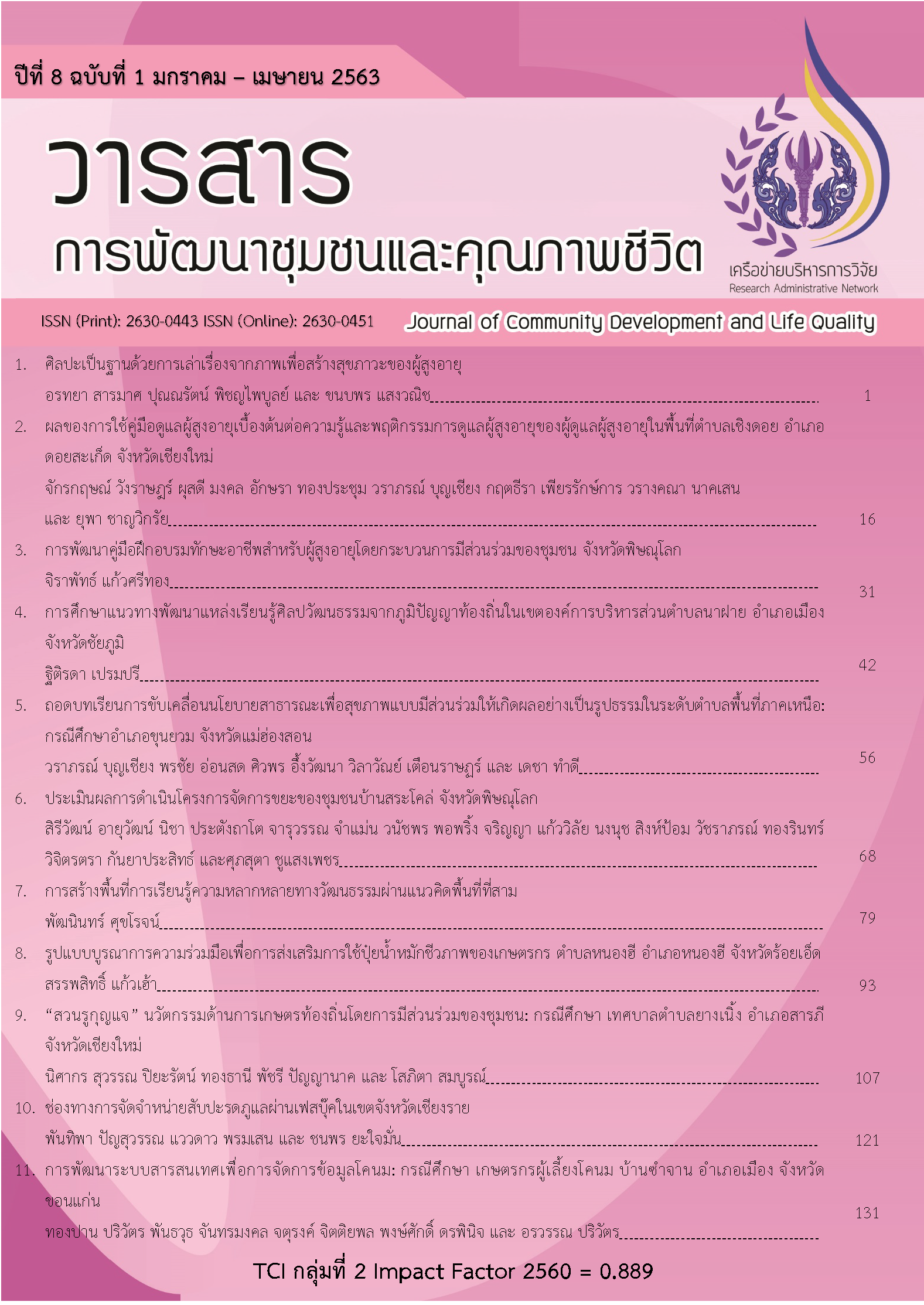
Main Article Content
Abstract
The objectives of this research were to develop the basic elderly care handbook through the community participation process and to study the effect of using the basic elderly care handbook on knowledge and behavior regarding elderly care among elderly caregivers. The first phase was the development of the basic elderly care handbook through the community participation process. Content validity was tested by experts to be 0.87 and the suitability of the developed handbook was at the highest level. The second phase was the study of the effect of using the developed handbook on knowledge and behavior regarding elderly care among elderly caregivers. The sample was elderly caregivers in Choeng Doi Subdistrict, Doi Saket District, Chiang Mai Province. There were two groups, namely the experimental group(n=45) and the control group (n=45). The sample was selected based on a purposive sampling. The research instruments consisted of 1) the questionnaire on general information of the respondents, 2) elderly care knowledge test with the consistency index of greater than 0.70, a reliability estimated by the Kuder–Richardson Formula of 0.74, and 3) elderly care behavior evaluation with the consistency index of greater than 0.70 and Cronbach's alpha coefficient of 0.87. The results showed that the experimental group had higher mean score of elderly care knowledge and behavior after using the handbook than before as reflected by dependent t-test. The experimental group had higher mean score of elderly care knowledge and behavior after using the handbook than the control group as reflected by independent t-test with a statistical significance level of <0.01. The findings could be concluded that the community participation process through mutual planning among local people and related parties and sectors to develop the basic elderly care handbook could provide useful information based on true needs and local lifestyle context of people, leading to the developed handbook with appropriate content covering important issues demanded by users and involving people and the enhancement of elderly care knowledge and behavior among elderly caregivers
Article Details
The Editorial Board claims a right to review and correct all articles submitted for publishing
