
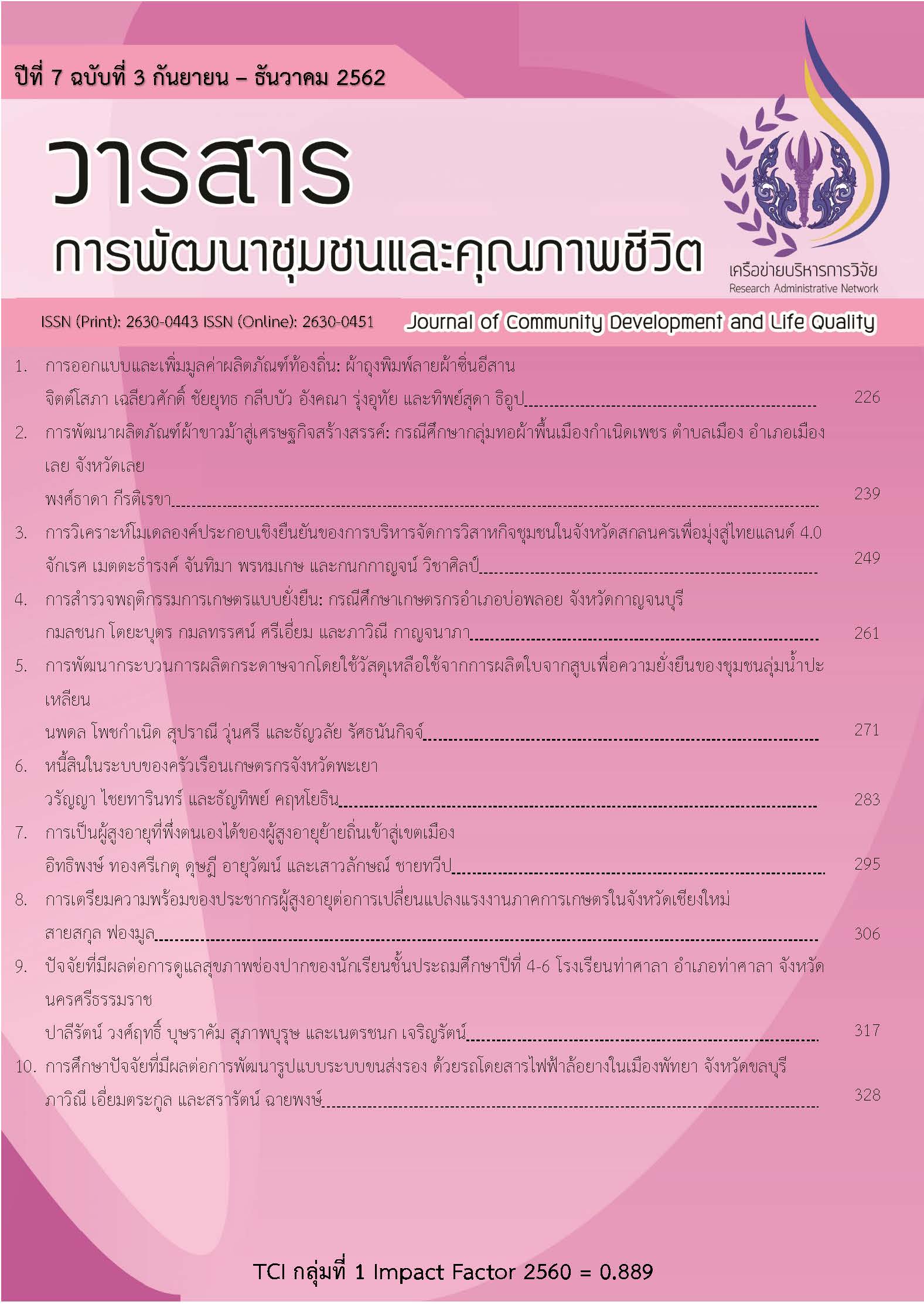
Analysis of A Confirmatory Factor Model of Community Enterprise Management in Sakon Nakhon Province to Thailand 4.0
Article Sidebar
Main Article Content
Abstract
This research aimed to study the community enterprise management model in Sakon Nakhon Province to Thailand 4.0. The research sampling was 400 entrepreneurs from 18 districts. The research tool was a questionnaire and used factor analysis to confirmatory factor and orthogonal rotation by a varimax method and used maximum likelihood to test value. The result of the test by KMO = 0.909. Bartlett’s Test of sphericity found that variables were a relationship to significance 0.000 presented the data are related. Therefore, can be used to factor analysis. The result of factor analysis has 6 component include 1) Innovation management 2) Evaluation management 3) Wisdom management 4) Stable management 5) Plan management and 6) Sufficiency economy management. There are analysis to structural base on a hypothesis that the result for studying the confirmatory factor analysis of Community enterprise management model in Sakon Nakhon Province to Thailand 4.0 that was confirmed to the empirical data at a good criterion. The goodness of fit indicated the good level which means the construct validity
Article Details
The Editorial Board claims a right to review and correct all articles submitted for publishing
References
Bebbington, A., Hinojosa, L., Bebbington, D. H., Burneo, M. L. and Warnaars, X. 2008. Contention and ambiguity: mining and the possibilities of development. Development & Change Journal 39(6): 887-914
Bollen, K. A. 1989. Structural equations with latent variables. New York: Wiley.
Brink, T. and S. O. Madsen. 2016. The triple helix frame for small – and medium-sized enterprises for innovation and development of offshore wind energy. Triple Helix 3(1): 1-23.
Bussi, M. and S. Khatiwada. 2017, April 11. Thailand 4.0 and the future of work. Bangkok Post. Retrieved from http://tinyurl.com/y86afunj
Chofreh, A. G., E. A. Goni. and J. J. Klemes. 2018. Sustainable enterprise resource planning systems implementation: A framework development. Journal of Cleaner Production 198: 1345-1354.
Costa, C. J., E. Ferreira, F. Bento. and M. Aparicio. 2016. Enterprise resource planning adoption and satisfaction determinants. Computers in Human Behavior 63: 659-671.
Cronbach, L. J. 1951. Coefficient alpha and the internal structure of tests. Psychometrika 16(3): 297-334.
Diamantopoulos, A. and A. D. Siguaw. 2000. Introducing LISREL: A guide for the uninitiated. Sage Publications, London.
Goni, F. A., A. G. Chofreh, S. Sahran, M. Mukhtar. and S. Abdul Shukor. 2013. Small to medium enterprises perspective in integrating business processes and functions. Journal of Applied Science and Agriculture 8(5): 474-489.
Hair, J. F., R. E. Anderson, R. L. Tatham. and W. C. Black. 1998. Multivariable data analysis (5th ed.) (pp. 103-108, p. 378). Upper Saddle River, NJ: Prentice-Hall.
Hair, J. F., R. E. Anderson, R. L. Tatham. and W. C. Black. 2010. Multivariate Data Analysis. Upper Saddle River, NJ: Pearson Prentice Hall.
Hosseini, M., J. Moore, M. Almaliki, A. Shahri, K. Phalp. and R. Ali. 2015. Wisdom of the crowd within enterprises: Practices and challenges. Computer Networks 90: 121-132.
Jaiswal. N. K. and K. B. Srivastava. 1976. Transfer of farm technology to small farmers: A study of organizational problems in India. Agricultural Administration 3(4): 249-262.
Jones, C. and Pimdee, P. 2017. Innovative ideas: Thailand 4.0 and fourth industrial revolution. Asian International Journal of Social Sciences 17(1): 4-35.
Kaewsuwan, V., K. Naressenie. and B. Sriharun. 2015. Strategies for community development based on the principle of sufficiency economy philosophy. VRU Research and Development Journal Humanities and Social Science 10(3): 285-294. (in Thai)
Kaplan, D. 2000. Structural equation modeling. Sage Publication, Thousand Oaks, California.
Klerkx, L., A. Noelle. and L. Cees. 2010. Adaptive management in agricultural innovation systems: The interactions between innovation networks and their environment. Agricultural Systems 103(6): 390-400.
Li, Y., S. Arora, j. Youtie. and P. Shapira. 2016. Using web mining to explore Triple Helix influences on growth in small and mid-size firms. Technovation. https://doi.org/10.1016/ j.technovation.2016.01.002.
Mettathamrong, J., C. Phromket. and C. Rattanaphunt. 2017. Factors of aggregation for occupations group development in Sakonnakhon of villagers 9(2): 141-158. (in Thai)
Mokeev, V. V., E. V. Bunova. and A. V. Perevedentceva. 2015. Analyzing the economic stability of an enterprise with the help of eigenstate method. Procedia Engineering 129: 681-689.
Office of the national economic and social development board. 2003. Annual report 2003 sustainable development: Economic and social development of the country: 2 years of change. Bangkok. (in Thai)
Office of the secretary of the board of community enterprise. 2005. The enterprises promotion act b.e. 2548 community. Bangkok: Department of agriculture. The ministry of agriculture and cooperatives. (in Thai)
Pandey, G. 2018. Challenges and future prospects of agri-nanotechnology for sustainable agriculture in India. Environment Technology & Innovation 11: 299-307.
Pensute, C. 2017. Thailand 4.0 economics and political contexts. Political Science and Public Administration Journal 8(1): 67-99. (in Thai)
Perciun, R., A. Stratan. and A. Timush. 2014. The methodology of financial stability assessment of republic of moldova through macroeconomic indicators. Procedia Economics and Finance. 383-392.
Pimki, T. and J. Ridsomboon. 2014. The practical use of the royal sufficiency economy with community enterprise in Chanthaburi Province. SDU Research Journal Humanities and Social Sciences 10(1): 1-22. (in Thai)
Rowley, J. 2006. What do we need to know about wisdom?. Management Decision 44(9): 1246-1257.
The Community Development Department. 2004. An analysis of the study on rural development in Thailand, One tambon one product process. Bangkok: The Community Development Department. (in Thai)
Tirakanant, S. 2007. Project evaluation to approach practical. 7th ed. Bangkok: Printing of Chulalongkorn university. (in Thai)
Yamane, T. 1973.Statistics: An Introductory Analysis.(3rd Ed). New York: Harper and Row Publications.
Yang, S. H. 2008. A Process view of wisdom. Journal of Adult Development 15: 62-75.
Yang, S. Y. 2011. Wisdom displayed through leadership: exploring leadership-related wisdom. Leadership Quarterly 22: 616-632.
