
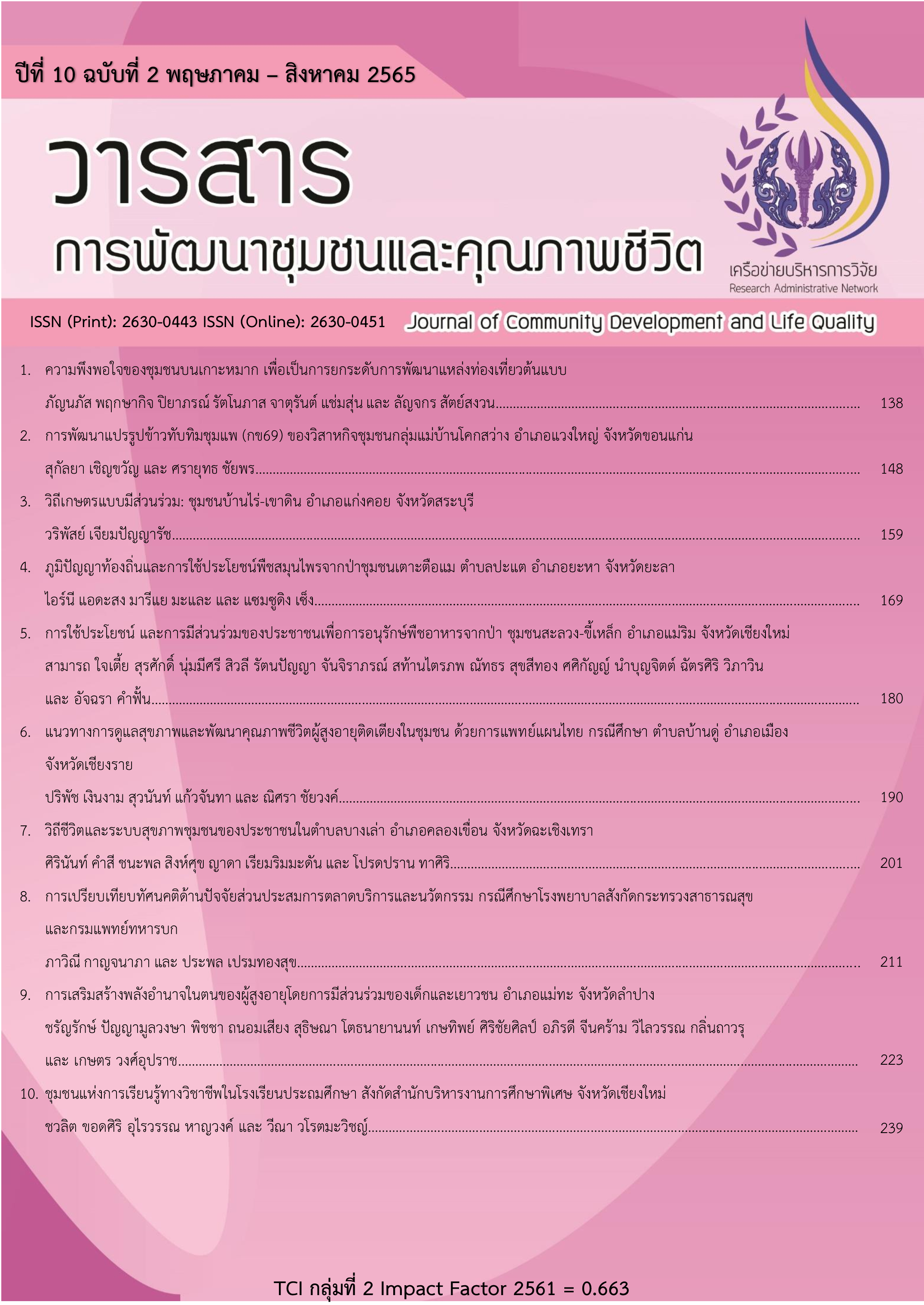
Professional Learning Communities in Primary School Under the Bureau of Special Education Administration, Chiang Mai Province
Keywords:
Professional learning communities, elementary education, special educationAbstract
The study aimed to develop the process of building a professional learning community in the target primary school and to provide the recommendations related to its difficulties and problems encountered. The 40 key informants were the teachers and administrators in the first semester of school year 2017-2018. The research instruments were questionnaires, interview, participant observation and group discussions. The results revealed that the target school had great success in five activities of building a professional learning community. In response to the problems encountered and the recommendations provided, implicit processes should be expedited; the continuous process of providing more knowledge and understandings of building professional learning community should be implemented in accordance with individual differences of the students. Furthermore, there should be a mutual exchange of ideas and opinions over the nature of each discipline and job analysis. This process should be integrated with all the activities in class and subjects byactive learning and emphasize its design based on specific contexts.
References
Chookamnerd, W., E. Sungtong and C. Kerdti. 2014. A model of a professional learning community of teachers toward 21st century learning of schools in Thailand. Hatyai Journal 12(2): 123-134. (in Thai)
Dufour, R.2007.Professional learning communities: A bandwagon, an idea worth considering, or our best hope for high levels of learning? Middle School Journal, 39(1): 4-8.
Kuriloff, P., W. Jordan and A. Ponnock. 2019. Teacher preparation and performance in high-needs urban schools: What matters to teacher.Teaching and Teacher Education, 83(1): 54-63.
Louis, K. S., H. M. Marks and K. Sharon. 1996. Teachers’ professional community in restructuring schools. American Educational Research Journal 33(1): 757-798.
Luyten H. and M. Bazo. 2019. Transformational leadership,professional learning communities, teacher learning and learner centred teaching practices; Evidence on their interrelations in Mozambican primary education. Studies in Educational Evaluation 60(1): 14-31.
Netasit, A., P. Seethong, S. Chanowan and K. Wilaiwan. 2017. Creating process to
develop teachers’ class management in establishing “moderate class more knowledge” learning activities of pilot school, Muang Parn district, Lampang
province.Journal of Community Development and Life Quality 6(2): 221-230. (in Thai)
Padwad, A. and K.K. Dixit. 2008. Impact of professional learning community participation on teachers' thinking about classroom problems. TESL-EJ 12(3): 1-11.
Saengpun, J. and T. Anchalee. 2018. Lesson study as an activity system for mathematics teacher’s professional development. Journal of Community Development and Life Quality 6(3): 665-674. (in Thai)
Theparee, P. and M. Patphol. 2014. A development of professional
learning community model for the primary school teachers. Silpakorn Educational Research Journal 6(2): 284-296. (in Thai)
Thitikunakorn, A. 2017. The priority needs to enhance a professional learning community of Kularbwittaya school. An Online Journal of Education: OJED 10(2): 562-575. (in Thai)
Triwaranyu, C. 2017. Development of professional learning community
through lesson study: An approach and guideline for success. Journal of Education Studies Chulalongkorn University 45(1): 299-319. (in Thai)
Vescio, V. and A. Adams. 2008. A review of research on the impact of professional learning communities on teaching practice and student learning. Teaching and Teacher Education 24(1): 80-91.
Yin, H. and X. Zheng. 2018. Facilitating professional learning communities in
China: Do leadership practices and faculty trust matter? Teaching and Teacher Education 76(1): 140–150.
Downloads
Published
How to Cite
Issue
Section
License
Copyright (c) 2022 Journal of Community Development and Life Quality

This work is licensed under a Creative Commons Attribution-NonCommercial-NoDerivatives 4.0 International License.
The Editorial Board claims a right to review and correct all articles submitted for publishing


