
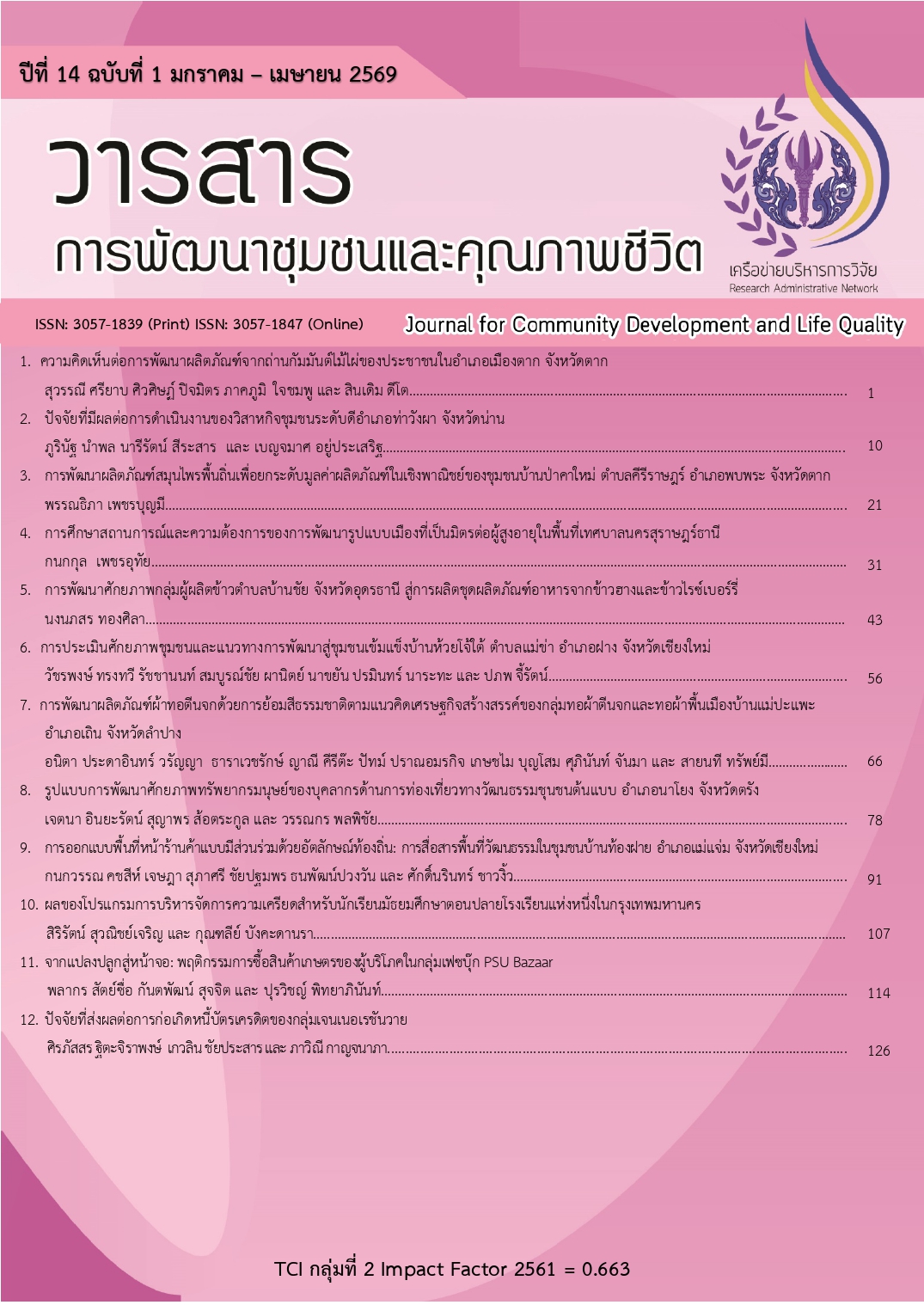
ปัจจัยที่ส่งผลต่อการก่อเกิดหนี้บัตรเครดิตของกลุ่มเจนเนอเรชันวาย
คำสำคัญ:
หนี้บัตรเครดิต , เจนเนอเรชันวาย , ทัศนคติด้านการออม , ค่านิยมการใช้จ่ายบทคัดย่อ
การวิจัยมีวัตถุประสงค์เพื่อศึกษา 1) อิทธิพลของทัศนคติด้านการออมที่ส่งผลต่อการก่อเกิดหนี้บัตรเครดิตของกลุ่มเจนเนอเรชันวาย 2) อิทธิพลของค่านิยมการใช้จ่ายที่ส่งผลต่อการก่อเกิดหนี้บัตรเครดิตของกลุ่มเจนเนอเรชันวาย และ 3) อิทธิพลของสถานการณ์ของการซื้อที่ส่งผลต่อการก่อเกิดหนี้บัตรเครดิตของกลุ่มเจนเนอเรชันวาย การวิจัยนี้เป็นเชิงปริมาณ กลุ่มตัวอย่างคือ ผู้ใช้บัตรเครดิตจำนวน 400 คน โดยใช้แบบสอบถามเป็นเครื่องมือในการเก็บรวบรวมข้อมูล สถิติที่ใช้ในการวิเคราะห์คือ ร้อยละ ค่าเฉลี่ย และการวิเคราะห์ความถดถอยเชิงเส้นแบบพหุคูณ ผลการศึกษาพบว่า ปัจจัยที่มีอิทธิพลต่อพฤติกรรมการก่อเกิดหนี้บัตรเครดิตของกลุ่มเจนเนอเรชันวาย ได้แก่ ปัจจัยค่านิยมของการใช้จ่ายด้านผลิตภัณฑ์และด้านการส่งเสริมการตลาด และปัจจัยด้านสถานการณ์ของการซื้อ โดยคาดหวังว่าผลวิจัยจะสามารถใช้ประโยชน์ในการกำหนดนโยบายการตลาดของบัตรเครดิตเพื่อลดโอกาสเกิดหนี้เสียและปัญหาภาระหนี้สินทั้งในระดับปัจเจกบุคคลและระดับครอบครัว
เอกสารอ้างอิง
An, T. L., S. Ramasamy and Y. Y. Yuen. 2024. The factors affecting consumer’s perception about credit cards usage: A study in Melaka, Malaysia. Environment and Social Psychology 9(2): 2030, doi:10.54517/esp.v9i2.2030.
Bank of Thailand. 2024. Adjusting relief measures for debtors. (Online). Available: https://www.bot.or.th/th/
news-and-media/news/news-20240802.html?utm_source=chatgpt.com (April 14, 2024). (in Thai)
Bank of Thailand. 2025. Provision of credit card services by card type. (Online). Available: https://app.bot.or.th/BTWS_STAT/
statistics/BOTWEBSTAT.aspx?language=TH&reportID=757 (April 14, 2025). (in Thai)
Chaiyatoum, J. 2021. Legal measures for credit card users. Journal of Social Science for Local Rajabhat Development Mahasarakham University 5(1): 203-210. (in Thai)
Chitranapawong, K. and S. Chirapanda. 2025. The impact of consumer attitudes, subjective norms, brand trust, repurchase intention and repurchase behaviors of Gen X and Gen Y consumers: A study of life insurance in Thailand. Journal of Posthumanism 5(2): 502-531.
Cochran, W. G. 1953. Sampling techniques. John Wiley & Sons, Inc., New York. 330 p.
Gawior, B., M. Polasik and J. L. del Olmo. 2022. Credit card use, hedonic motivations, and impulse buying behavior in fast fashion physical stores during COVID-19: The sustainability paradox. Sustainability 14(7): 4133, doi.org/10.3390/su14074133.
George, D. and P. Mallery. 2003. SPSS for Windows step by step: A simple guide and reference. Allyn & Bacon, Boston. 386 p.
Gunarathna, M. S. U. and M. S. H. Rathnasiri. 2024. Determinants of credit card debt behaviour among generation Y consumers in Sri Lanka. P.14. In: Proceedings of the 5th Management Undergraduates’ Research Session (MURS 2023). Belihuloya, Sri Lanka.
Guttman-Kenney, B., C. Firth and J. Gathergood. 2023. Buy now, pay later (BNPL) on your credit card. Journal of Behavioral and Experimental Finance 37: 100788, doi.org/10.1016/j.jbef.2023.100788.
Hiranphaet, A. 2023. Consumer purchasing behavior of pomelo through social media across generations: A case study of ABC facebook fanpage. Journal of Community Development and Life Quality 11(3): 215-223.
Huang, C. M., S. Chuang, Y. Cheng and J. Hou. 2025. Payment forms linked to consumer preferences for promotional offers: Mediating and moderating factors. International Journal of Bank Marketing 43(8): 1662-1683.
Kumar, M. D. 2024. A comparative study on debit and credit card transactions for point of sale (PoS) in India. International Journal on Global Business Management and Research 13(1-2): 36-44.
Lee, J. M. and Y. G. Lee. 2021. Multidimensional credit attitude and credit card debt behavior in the United States. Review of Behavioral Finance 14(2): 183-196.
Megat, P. A., T. Marimuthu, A. Ateik, A. Aljounaidi, W. G. Melhem and Liswandi. 2024. Examining the contributory factors influencing credit card debt among consumers in Malaysia. Journal of Hunan University (Natural Sciences) 51(10): 108-121.
Minibas-Poussard, J., H. B. Bingol and C. Roland-Levy. 2018. Behavioral control or income? An analysis of saving attitudes and behavior, credit card use and buying on installment. European Review of Applied Psychology 68(6): 205-214.
Money and Banking Online. 2023. Economic: Starting January 2024, the minimum payment for credit cards will be raised to 8%. Card issuers are gearing up to adapt and advise customers unable to afford to seek debt restructuring. Available: https://moneyand
banking.co.th/2023/82328/?utm_source=chatgpt.com (April 14, 2025). (in Thai)
Owusu, G. M. Y., T. O. Kwakye and H. Duah. 2024. The propensity towards indebtedness and savings behaviour of undergraduate students: the moderating role of financial literacy. Journal of Applied Research in Higher Education 16(2): 583-596.
Pamungkas, A. S., D. E. Herwindiati and M. I. Taba. 2025. Saving behavior of the millennial generation in Jakarta. International Journal of Application on Economics and Business (IJAEB) 3(1): 2987-1972, doi.org/10.24912/ijaeb.v3i1.1-7.
Rai, S., and P. Narwal. 2025. Behavioral insights into sustainable food consumption: A perspective from self-determination theory, theory of reasoned action, and environmental engagement. Journal of Environmental Management 380: 125077, doi: 10.1016/j.jenvman.2025.125077.
Schomburgk, L., A. Belli and A. O. I. Hoffmann. 2024. Less cash, more splash? A meta-analysis on the cashless effect. Journal of Retailing 100(3): 382-403.
Zainudin, R., N. S. Mahdzan and M. Yeap. 2019. Determinants of credit card misuse among Gen Y consumers in urban Malaysia. International Journal of Bank Marketing 37(5): 1350-1370.
ดาวน์โหลด
เผยแพร่แล้ว
รูปแบบการอ้างอิง
ฉบับ
ประเภทบทความ
สัญญาอนุญาต
ลิขสิทธิ์ (c) 2025 วารสารการพัฒนาชุมชนและคุณภาพชีวิต

อนุญาตภายใต้เงื่อนไข Creative Commons Attribution-NonCommercial-NoDerivatives 4.0 International License.
กองบรรณาธิการขอสงวนสิทธิ์ในการตรวจและแก้ไขบทความที่เสนอเพื่อตีพิมพ์ในวารสารการพัฒนาชุมชนและคุณภาพชีวิต
บทความหรือข้อความคิดเห็นใด ๆ ที่ปรากฏในวารสารการพัฒนาชุมชนและคุณภาพชีวิต เป็นวรรณกรรมของผู้เขียนโดยเฉพาะคณะผู้จัดทำไม่จำเป็นต้องเห็นด้วย และไม่ใช่ความรับผิดชอบของมหาวิทยาลัยและคณะผู้จัดทำ / บรรณาธิการ


