
Evaluatingthe Effectiveness ofthe Planets Approximating of Rising and setting Time(PARST) Educational Tool
Article Sidebar
Main Article Content
Abstract
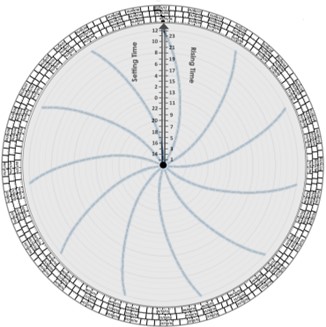
The Planets Approximating of Rising and Setting Time (PARST) educational tool was designedas a hands-on activitytoillustrate planets’rising and setting times over long periods,considering the repeating patterns of these events. It was anticipatedto enhance students’ learning experience about planetary motion. This research aimed to evaluate PARST’s learning effectiveness across three student groups in the classroom; these groups are (1) a group using only PARST, (2) a group taught about planetarymotion without using PARST, and (3) a group taught about the planet motion and using PARST. The pre-test and post-test, with questions designed based on the elements of Bloom’s taxonomy, were used to evaluate the three student groups. The four methods for evaluating pre-test and post-test results are (a) hypothesis testing, (b) effective size, (c) normalized gain, and (d) difficulty level. The four evaluation methods show the same pattern of the highest efficiency in the group of students who use the PARST educational toolonly without taking lectures about planetary motion. These results imply that using the PARST educational tool without studying the rising and setting times of planets can encourage students to develop an understanding of planetary motion.
Article Details

This work is licensed under a Creative Commons Attribution-NonCommercial-NoDerivatives 4.0 International License.
References
Abdulwahed, M., & Nagy, Z. (2009). Applying Kolb's Experiential Learning Cycle for Laboratory Education. Journal of Engineering Education, 98.
Bakas, C., & Mikropoulos, T. (2003). Design of virtual environments for the comprehension of planetary phenomena based on students' ideas. International Journal of Science Education, 25, 949 - 967.
Bardar, E. M. (2007). First results from the light and spectroscopy concept. Astronomy Education Review, 6(2), 75-84.
Barnett, M. L., & Mathisen, A. (1997). Tyranny of the p-value: the conflict between statistical significance and common sense. Journal of dental research, 76(1), 534–536.
Bloom, B. S. (1956). Taxonomy of educational objectives. Longman green and co LTD, England.
Boopathiraj, C., & Chellamani, D.K. (2013). Analysis of test items on difficulty level and discrimination index in the test for research in education. International Journal of Social Sciences & Interdisciplinary Research, 2, 189-193.
Coe, R. (2012). It's the Effect Size, Stupid What effect size is and why it is important. Paper Presented at the British Educational Research Association Annual Conference, Exeter, England, UK. 2002
Cohen, A. (2022). Teaching the astronomical visualization used for the explanation of the ancient Ein-Gedi archaeological zodiac and its related inscription. Journal of Astronomy & Earth Sciences Education, 9(2), 25–38.
Cohen, J. (1988). Statistical power analysis for the behavioral sciences. Lawrence Erlbaum Associate, New York.
Galano, S., Colantonio, A., Leccia, S., Marzoli, I., Puddu, E., & Testa, I. (2018). Developing the use of visual representations to explain basic astronomy phenomena. Physical Review Physics Education Research, 14(1), 010145
Hake, R. R. (1998). Interactive-engagement vs traditional methods: A six-thousand student survey of mechanics test data for introductory physics courses. American Journal of Physics, 66(1), 64-74.
Karaksha, A., Grant, G.D., Nirthanan, S., Davey, A.K., & Anoopkumar‐Dukie, S. (2014). A Comparative Study to Evaluate the Educational Impact of E-Learning Tools on Griffith University Pharmacy Students’ Level of Understanding Using Bloom’s and SOLO Taxonomies. Education Research International, 2014 (2014): 934854-1-934854-11.
Laphirattanakul, A., Wannawichian, S. & Wattanakasiwich, P. (2024). PARST educational tool for planet positioning. The Physics Teacher, 62(4), 272-277.
Nakagawa, S., & Cuthill, I. C. (2007). Effect size, confidence interval and statistical significance: a practical guide for biologists. Biological reviews of the Cambridge Philosophical Society, 82(4), 591–605.
Neyman, J. & Pearson, E. S. (1933). On the problem of the most efficient tests of statistical hypotheses. Springer Series in Statistics. Springer, New York, NY.
Ole, F. C. B. (2020). Effect of a developed physics laboratory manual on the conceptual understanding of industrial technology student. European Journal of Education Studies, 7(6), 113-122.
Peralta, J., Prieto, J. A., Orozco-Sáenz, P., González, J., Trujillo, G., Torres, L., Sánchez, A. & Arnedo, M. (2023). Secondary school students observe Venus with NASA Infrared Telescope Facility (IRTF), Research Notes of the AAS, 7(3), 53-57.
Plummer, J.D. (2014). Spatial thinking as the dimension of progress in an astronomy learning progression. Studies in Science Education. 50(1), 1-45.
Rakap, S. (2015). Effect sizes as result interpretation aids in single-subject experimental research: description and application of four non overlap method. British Journal of Special Education, 42(1), 11-33.
Ruangsuwan, C. & Arayathanitkul, K. (2009). A low-cost celestial globe for hands-on astronomy. Physics Educucation, 44(5), 503-508.
Seidel, T., & Shavelson, R. J. (2007). Teaching effectiveness research in the past decade: The role of theory and research design in disentangling meta-analysis results. Review of educational research, 77(4), 454-499
Srisawasdi, N. (2018). Transforming chemistry class with technology-enhanced active inquiry learning for the digital native generation. In C. Cox & W. Schatzberg (Eds.) International Perspectives on Chemistry Education Research and Practice (pp. 221–233). ACS Symposium Series 1142, American Chemical Society: Washington, DC.
Stover, S., & Saunders, G. (2000). Astronomical misconceptions and the effectiveness of science museums in promoting conceptual change. Journal of Elementary Science Education, 12, 41-51.
Sullivan, G. M. & Feinn, R. (2012). Using Effect Size-or Why the P Value Is Not Enough. Journal of Graduate Medical Education, 4(3), 279-282.
Woods, M. & Rosenberg, M. E. (2016). Educational tools: Thinking outside the box. Clinical Journal of the American Society of Nephrology, 11(3), 518-526.
Xu, M., Fralick, D., Zheng, J. Z., Wang, B., Tu, X. M. & Feng, C. (2017) The Differences and Similarities Between Two-Sample T-Test and Paired T-Test. Shanghai Arch Psychiatry, 29(3), 184-188.
