
The Growth Mindset Development Model of school administrators under the Office of Secondary Educational Service Area Khon Kaen
Article Sidebar
Main Article Content
Abstract
The objectives of this research were to: 1) study the components and indicators of the Growth Mindset of school administrators; 2) examine the consistency of the Growth Mindset component model of school administrators with empirical data; 3) develop and evaluate the growth mindset development model of school administrators with a focus on its appropriateness, feasibility, and utility.". This research used a mixed-methods approach, divided into two stages. The first stage was quantitative research. The sample group consisted of 260 participants, including school administrators and teachers. The research tool was a 5-level rating scaled questionnaire with a Cronbach's alpha coefficient value of 0.7 and the reliability was equivalent to 0.970 . The second stage was qualitative research. By establishing a growth mindset development model. The statistics used were confirmatory component analysis. 3) the results were as follows.
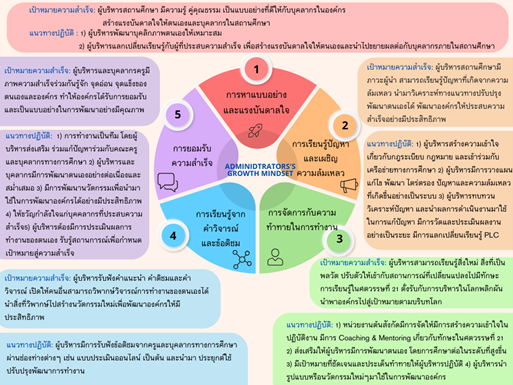
1) "The Growth Mindset framework for school administrators comprises five key components with a total of thirteen indicators: (1) Managing Work Challenges, including three indicators; (2) Seeking Role Models and Inspiration, with three indicators; (3) Acknowledging Success, encompassing three indicators; (4) Learning from Problems and Facing Failure, consisting of two indicators; and (5) Learning from Criticism and Feedback, which includes two indicators."
2) The model for measuring growth mindset components under the Office of Secondary Educational Service Area Khon Kaen was statistically congruent with the empirical data: X2= 24.313, df = 19, / df = 1.279, P-Value = 0.184, RMSEA = 0.033, SRMR = 0.023, CFI = 0.998, TLI = 0.991
3) The growth mindset of school administrators included model names, principles, goals, and guidelines. The results of suitability and usefulness were at the highest level, while possibility at a high level.
Article Details

This work is licensed under a Creative Commons Attribution-NonCommercial-NoDerivatives 4.0 International License.
References
ชนิตา รุ่งเรือง และ เสรี ชัดแช้ม. (2559). กรอบความคิดเติบโต: แนวทางใหม่แห่งการพัฒนาศักยภาพมนุษย์. วารสารวิทยาการ วิจัยและวิทยาการปัญญา , 14(1), 1-13.
นันท์นภัส ลิ้มสันติธรรม (2561). การพัฒนารูปแบบการจัดการเรียนรู้ STEMGM เพื่อส่งเสริมกรอบแนวคิดเติบโต และความสามารถในการแก้ปัญหา สำหรับนักเรียนชัชั้นมัธยมศึกษาตอนต้น. ปริญญาการศึกษาดุษฎีบัณฑิต มหาวิทยาลัย ศรีนครินทรวิโรฒ
นิทัสน์ มาสาลี, วัลลภา อารีรัตน์, เสาวนี สิริสุขศิลป์ (2565). แนวทางการพัฒนากรอบความคิดเติบโตของผู้บริหารสถานศึกษา. วารสารวิทยาลัยบัณฑิตเอเซีย, 12(3),199-203.
ประกฤติยา ทักษิโณ. (2559). เอกสารประกอบการอบรม เรื่อง การวิเคราะห์ข้อมูลด้วย LISREL และ MPLUS: ความรู้พื้นฐานก่อนการวิเคราะห์. ขอนแก่น: มหาวิทยาลัยขอนแก่น.
รัตนะ บัวสนธ์. (2556). วิจัยเชิงคุณภาพการศึกษา. พิมพ์ครั้งที่ 4. กรุงเทพฯ: สำนักพิมพ์แห่งจุฬาลงกรณ์มหาวิทยาลัย.
วีระยุทธ แสนพินิจ (2562). รูปแบบการพัฒนากรอบความคิดเติบโตของผู้บริหารโรงเรียนมัธยมศึกษา : การวิจัยผสมผสานวิธี. วิทยานิพนธ์ปริญญาศึกษาศาสตรมหาบัณฑิต มหาวิทยาลัยขอนแก่น.
ศรัญญู พงศ์ประเสริฐสิน และคณะ (2565). การวิเคราะห์องค์ประกอบเชิงยืนยันของชุดความคิดแบบเติบโต สำหรับนักศึกษา วิชาชีพครู. Journal of Social Science and Buddhistic Anthropology, 7(3),162-175.
สำนักงานเขตพื้นที่การศึกษามัธยมศึกษาขอนแก่น. (2564). ข้อมูลสารสนเทศทางการศึกษาประจำปีการศึกษา 2564. [ม.ป.ป.]: ขอนแก่น.
สำนักงานคณะกรรมการข้าราชการพลเรือน. (2563). แนวทางการพัฒนาบุคลากรภาครัฐ พ.ศ. 2563 - 2565. จาก https://www.ocsc.go.th/civilservice
อรพิน โคตรวิทย์ และคณะ (2563). ความต้องการจําเป็นในการพัฒนากรอบความคิดแบบเติบโตของครูในโรงเรียนสังกัด สำนักงานเขตพื้นที่การศึกษาประถมศึกษาอุดรธานี เขต 3. วารสารบริหารการศึกษามหาวิทยาลัยขอนแก่น, 16(2), 141-153.
Best, J., & Kahn, J. V. (1993). Research in education (7th ed.). Boston: Allyn and Bacon.
Dweck, C.S. (2006a). Mindset: The new psychology of success. New York: Random House.
Keeves, J.P. (1988). Model and Model building. Oxford: Pergamon Press.
