
Lesson Learned from Pre-Service Science Teachers’ Views about Pedagogy Content Knowledge for Teaching Argumentation
Article Sidebar
Main Article Content
Abstract
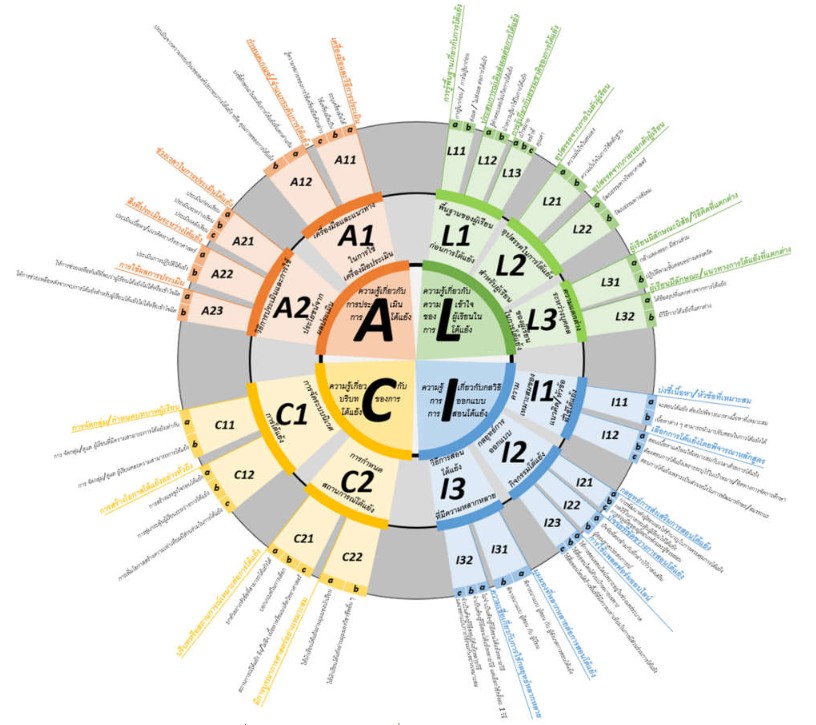
The Views of Pre-service science teachers played a crucial role to connect their understandings, beliefs, and practice on teaching argumentation as an aim of the science and engineering practice (SEPs) course. Beyond with to determine the strategies to support them to create and instruct the learning activity focusing critiquing practice in science or integrated disciplinaries classroom. This survey research had the objective to investigate 5 PST’s views about pedagogy content knowledge for teaching argumentation practice (PCK-AP) after their micro-teaching focusing to enhance learner’s argumentation practice in SEPs course from the university in Bangkok, Thailand. They were interviewed via semi-structured that consisted of the question and probing-question to cover four knowledge about learners; instructions; context; and assessment of teaching argumentation practice. The data then were analyzed by content analysis. The results have highlighted the diversity in teaching argumentation, that defined the diversity of thoughts from an argumentation issue, the diversity of distinguished learners, the diverse styles of learner’s argumentations, the diversity of argumentation teaching strategies, and the diversity of individual learner’s conclusion. While their views about argumentation context showed that they could construct their own features to determine or justify the context of argumentation with the captured moment, the different perspectives, and the frame of viewing. The lesson learned from PST’s views allows them to define or construct the feature of teaching argumentation or other practices that reflect how to achieve the teaching purpose(s). Furthermore, the framework PCK-AP in this study could be elaborated or extended to the other SEPs with determining the strategies or designing the programs to develop PST’s quality to teach argumentation practice with/or other SEPs effective in the next study.
Article Details

This work is licensed under a Creative Commons Attribution-NonCommercial-NoDerivatives 4.0 International License.
References
Baxter, P. & Jack, S. (2008). Qualitative case study methodology: Study design and implementation for novice researchers. The Qualitative Report, 13(4), 544–559.
Bernard, H., & Ryan, G. (2010). Analyzing qualitative data: Systematic approaches. Sage Publications.
Berland, L. & Reiser, B. (2009). Making sense of argumentation and explanation. Science Education, 93(1), 26-55.
Bogar, Y. (2019). Synthesis Study on Argumentation in Science Education. International Education Studies. 12(1).
Bybee, R. W. (2014). The Case for STEM Education: Challenges and Opportunities. NSTA Press.
Chen, Y.-C., & Terada, T. (2021). Development and validation of an observation-based protocol to measure the eight scientific practices of the next generation science standards in K-12 science classrooms. Journal of Research in Science Teaching, 58(10), 1–38.
Choi, A., Seung, E. & Kim, D. (2021). Science Teachers’ Views of Argument in Scientific Inquiry and Argument-Based Science Instruction. Research in Science Education, 51, 251–268.
Christian, K. B., Kelly, A. M. & Bugallo, M.F. (2021). NGSS-based teacher professional development to implement engineering practices in STEM instruction. International Journal of STEM Education, 8(21).
Cunningham, C. M., & Kelly, G. J. (2017). Epistemic practices of engineering for education. Science Education, 101(3), 486-505.
English, L. D. (2016). STEM education K-12: perspectives on integration. International Journal of STEM Education, 3(1), 3.
Gess-Newsome, J. (2015). A model of teacher professional knowledge and skill including PCK: Results of the thinking from the PCK summit. In A. Berry, P. Friedrichsen, and J. Loughran. (eds.) Re-examining Pedagogical Content Knowledge in Science Education. New York: Routledge, 38–52.
Hanuscin, D. L., M. H. Lee, and V. L. Akerson. (2011). Elementary teachers' pedagogical content knowledge for teaching the nature of science. Science Education. 95 (1): 145–167.
Honey, M., Pearson, G., and Schweingruber, H. (2014). STEM Integration in K-12 Education: Status, Prospects, and an Agenda for Research. Washington, DC: National Academies.
Kang, E. J. S., McCarthy, M. J. & Donovan, C. (2019). Elementary Teachers’ Enactment of the NGSS Science and Engineering Practices. Journal of Science Teacher Education, 30(7), 788-814.
Kelly G. J., Licona P. (2018). Epistemic Practices and Science Education. History, Philosophy and Science Teaching. Science: Philosophy, History and Education.
Kelley, T. R., & Knowles, J. G. (2016). A conceptual framework for integrated STEM education. International Journal of STEM Education, 3(1), 11.
Kite, V., Park, S., McCance, K., & Seung, E. (2020). Secondary science teachers' understandings of the epistemic nature of science practices. Journal of Science Teacher Education, 32(3), 243–264.
Konstantinidou, A., & Macagno, F. (2012). Understanding Students’ Reasoning: Argumentation Schemes as an Interpretation Method in Science Education. Science & Education, 22(5), 1069-1087.
McNeill K. L. & Knight, A. M. (2013). Teachers’ Pedagogical Content Knowledge of Scientific Argumentation: The Impact of Professional Development on K–12 Teachers. Science Education, 97(6), 936-972.
McNeill, K. L., Howard, M. G., Katsh-Singer, R. & Loper, S. (2015). Pedagogical content knowledge of argumentation: Using classroom contexts to assess high‐quality PCK rather than
McNeill, K. L., Lowenhaupt, R.J., & Katsh-Singer, R. (2017), Instructional leadership in the era of the NGSS: Principals' understandings of science practices. Science Education, 102(3), 452-473.
NGSS Lead States (2013). Next Generation Science Standards: For States, by States. Washington DC: The National Academies Press.
Osborne, J. F. & Patterson, A. (2010). Scientific Argument and Explanation: A Necessary Distinction? Science Education, 95(4), 627–638.
Patton, M. Q. (2015). Qualitative Research and Evaluation Methods: Integrating Theory and Practice (4th ed). California: Sage.
Sampson, V., Grooms, J. & Walker, J. P. (2011). Argument-Driven Inquiry as a Way to Help Students Learn How to Participate in Scientific Argumentation and Craft Written Arguments: An Exploratory Study. Science Education, 95(2), 217-257.
Sun, Y. & Strobel, J. (2014). From Knowing-About To Knowing-To: Development Of Engineering Pedagogical Content Knowledge By Elementary Teachers Through Perceived Learning And Implementing Difficulties. American Journal of Engineering Education, 5(1). 41-60.
Sengul, O., Enderle, P. J. & Schwartz, R. S., (2020). Science teachers’ use of argumentation instructional model: linking PCK of argumentation, epistemological beliefs, and practice. International Journal of Science Education, 42(7), 1068-1086
Shulman, L. S. (1986). Those who understand: Knowledge growth in teaching. Educational Researcher, 15(2), 4–14.
