
The Development of Grade 12 Students’ Representational Competence in Electrochemical Cell through Model-Based Learning
Article Sidebar
Main Article Content
Abstract
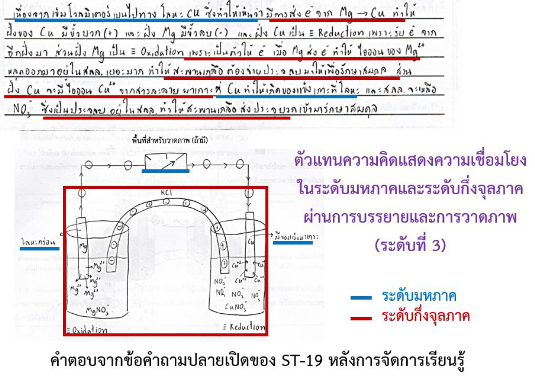
Representational competence is one of the core competences which focuses on students as generators who choose from a variety of multiple representations to analyze, interpret, reflect, and criticize their own ideas. The objective of this qualitative research was to investigate the development of students' representational competence in electrochemical cell through model-based learning. The participants were 23 grade 12 students. Data were collected through representational competence questionnaire. The data were analyzed qualitatively using content analysis and an inductive analysis approach. The results indicated that 1) after model-based learning, students could shift levels of representational competence on the electrochemical cell representation to sub-microscopic level (level 2) and linking macroscopic and sub-microscopic level (level 3). However, the study showed that students were unable to reflect on and analyze the meaning of the features of their own representation. Moreover, some students could not shift their representational competence. After model-based learning, students could employ various modes of external representations to demonstrate the phenomena in the abstract levels in chemical understanding. The student's representation was related to concepts about electrochemical cells.
Article Details
References
ชาตรี ฝ่ายคำตา. (2563). กลยุทธ์การจัดการเรียนรู้เคมี. กรุงเทพฯ: จุฬาลงกรณ์มหาวิทยาลัย.
พนิดา กระทุ่มนอก และร่มเกล้า จันทราษี. (2562). ความสามารถในการสร้างตัวแทนความคิด เรื่อง เซลล์กัลวานิก ของนักเรียนชั้นมัธยมศึกษาปีที่ 5 ที่เรียนรู้ด้วยการสร้างแบบจำลอง. วารสารวิจัยมหาวิทยาลัยขอนแก่น (ฉบับบัณฑิตศึกษา) สาขามนุษยศาสตร์และสังคมศาสตร์. 7(2), 36-47.
อภิวัฒน์ ศรีกันหา และปัฐมาภรณ์ พิมพ์ทอง. (2558). การศึกษามโนมติและตัวแทนความคิด เรื่อง การเกิดพันธะไอออนิก ของนักเรียนระดับชั้นมัธยมศึกษาปีที่ 4 โดยการสอนเพื่อเปลี่ยนแปลงมโนมติ. วารสารศึกษาศาสตร์ ฉบับวิจัยบัณฑิตศึกษา มหาวิทยาลัยขอนแก่น, 9(3), 213-221.
Aubusson, P. J., Harrison, A. G., & Ritchie, S. M. (2006). Metaphor and Analogy. In Metaphor and Analogy in Science Education (pp. 1-9). Springer, Dordrecht.
Briggs, M., & Bodner, G. (2005). A Model of Molecular Visualization. In Visualization in Science Education (pp. 61-72). Springer, Dordrecht.
Dolphin, G., & Benoit, W. (2016). Students’ Mental Model Development During Historically Contextualized Inquiry: How the ‘Tectonic Plate’Metaphor Impeded the Process. International Journal of Science Education, 38(2), 276-297.
Gkitzia, V., Salta, K., & Tzougraki, C. (2020). Students’ Competence in Translating Between Different Types of Chemical Representations. Chemistry Education Research and Practice, 21(1), 307-330.
Gilbert, J. K. (2005). Visualization: A Metacognitive Skill in Science and Science Education. In Visualization in Science Education (pp. 9-27). Springer, Dordrecht.
Gilbert, J. K., & Justi, R. (2016). Learning Scientific Concepts From Modelling-Based Teaching. In Modelling-Based Teaching in Science Education (pp. 81-95). Springer, Cham.
Gilbert, J. K., & Treagust, D. F. (2009). Introduction: Macro, Submicro and Symbolic Representations and the Relationship Between Them: Key Models in Chemical Education. In Multiple Representations in Chemical Education (pp. 1-8). Springer, Dordrecht.
Hand, B., Gunel, M., & Ulu, C. (2009). Sequencing Embedded Multimodal Representations in a Writing to Learn Approach to the Teaching of Electricity. Journal of Research in Science Teaching: The Official Journal of the National Association for Research in Science Teaching, 46(3), 225-247
Hilton, A., & Nichols, K. (2011). Representational Classroom Practices That Contribute to Students’ Conceptual and Representational Understanding of Chemical Bonding. International Journal of Science Education, 33(16), 2215-2246.
Ibrahim, B., & Rebello, N. S. (2013). Role of Mental Representations in Problem Solving: Students’ Approaches to Nondirected Tasks, Physical Review Special Topics - Physics Education Research, 9(2), 1–16.
Johnstone, A. H. (2006). Chemical Education Research in Glasgow in Perspective. Chemistry Education Research and Practice, 7(2), 49-63.
Kemmis, S., & McTaggart, R. (2005). Participatory Action Research: Communicative Action and the Public Sphere. In N. K. Denzin & Y. S. Lincoln (Eds.), The Sage Handbook of Qualitative Research (pp. 559- 604). Thousand Oaks: SAGE Publications Ltd.
Kozma, R. (2003). The Material Features of Multiple Representations and Their Cognitive and Social Affordances for Science Understanding. Learning and Instruction, 13(2), 205-226.
Kozma, R., & Russell, J. (2005). Students Becoming Chemists: Developing Representational Competence. In Visualization in Science Education (pp. 121-145). Springer, Dordrecht.
Krell, M., Walzer, C., Hergert, S., & Kr€uger, D. (2017). Development and Application of a Category System to Describe Pre-service Science Teachers’ Activities in the Process of Scientific Modelling. Research in Science Education, 333, 1096–1123
Minkley, N., Kärner, T., Jojart, A., Nobbe, L., & Krell, M. (2018). Students' mental load, stress, and performance when working with symbolic or symbolic–textual molecular representations. Journal of Research in Science Teaching, 55(8), 1162-1187.
Moore, T. J., Miller, R. L., Lesh, R. A., Stohlmann, M. S., & Kim, Y. R. (2013). Modeling in Engineering: The Role of Representational Fluency in Students’ Conceptual Understanding. Journal of Engineering Education, 102(1), 141-178.
Pande, P., & Chandrasekharan, S. (2017). Representational Competence: Towards a Distributed and Embodied Cognition Account. Studies in Science Education, 53(1), 1-43.
Padalkar, S., & Hegarty, M. (2015). Models as Feedback: Developing Representational Competence in Chemistry. Journal of Educational Psychology, 107(2), 451.
Prain, V., Tytler, R., & Peterson, S. (2009). Multiple Representation in Learning About Evaporation. International Journal of Science Education, 31(6), 787-808.
Sanger, M. J., & Greenbowe, T. J. (1997). Common Student Misconceptions in Electrochemistry: Galvanic, Electrolytic, and Concentration Cells. Journal of Research in Science Teaching: The Official Journal of the National Association for Research in Science Teaching, 34(4), 377-398.
Seel, N. M. (2014). Model-Based Learning and Performance. In Handbook of Research on Educational Communications and Technology (pp. 465-484). Springer, New York, NY.
Stieff, M., Hegarty, M., & Deslongchamps, G. (2011). Identifying Representational Competence with Multi- Representational Displays. Cognition and Instruction, 29(1), 123-145.
Supasorn, S. (2015). Grade 12 Students' Conceptual Understanding And Mental Models of Galvanic Cells Before and After Learning by Using Small-Scale Experiments In Conjunction With a Model Kit. Chemistry Education Research and Practice, 16(2), 393-407.
Tien, L. T., & Osman, K. (2017). Misconceptions in Electrochemistry: How Do Pedagogical Agents Help?. In Overcoming Students' Misconceptions in Science (pp. 91-110). Springer, Singapore.
Wu, H. K., Krajcik, J. S., & Soloway, E. (2001). Promoting Understanding of Chemical Representations: Students’ Use of a Visualization Tool in the Classroom. Journal of Research in Science Teaching: The Official Journal of the National Association for Research in Science Teaching, 38(7), 821-842.
