
Infusion Approach with STEM Problem-based Learning for Enhancing Critical Thinking in Acid-Base Topic
Article Sidebar
Main Article Content
Abstract
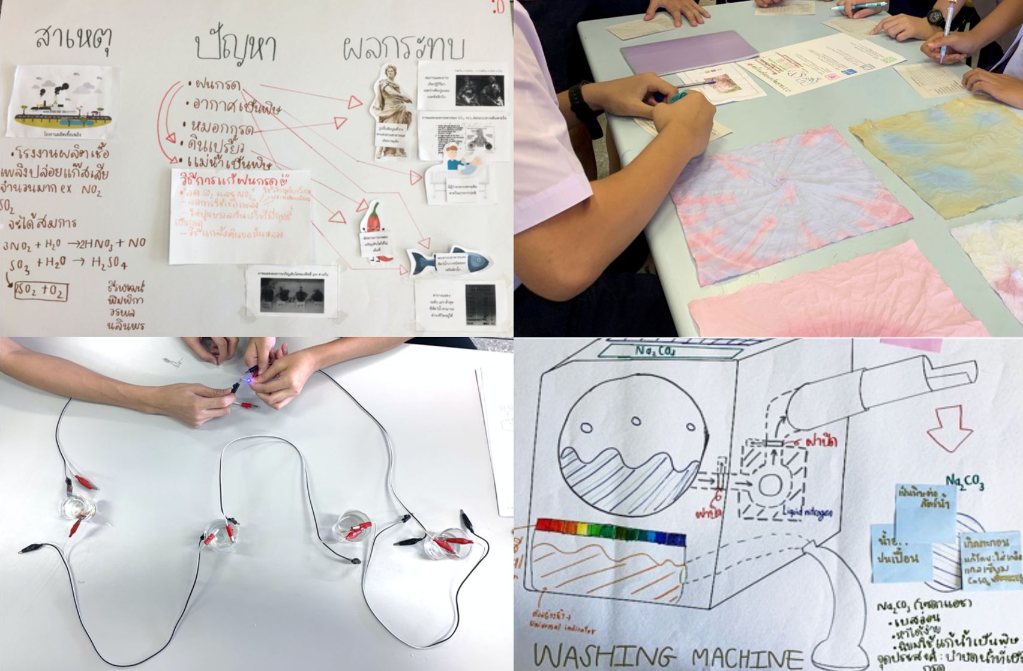
This classroom action research is aimed at examining teaching guidelines in using the Infusion Approach with STEM Problem-based Learning (STEM-PBL) to improve critical thinking (CT) on Acid-Base topic for 11th grade students. The data was collected from critical thinking survey, teacher’s and students’ reflective journals, and students’ worksheets. Most CT components have been raised and performed at a high level, except for evaluation skills, which is still at a medium level. STEM-PBL teaching guidelines were categorized into three main themes: 1. The scenarios utilized in STEM-PBL should be ill-defined issues with obvious criteria and constraints. Thus, students can design their work before doing it and improve their analysis and inference skills. 2. Circular presentation with the common rules that the presenter and audience should discuss together, can develop evaluation and reflective judgment skills. 3. An infusion approach, using case studies and the sharing of ideas throughout the classroom, helps students develop their critical thinking. Suggestions for implementing an infusion approach for enhancing critical thinking in the science classroom as well as through problem-based learning and STEM education will be provided.
Article Details
References
กระทรวงศึกษาธิการ. (2551). หลักสูตรแกนกลางขั้นพื้นฐาน พุทธศักราช 2551. กรุงเทพฯ: กระทรวงศึกษาธิการ.
ธวัช ยะสุคำ และ ศักดิ์ศรี สุภาษร. (2555). การพัฒนาทักษะการคิดเชิงวิพากษ์และผลสัมฤทธิ์ทางการเรียนด้วยกิจกรรมการเรียนรู้แบบสืบเสาะหาความรู้ เรื่อง อัตราการเกิดปฏิกิริยาเคมี. วารสารศึกษาศาสตร์ มหาวิทยาลัยนเรศวร, 14(2), 23-33.
พงศธร ปัญญานุกิจ. (2562). การพัฒนาทักษะการคิดอย่างมีวิจารณญาณด้วยการจัดการเรียนรู้แบบสืบเสาะหาความรู้ 6 ขั้น ตามแนวสะเต็มศึกษาในหัวข้อเรื่องเชื้อเพลิงซากดึกดำบรรพ์และผลิตภัณฑ์ของนักเรียนระดับชั้นมัธยมศึกษาปีที่ 5. (วิทยานิพนธ์ศึกษาศาสตรมหาบัณฑิต). กรุงเทพฯ: มหาวิทยาลัยเกษตรศาสตร์.
ภูธร สุคันธวณิช และ มนสิช สิทธิสมบูรณ์. (2560). ผลการจัดการเรียนรู้ตามสภาพจริงด้วยวิธีการทางประวัติศาสตร์ที่ส่งเสริมความสามารถในการคิดเชิงวิพากษ์ของนักเรียนชั้นมัธยมศึกษาปีที่ 2. วารสารศึกษาศาสตร์ มหาวิทยาลัยนเรศวร, 19(4), 188-199.
สะเต็มศึกษา ประเทศไทย. (2557). รู้จักสะเต็ม. ค้นเมื่อ 16 มิถุนายน 2564, จาก http://www.stemedthailand.org/?page_id=23
Abrami, P. C., Bernard, R. M., Borokhovski, E., Waddington, D. I., Wade, C. A., & Persson, T. (2015). Strategies for teaching students to think critically: A meta-analysis. Review of Educational Research, 85(2), 275–314.
Bybee, R. W. (2010). What is STEM education? Science, 329(5995), 996.
Che, F. S. (2002). Teaching critical thinking skills in a Hong Kong secondary school. Asia Pacific Education Review, 3(1), 83–91.
Duit, R., Treagust, D., & Widodo, A. (2008). Teaching science for conceptual change: Theory and practice. International Handbook of Research on Conceptual Change, 629-646.
Duran, M., & Sendag, S. (2012). A preliminary investigation into critical thinking skills of urban high school students: Role of an IT/STEM program. Creative Education, 3(02), 241–250.
Dwyer, C. P., Hogan, M. J., & Stewart, I. (2014). An integrated critical thinking framework for the 21st century. Thinking Skills and Creativity, 12, 43–52.
Ennis, R. H. (1989). Critical thinking and subject specificity: Clarification and needed research. Educational Researcher, 18(3), 4–10.
Ernst, J., & Monroe, M. (2006). The effects of environment-based education on students’ critical thinking skills and disposition toward critical thinking. Environmental Education Research, 12(3–4), 429–443.
Kemmis, R., & McTaggart, S. (Eds.). (1988). The action research planner. (3rd ed.). UNSW Press.
Mutakinati, L., Anwari, I., & Kumano, Y. (2018). Analysis of students’ critical thinking skill of middle school through STEM education Project-Based Learning. Jurnal Pendidikan IPA Indonesia, 7(1), 54–65.
Partnership for 21st Century Learning. (2019). Framework for 21st Century Learning. Retrieved June 16, 2021, from https://www.battelleforkids.org/networks/p21
Tiruneh, D. T., De Cock, M., & Elen, J. (2018). Designing learning environments for critical thinking: Examining effective instructional approaches. International Journal of Science and Mathematics Education, 16(6), 1065–1089.
Tiwari, A., Lai, P., So, M., & Yuen, K. (2006). A comparison of the effects of problem-based learning and lecturing on the development of students’ critical thinking. Medical Education, 40(6), 547–554.
Wang, H.-H., Chen, H.-T., Lin, H.-S., Huang, Y.-N., & Hong, Z.-R. (2017). Longitudinal study of a cooperation-driven, socio-scientific issue intervention on promoting students’ critical thinking and self-regulation in learning science. International Journal of Science Education, 39(15), 2002–2026.
Wood, D. F. (2008). Problem based learning. BMJ, 336(7651), 971.
Zohar, A., Weinberger, Y., & Tamir, P. (1994). The effect of the biology critical thinking project on the development of critical thinking. Journal of Research in Science Teaching, 31(2), 183–196.
