
Design and Development of Constructivist Web-based Learning Environment Model to Enhance Creativity Thinking for Undergraduate Student with Integration of Pedagogy and Neuroscience
Article Sidebar
Main Article Content
Abstract
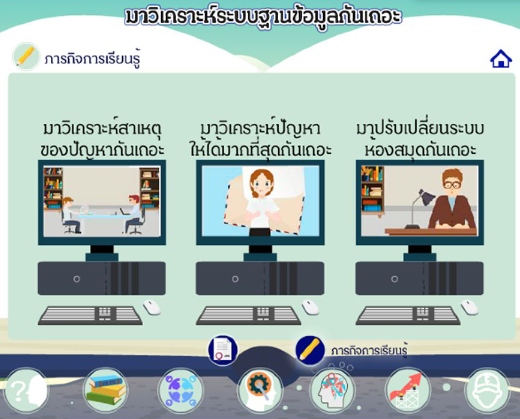
The purposes of this research are to design and develop a constructivist web-based learning environment model to Enhance Creativity Thinking for Undergraduate Student with Integration of Pedagogy and Neuroscience. The developmental research phase I was employed in this study. Several methodology used in this study are document analysis and survey. In this research, the target group consisted of 3 experts in content, 3 experts in media, 3 experts in model design, 3 experts in measurement and evaluation, 120 students at Roi Et Rajabhat University and Loei Rajabhat University of Academic Year 2/2020, 1 designer, 1 developer, and 2 instructors. The result revealed that: 1) In terms of designing and developing the constructivist web-based learning environment model to enhance creative thinking, it was found that the process of designing and developing the model started from studying theories and related research, synthesizing the theoretical conceptual framework, developing the web-based learning environment, and validating the model quality. The web-based learning environment model consisted of important components: (1) problem situations, (2) learning resources, (3) learning exchange center, (4) intellectual tool center, (5) center for promoting creative thinking, (6) help center, and (7) support center. The efficiency of the constructivist web-based learning environment model to enhance creativity thinking 3 the appropriated dimensions:The content is appropriate for learning.The characteristicof web base was appropriate for supporting the learners to learn and access information easily. The design of seven components were congruent with the underlined theories.
Article Details
References
จารุณี ซามาตย์. (2559). การออกแบบและพัฒนาห้องเรียนกลับทางตามแนวคอนตรัคติวิสต์เพื่อส่งเสริมการคิดสร้างสรรค์ รายวิชา หลักการพื้นฐานสำหรับการพัฒนาซอฟต์แวร์ทางการศึกษา สำหรับนักศึกษาคอมพิวเตอร์ศึกษา. วารสารมหาวิทยาลัยราชภัฏมหาสารคาม (มนุษยศาสตร์และสังคมศาสตร์), 10(3), 56-59.
ดวงจันทร์ วรคามิน และคณะ. (2559). รายงานวิจัย.การศึกษาความสามารถด้านการคิดวิเคราะห์และการมีจิตสาธารณะเพื่อพัฒนาศักยภาพการเป็นคนดีคนเก่งของนักเรียนไทย. กรุงเทพฯ: (ม.ป.พ.).
สุมาลี ชัยเจริญ และคณะ. (2546). เอกสารประกอบวิชา เทคโนโลยีร่วมสมัย. ภาควิชาเทคโนโลยีการศึกษา คณะศึกษาศาสตร์ มหาวิทยาลัยขอนแก่น.
สุมาลี ชัยเจริญ. (2559). การออกแบบการสอน: หลักการ ทฤษฎี สู่การปฏิบัติ. ขอนแก่น: เพ็ญปริ้นติ้ง.
อรพรรณ์ แก้วกันหา จุฑามาส ศรีจำนงค์ และจุรีรัตน์ ประวาลลัญฉกร. (2561). การวิจัยปฏิบัติการเพื่อพัฒนาความคิดสร้างสรรค์ รายวิชาคอมพิวเตอร์ ของนักเรียนชั้นประถมศึกษาปีที่ 5 โรงเรียนบ้านน้้าคิว สังกัดส้านักงานเขตพื้นที่การศึกษาประถมศึกษาเลย เขต 1. วารสารศึกษาศาสตร์ มหาวิทยาลัยนเรศวร, 19, 289-304.
Brown, J. S., Collins, A., & Duguid, P. (1989). Situated Cognition and the Culture of Learning. Educational researcher, 18(1), 32-42.
Chaijaroen, S., Kanjug, I., & Samat, C. (2019). Learner’s Creative Thinking Learning with Constructivist Web-Based Learning Environment Model: Integration Between Pedagogy and Neuroscience. In: Rønningsbakk, L., Wu, TT., Sandnes, F., & Huang, YM. (eds). Innovative Technologies and Learning. ICITL 2019. Lecture Notes in Computer Science, 11937. Springer, Cham.
Florida, R., & Mellander, C. (2015). The Global Creativity Index 2015. Toronto Martin: Prosperity Institute.
Guilford, J. P. (1967). The Nature of Human Intelligence. New York: McGraw-Hill.
Hannafin, M. J., Land, S. M., & Oliver, K. (1999). Open Learning Environments: Foundations, Methods, and Models. In C. Reigeluth (Ed.), Instructional design theories and models. (Vol. II). Mahwah, NJ: Erlbaum.
Klausmeier, H. J. (1985). Educational Psychology. (5th ed.). Harper & Row, New York.
Mayer, R. E. (1999). Designing Instruction for Constructivist Learning. In C. M. Reigeluth (Ed.), Instructional Design Theories and Models: A New Paradigm of Instructional Theory. (pp. 141-159). Mahwah, NJ: Lawrence Erlbaum Associates, Inc.
Piaget J. (1977). The Development of Thought: Equilibration of Cognitive Structures. New York: The Viking Press.
Richey, R. C., & Klein, J. (2007). Design and Developmental Research. New Jersey: Lawrence.
Sweller, J. (1994). Cognitive Load Theory, Learning Difficulty, and Instructional Design. Learn. Instr. 4, 295–312.
Trilling, B., & Fadel, C. (2009). 21st Century Skills Learning for Life in Our Times. Francisco: Jossey-Bass.
Vygotsky, L. S. (1978). Mind in Society: Development of Higher Psychological Processes. Cambridge, MA: Harvard University Press.
World Economic Forum. (2020). The Future of Jobs Report 2020 | World Economic Forum. Research Report, (October), 1163.
