
Assessing Alignment between Thai and International English Language Learning on Massive Open Online Course (MOOC) Using Porter’s Alignment Index
Article Sidebar
Main Article Content
Abstract
This research aimed to (1) study learning outcomes, teaching methods and assessment methods between Thai and International English Language Learning on Massive Open Online Course (MOOC), (2) assess alignment of learning outcomes, teaching methods and assessment methods between English Language Learning courses on Thai (Thai MOOC and Chula MOOC) and International (Coursera). Research subjects were 89 English Language Learning Courses on Thai and International MOOCs. The research instruments consisted of 1) learning outcomes and teaching methods record form, 2) learning outcomes and assessment methods record form, and 3) teaching methods and assessment methods record form. Porter’s alignment index was used for analysis.
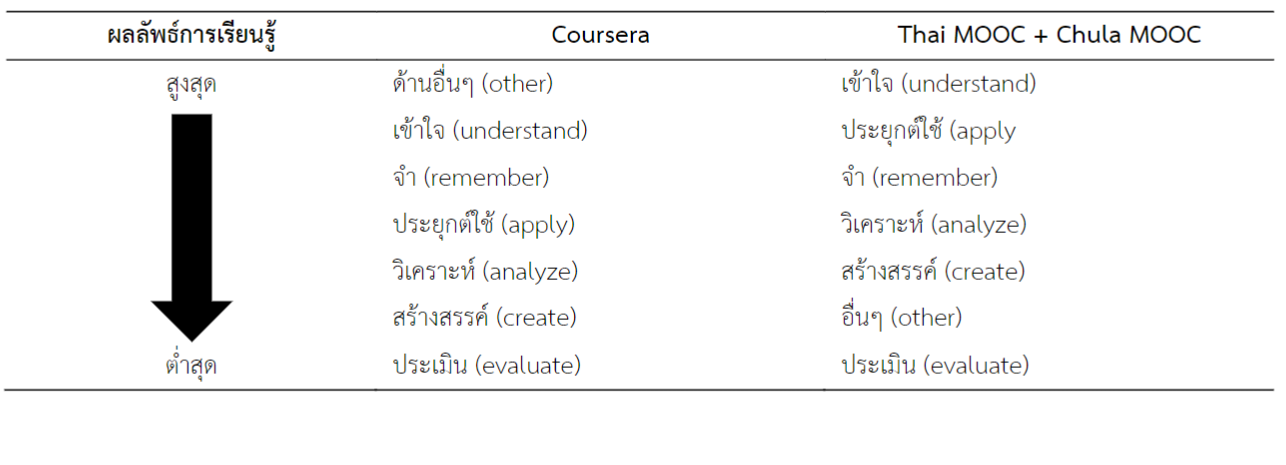
The research results found that learning outcomes, teaching methods and assessment methods between English Language Learning Courses on Thai and international MOOC had both similar and different points. Most of the learning outcomes were understand cognitive process level. Most of teaching methods were using video, document, practice exercise, and discussion method. Coursera had more others teaching methods than Thai MOOC and Chula MOOC. There were some different assessment methods on Thai and International MOOCs. Coursera had three assessment methods: quiz, peer graded assignment, and combination of quiz and peer graded assignment, while Thai MOOC and Chula MOOC just had quiz and final exam. Alignment of learning outcomes, teaching methods, and assessment methods were low to moderate levels with ranged between 0.110 to 0.630.
Article Details
References
บุษยารัตน์ จันทร์ประเสริฐ. (2560). ความสอดคล้องในแนวเดียวกันระหว่างข้อสอบในการประเมิน ระดับชาติกับข้อสอบใน การประเมินระดับชั้นเรียน กลุ่มสาระการเรียนรู้วิทยาศาสตร์: การประยุกต์ใช้โมเดลหลายองค์ประกอบของราส์ช และทฤษฎีการสรุปอ้างอิงความน่าเชื่อถือของผลการวัด. ภาควิชาวิจัยและจิตวิทยาการศึกษา สาขาวิชาการวัดและ ประเมินผลการศึกษา คณะครุศาสตร์ จุฬาลงกรณ์มหาวิทยาลัย กรุงเทพมหานคร ประเทศไทย.
บุษยารัตน์ จันทร์ประเสริฐ, ณัฏฐภรณ์ หลาวทอง, และสังวรณ์ งัดกระโทก. (2563). ความเที่ยงระหว่างผู้ประเมินของความ สอดคล้องในแนวเดียวกันระหว่างข้อสอบกับตัวชี้วัดวิทยาศาสตร์. วารสารครุศาสตร์ จุฬาลงกรณ์มหาวิทยาลัย, 48(2), เมษายน-มิถุนายน.
ศิริชัย กาญจนวาสี. (2556). ทฤษฎีการทดสอบแบบดั้งเดิม. กรุงเทพฯ: คณะครุศาสตร์ จุฬาลงกรณมหาวิทยาลัย.
สังวรณ์ งัดกระโทก. (2561). การวัดและการประเมินผลสำหรับการจัดการศึกษาอิงมาตรฐาน.กรุงเทพฯ: โรงพิมพ์แห่งจุฬาลงกรณ์มหาวิทยาลัย.
Anderson, L. W., Krathwohl, D. R., Airasian, P. W., Cruikshank, K. A., Mayer, R. E., Pintrich, P. R., Wittrock, M. C. (2001). A taxonomy for learning, teaching, and assessing: A revision of Bloom's taxonomy of educational objectives (Complete ed.). New York: Longman.
Porter, A. C. (2002). Measuring the content of instruction: Uses in research and practice. Educational Researcher, 31(7), 3-14
Porter, A. C.& Smithson, J. L. (2001). Defining, developing, and using curriculum indicators. CPRE research report series RR-048. Retrieved from Philadelphia, PA: University of Pennsylvania Graduate School of Education.
Webb, N. L. (1997). Criteria for Alignment of Expectations and Assessments in Mathematics and Science Education. (Research Monograph No. 8). Washington, DC: Council of Chief State School Officers.
