
Effect of Digital Card Game-based Open Inquiry Science Learning on Protein Synthesis on Secondary School Students’ Learning Motivation toward Biology
Article Sidebar
Main Article Content
Abstract
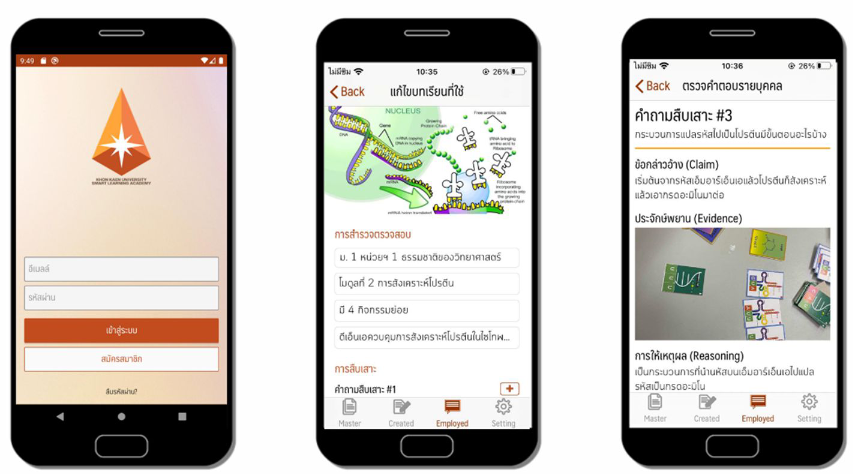
Currently, the teaching of science content is often uninteresting as reported in literatures, and students are not pay attention to learn science as it should be. To address the point, using game for learning has been mentioned its benefits for learning in order to better motivation to new generation students. This article reported a result of implementing card game-based open inquiry learning on protein synthesis concepts to 86 tenth-grade students in a university-based secondary school located northeastern Thailand. A quasi-experimental research design has been used to examine the difference between posttest scores of an experimental and a control group of students. A 25 5-point Likert rating scale of science motivation questionnaire was administered to both groups as posttest, and then the obtained data was analyzed using MANOVA. The result is students interacted with card game-based open inquiry learning gained higher science motivation than another with no significant difference on statistical testing. Moreover, it was found that the highest and lowest science motivation scores was Intrinsic Motivation and Self-efficacy respectively. Therefore, the proposed card game-based open inquiry learning approach could be a better way than the conventional teaching method to facilitate the development of science motivation for secondary school students.
Article Details
References
นุชลี อุปภัย. (2558). จิตวิทยาการศึกษา. (พิมพ์ครั้งที่ 4). กรุงเทพฯ: สำนักพิมพ์แห่งจุฬาลงกรณ์มหาวิทยาลัย.
ประพนธ์ เจียรกูล. (2535). ของเล่นและเกมในการเรียนการสอนคณิตศาสตร์. ในเอกสารชุดฝึกอบรมหลักสูตรการจัดกิจกรรมการเรียนการสอนคณิตศาสตร์ด้วยของเล่นและเกม. นนทบุรี: สำนักพิมพ์มหาวิทยาลัยสุโขทัยธรรมาธิราช.
ศุภกร ถิรมงคลจิต. (2559). ผลของการจัดกิจกรรมการเรียนรู้วิชาวิทยาศาสตร์ตามแนวคิดเกมิฟิเคชันเพื่อเสริมสร้างแรงจูงใจในการเรียนของนักเรียนชั้นประถมศึกษาปีที่ 2. วารสารอิเล็กทรอนิกส์ทางการศึกษา, 11(4), 450-464.
สาโรตม์ ศิโรตมานนท์. (2554). คู่มือนิเทศกลุ่มสาระการเรียนรู้คณิตศาสตร์ : เกมประกอบการเรียนการสอน. ชัยภูมิ: สำนักงานเขตพื้นที่การศึกษาชัยภูมิ เขต 1.
สนธิยา ยอดสง่า. (2564). ผลของการจัดการเรียนรูวิทยาศาสตร์สืบเสาะโดยใชบอร์ดเกมดิจิทัล ที่มีผลต่อแรงจูงใจทางวิทยาศาสตร์ เรื่อง การสังเคราะห์ด้วยแสงของพืช. วารสารศึกษาศาสตร์ มหาวิทยาลัยขอนแก่น, 44(3), 144-162.
Arnel, F. (2013). Development and Effectiveness of an Educational Card Game as Supplementary Material in Understanding Selected Topics in Biology. CBE—Life Sciences Education,
Black A. E. & Deci E. L., (2000), The Effects of Instructors’ Autonomy Support and Students’ Autonomous Motivation on Learning Organic Chemistry: A Self-Determination Theory Perspective. Sci. Educ., 84(6), 740–756.
Boonpotjanawetchakit, A., Kaweerat, K. & Vittayakorn S. (2020). Element: Interactive Digital Card Game for Chemistry, IEEE Global Engineering Education Conference (EDUCON), 344-348.
Bressler, D. M., & Bodzin, A. M. (2016). Investigating Flow Experience and Scientific Practices During a Mobile Serious Educational Game. Journal of Science Education and Technology, 25(5), 795–805.
Brophy, J. (2004). Motivating Students to Learn. (2nd ed.). Mahwah, NJ: Erlbaum.
Buck, L. B., Bretz, S. L. & Towns, M. H. (2008). Characterizing the Level of Inquiry in the Undergraduate Laboratory. Journal of College Science Teaching, 38(1), 52-58.
De Castell, S., Jenson, J., & Taylor, N. (2007). Digital Games for Education: When Meanings Play. Intermedialities, (9), 45–54.
Denning, T., Lerner, A., Shostack, A. & Kohno, T. (2013). Control-Alt-Hack: The Design and Evaluation of a Card Game for Computer Security Awareness and Education. CCS,
Erhel, S., & Jamet, E. (2013). Digital Game-Based Learning: Impact of Instructions and Feedback on Motivation and Learning Effectiveness. Computers & Education, 67, 156–167.
Glynn, S.M., Brickman, P., Armstrong, N., & Taasoobshirazi, G. (2011). Science Motivation Questionnaire II: Validation With Science Majors and Nonscience Majors. Journal of Research in Science Teaching, 48(10), 1159-1176.
National Research Council. (2012). A Framework for K-12 Science Education: Practices, Crosscutting Concepts, and Core Ideas. Washington, DC: The National Academies Press.
Paraskeva, F., Mysirlaki, S. & Papagianni, A. (2010). Multiplayer Online Games as Educational Tools: Facing New Challenges in Learning. Computers & Education, 54(2), 498-505.
Pedaste, M., Mäeots, M., Siiman, L. A., de Jong, T., van Riesen, S. A., Kamp, E. T., Manoli, C. C., Zacharia, Z. & Tsourlidaki, E. (2015). Phases of Inquiry-Based Learning: Definitions and The Inquiry Cycle. Educational research review, 14, 47-61.
Ramsi, A. & Mohamed, F. (2015). A Game-Based Learning Model. Master thesis in Software Engineering, United Arab Emirates University College of Information Technology,
Smith, D.R. & Munro, E. (2009). Educational Card Games. Physics Education, 44(5),
Srisawasdi, N., & Panjaburee, P. (2019). Implementation of Game-Transformed Inquiry-Based Learning to Promote the Understanding of and Motivation to Learn Chemistry. Journal of Science Education and Technology, 28, 152–164.
