
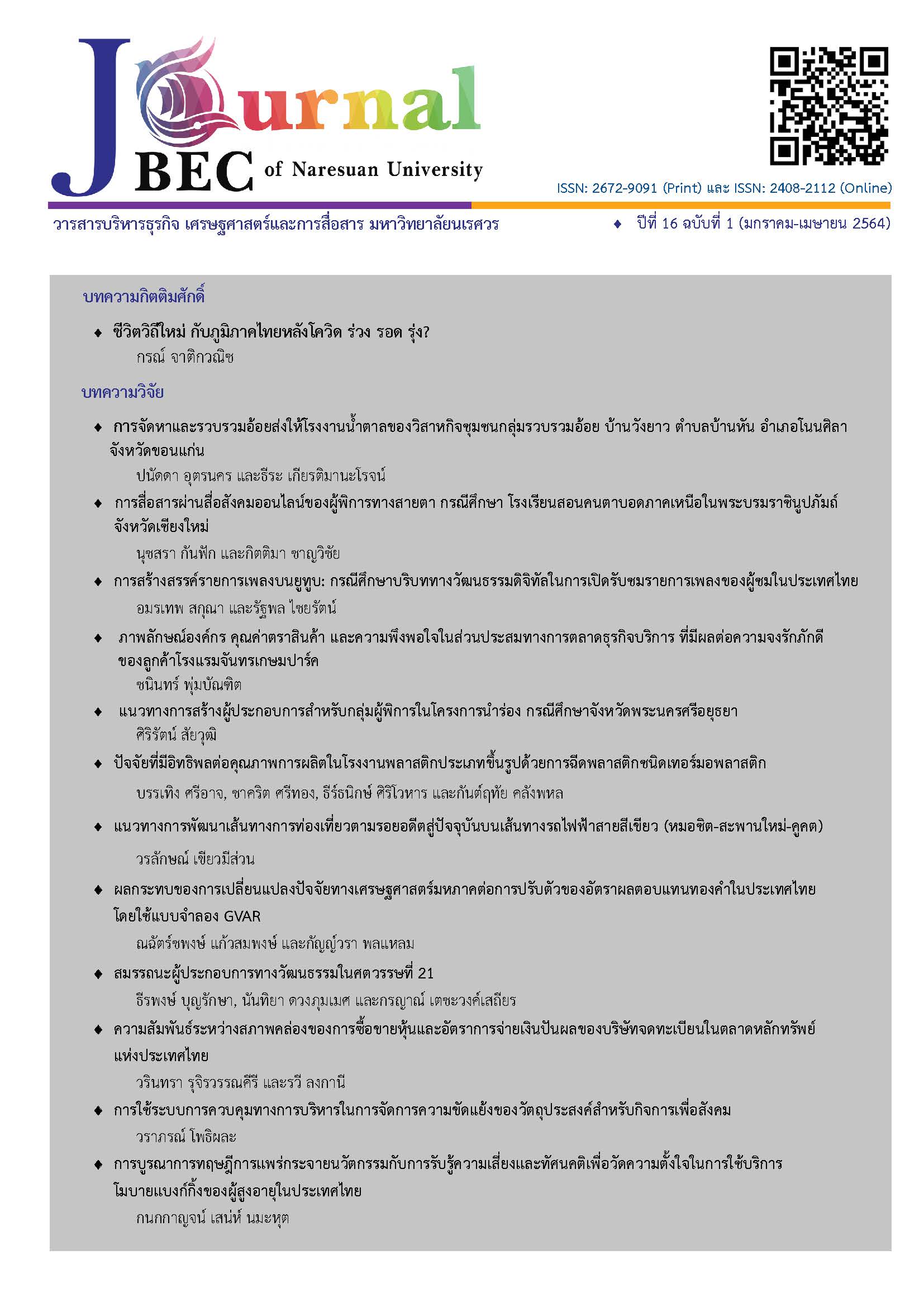
The Use of Management Control Systems in Social Enterprises
Article Sidebar
Main Article Content
Abstract
SE has a distinctive characteristic which is a dual mission between social and financial sustainability goals. The dual mission induces the tension between the goals. Much literature investigates how to manage the tensions; however, most of them propose a theoretical analysis rather than empirical evidences. Some literature suggests that a cleared performance measurement should be used to resolve the tension. While performance measurement, which is one kind of Management Control System (MCS), is included, other MCSs are not explored. This research provides an empirical evidence how to use the MCS to manage the tension of SE. The research draws on a MCS framework, proposed by Tessier and Otley (2012) and uses data from a qualitative study of Thai SEs. The result found that social control is essential to achieve tension management. The result extends MCS literature by providing empirical evidence of the use of MCS in a new form of organization. It also reveals knowledge on how to use MCS for SE to achieve both financial sustainability and social goals simultaneously.
Article Details
References
Ansari, S. L. (1977). An integrated approach to control system design. Accounting, Organizations and Society, 2(2), 101-112. doi:http://dx.doi.org/10.1016/0361-3682(77)90027-7
Asian Development Bank. (2013). Poverty Analysis (Summary). Country Partnership Strategy: Thailand 2013-2016. Retrieved from https://www.adb.org/sites/default/files/linked-documents/cps-geo-2014-2018-pa.pdf
Austin, J., Stevenson, H., & Wei-Skillern, J. (2006). Social and Commercial Entrepreneurship: Same, Different, or Both? Entrepreneurship Theory and Practice, 30(1), 1-22. doi:10.1111/j.1540-6520.2006.00107.x
Baxter, P., & Jack, S. (2010). Qualitative Case Study Methodology: Study Design and Implementation for Novice Researchers. The Qualitative Report, 13(4), 544-559.
Chenhall, R. H. (2003). Management control systems design within its organizational context: findings from contingency-based research and directions for the future. Accounting, Organizations and Society, 28(2), 127-168. doi:http://dx.doi.org/10.1016/S0361-3682(01)00027-7
Chenhall, R. H., Hall, M., & Smith, D. (2010). Social capital and management control systems: A study of a non-government organization. Accounting, Organizations and Society, 35(8), 737-756. doi:http://dx.doi.org/10.1016/j.aos.2010.09.006
Defourny, J., & Kim, S.-Y. (2011). Emerging models of social enterprise in Eastern Asia: a cross‐country analysis. Social Enterprise Journal, 7(1), 86-111. doi:doi:10.1108/17508611111130176
Defourny, J., & Nyssens, M. (2008). Social enterprise in Europe: recent trends and developments. Social Enterprise Journal, 4(3), 202-228. doi:doi:10.1108/17508610810922703
Doherty, B., Haugh, H., & Lyon, F. (2014). Social Enterprises as Hybrid Organizations: A Review and Research Agenda. International Journal of Management Reviews, 16(4), 417-436. doi:10.1111/ijmr.12028
Ebrahim, A., Battilana, J., & Mair, J. (2014). The governance of social enterprises: Mission drift and accountability challenges in hybrid organizations. Research in Organizational Behavior, 34, 81-100. doi:http://dx.doi.org/10.1016/j.riob.2014.09.001
Eisenhardt, K. M. (1989). Building Theory From Case Study Research. Academy of Management Review, 14(4), 532-550. doi:10.2307/258557
Flamholtz, E. G., Das, T. K., & Tsui, A. S. (1985). Toward an integrative framework of organizational control. Accounting, Organizations and Society, 10(1), 35-50.
Haugh, H. (2005). A research agenda for social entrepreneurship. Social Enterprise Journal, 1(1), 1-12. doi:doi:10.1108/17508610580000703
Hussey, A. (1993). Rapid Industrialization in Thailand 1986-1991. Geographical Review, 83(1), 14-28. doi:10.2307/215377
Kerlin, J. A. (2006). Social Enterprise in the United States and Europe: Understanding and Learning from the Differences. VOLUNTAS: International Journal of Voluntary and Nonprofit Organizations, 17(3), 246. doi:10.1007/s11266-006-9016-2
Malmi, T., & Brown, D. A. (2008). Management control systems as a package—Opportunities, challenges and research directions. Management Accounting Research, 19(4), 287-300. doi:http://doi.org/10.1016/j.mar.2008.09.003
Mata, J. a. P., Pedro,. (1994). Life Duration of New Firms. The Journal of Industrial Economics, 42(3), 227-245. doi:10.2307/2950567
Otley, & Berry. (1980). Control, organisation and accounting. Accounting, Organizations and Society, 5(2), 231-244. doi:http://dx.doi.org/10.1016/0361-3682(80)90012-4
Ouchi, W. (1979). A Conceptual Framework for Design of Organisational Control Mechanism (Vol. 25).
Phillips, B. D., & Kirchhoff, B. A. (1989). Formation, growth and survival; Small firm dynamics in the U.S. Economy. Small Business Economics, 1(1), 65-74. doi:10.1007/bf00389917
Royal Thai Government. (2011). The Eleventh National Economic and Social Developement Plan (2012 - 2016) ...
Schneider, A. (2016). Social Entrepreneurship, Entrepreneurship, Collectivism, and Everything in Between: Prototypes and Continuous Dimensions. Public Administration Review, n/a-n/a. doi:10.1111/puar.12635
Simons, R. (1990). The role of management control systems in creating competitive advantage: New perspectives. Accounting, Organizations and Society, 15(1), 127-143. doi:http://dx.doi.org/10.1016/0361-3682(90)90018-P
Simons, R. (1995). Levers of control: How managers use innovative control systems to drive strategic renewal. Boston, Mass: Harvard Business School Press.
Smith, W. K., Gonin, M., & Besharov, M. L. (2013). Managing Social-Business Tensions: A Review and Research Agenda for Social Enterprise. Business Ethics Quarterly, 23(3), 407-442.
Tessier, S., & Otley, D. (2012). A conceptual development of Simons’ Levers of Control framework. Management Accounting Research, 23(3), 171-185. doi:http://dx.doi.org/10.1016/j.mar.2012.04.003
Vieira, R., Ha, T. T. L., & O' Dwyer, B. (2013). Interplay of Management Control Systems and Social Enterprises: A Case Study of a Social Enterprise in Vietnam. Paper presented at the The Seventh Asia Pacific Interdisciplinary Research in Accounting Conference, Kobe, Japan. http://www.apira2013.org/
World Bank. (2018, 11 August 2020). Thailand Overview. Retrieved from http://www.worldbank.org/en/country/thailand/overview
Yin, R. K. (2003). Case Study Research: Design and Methods, 3rd Edition. Sage publications.
