
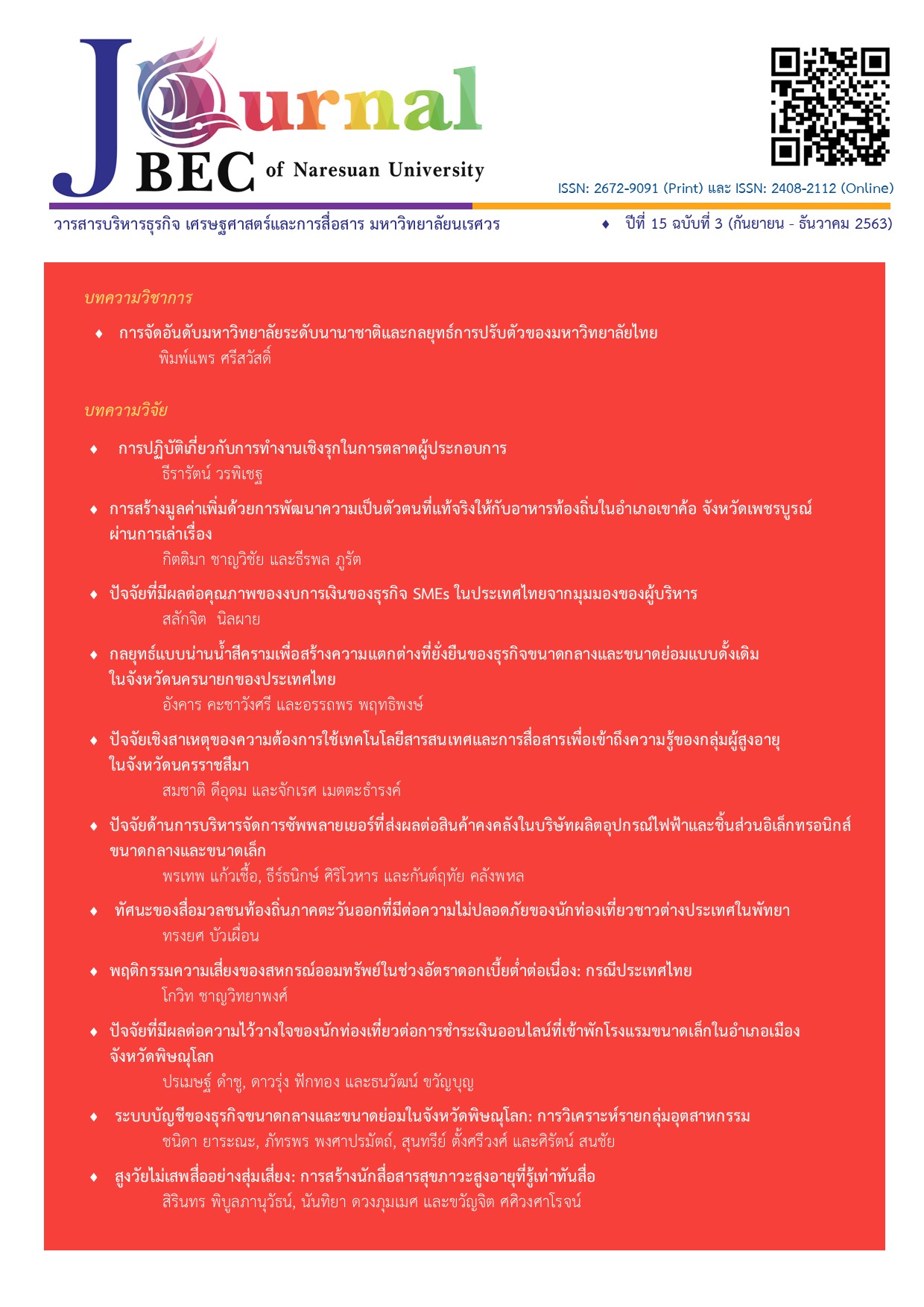
Supplier Management Factors Affecting Inventory in Small and Medium-sized Electronics and Electrical Parts Manufacturers
Article Sidebar
Main Article Content
Abstract
The research aimed to find the supplier management factors which affected the inventory in small and medium-sized electronics and electrical parts manufacturers.The researcher employed the qualitative research which was the case study research technique and used the in-depth interview technique by interviewing with five relevant people and three academic experts. The data triangulation technique was employed to check the accuracy of data. The research results found that the supplier management factors affecting inventory were 1. trust between suppliers and manufacturers factor 2. quality factor 3. delivery time factor and 4. relationship between suppliers and manufacturers factor, respectively.
Article Details
References
Abdolnaser, D., Hway-Boon, O. and Govindan, M. (2019). Supplier Development Activities and Buying Firm’s Performance: An Empirical Investigation of Iranian SMEs. Iranian Journal of Management Studies, 12(3), 405-424.
Amachree, T. T., Apkan, E. O. P., Ubani, E. C., Okorocha, K. A. and Eberendu, A. C. (2017). Inventory Management Strategies For Productivity Improvement In Equipment Manufacturing Firms. International Journal of Scientific and Technology Research, 6(8), 99-107.
Atnafu, D., Balda, A. and Liu, S. (2018). The impact of inventory management practice on firms’ competitiveness and organizational performance: Empirical evidence from micro and small enterprises in Ethiopia. Cogent Business & Management, 5(1), 1-16.
Baird, K., Jia, H. K. and Reeve, R. (2011). The relationships between organizational culture, total quality management practices and operational performance. International Journal of Operations & Production Management, 31(7), 789-814.
Golobovante, A. F. M., Ribeiro, P. C. C. and Gomes, C. F. S. (2018). Adoção de Resposta Rápida e gerenciamento de estoques no fast fashion: dois estudos de caso em Minas Gerais. Gestão & Produção, 25(3), 557-567.
Govindan, K., Kannan, D. and Noorul, H. A. (2010). Analyzing supplier development criteria for an automobile industry. Industrial Management & Data Systems, 110(1), 43-62.
Haji, A., Afzalabadi, M. and Haji, R. (2018). Pricing and inventory decisions in a vendor managed inventory system with revenue sharing contract. Uncertain Supply Chain Management, 2018(6), 299-320.
Herbert, E. S., Dorothy, M. G. and Maynard, W. S. (1963). Multistage Inventory Models and Techniques. Stanford University: Stanford University Press.
Hu, H., Xiong, H., You, Y. and Yan, W. (2016). A Mixed Integer Programming Model for Supplier Selection and Order Allocation Problem with Fuzzy Multiobjective. Scientific Programming, 2016(1), 1-13.
John, N. E., Etim, J. J. and Ime, T. U. (2015). Inventory management practices and operational performance of flour milling firms in Lagos, Nigeria. international journal of supply and operation management, 1(4), 392-406.
Joshi, S., Kharat, M., Raut, R., Kamble, S. and Kamble, S. (2017). To examine the relationships between supplier development practices and supplier-buyer relationship practices from the supplier’s perspective. Benchmarking: An International Journal, 24(5), 1309-1336.
Kazemi, Y. and Zhang, J. (2013). Optimal decisions and comparison of VMI and CPFR under price-sensitive uncertain demand. Journal of Industrial Engineering and Management, 6(2), 547-567.
Kitheka, S. S. and Gerald, O. O. (2014). Inventory Management Automation and The Performance of Supermarkets in Western Kenya. International Journal of Research in Management & Business Studies, 1(4), 9-18.
Lashgari, M., Sadjadi, S. J. and Sahihi, M. (2018). A multi-product, multi-period model to select supplier for deteriorating products while considering uncertainty as well as backorder. Journal of Industrial Engineering International, 15(1), 93-101.
Li, Y., Guo, H. and Zhang, Y. (2017). An integrated location-inventory problem in a closed-loop supply chain with third-party logistics. International Journal of Production Research, 56(10), 3462-3481.
Lin, C., Chow, W. S., Madu, C. N., Kuei, C.-H. and Pei Yu, P. (2005). A structural equation model of supply chain quality management and organizational performance. International Journal of Production Economics, 96(3), 355-365.
Lorenzo Ochoa, O., Claes, B., Koryak, O. and Diaz, A. (2017). Integration through orchestration. Journal of Enterprise Information Management, 30(4), 555-582.
Marodin, G. A., Tortorella, G. L., Frank, A. G. and Godinho Filho, M. (2017). The moderating effect of Lean supply chain management on the impact of Lean shop floor practices on quality and inventory. Supply Chain Management: An International Journal, 22(6), 473-485.
Milosevic, I., Trajkovic, A., Rajic, T., Nikolic, D. and Arsic, S. (2018). The effects of quality certification in establishing and developing customer: Supplier relationships. Serbian Journal of Management, 13(1), 115-131.
Mohamad, Y. J. (2009). Inventory Management Non-Classical Views. Ohio: CRC Press Taylor & Francis Group.
Mohammad, S. A. and Akram, A. M. (2017). Inventory management, cost of capital and firm performance: evidence from manufacturing firms in Jordan. Investment Management and Financial Innovations, 14(3), 4-14.
Naliaka, V. W. and Namusonge, G. S. (2015). Role of Inventory Management on Competitive Advantage among Manufacturing Firms in Kenya: A Case Study of Unga Group Limited. International Journal of Academic Research in Business and Social Sciences, 5(5), 87-104.
Niknamfar, A. H. (2015). Multi-objective production-distribution planning based on vendor-managed inventory strategy in a supply chain. Industrial Management & Data Systems, 115(6), 1086-1112.
Office of the National Economic and Social Development Council. (2019). Thailand's Logistics Report 2018 (1-18). Retrieved from www.nesdc.go.th
Otchere, A. F., Adzimah, E. D. and Aikens, I. (2016). Assessing the inventory management practices in a selected company in Ghana. International Journal of Development and Sustainability, 5(3), 105-119.
Punniyamoorty, M., Lorentz, H., Mathiyalagan, P. and Lakshmi, G. (2012). A combined application of structural equation modeling (SEM) and analytic hierarchy process (AHP) in supplier selection. Benchmarking: An International Journal, 19(1), 70-92.
Rajeev, N. (2014). Factors discriminating inventory management performance: An exploratory study of Indian machine tool SMEs. Journal of Industrial Engineering and Management, 7(3), 605-621.
Sharipbekova, K. and Raimbekov, Z. (2018). Influence of Logistics Efficiency on Economic Growth of the CIS Countries. European Research Studies Journal, 21(2), 678-690.
Shen, H., Deng, Q., Lao, R. and Wu, S. (2016). A Case Study of Inventory Management in a Manufacturing Company in China. Nang Yan Business Journal, 5(1), 20-40.
Tsai, K. H., Tsai, M. L. and Wang, J. C. (2012). Supplier collaboration and new product performance: a contingency model. Industrial Management & Data Systems, 112(2), 268-289.
Wangari, K. L. and Kagiri, A. W. (2015). INFLUENCE OF INVENTORY MANAGEMENT PRACTICES ON ORGANIZATIONAL COMPETITIVENESS: A CASE OF SAFARICOM KENYA LTD. International Academic Journal of Procurement and Supply Chain Management, 1(5), 72-98.
Yang, Y., Pan, S. and Ballot, E. (2016). Innovative vendor-managed inventory strategy exploiting interconnected logistics services in the Physical Internet. International Journal of Production Research, 55(9), 2685-2702.
Ziaee, M. and Bouquard, J. L. (2010). Optimal pricing and lot sizing vendor managed invento. International Journal of Industrial Engineering Computations, 1(1), 33-44.
