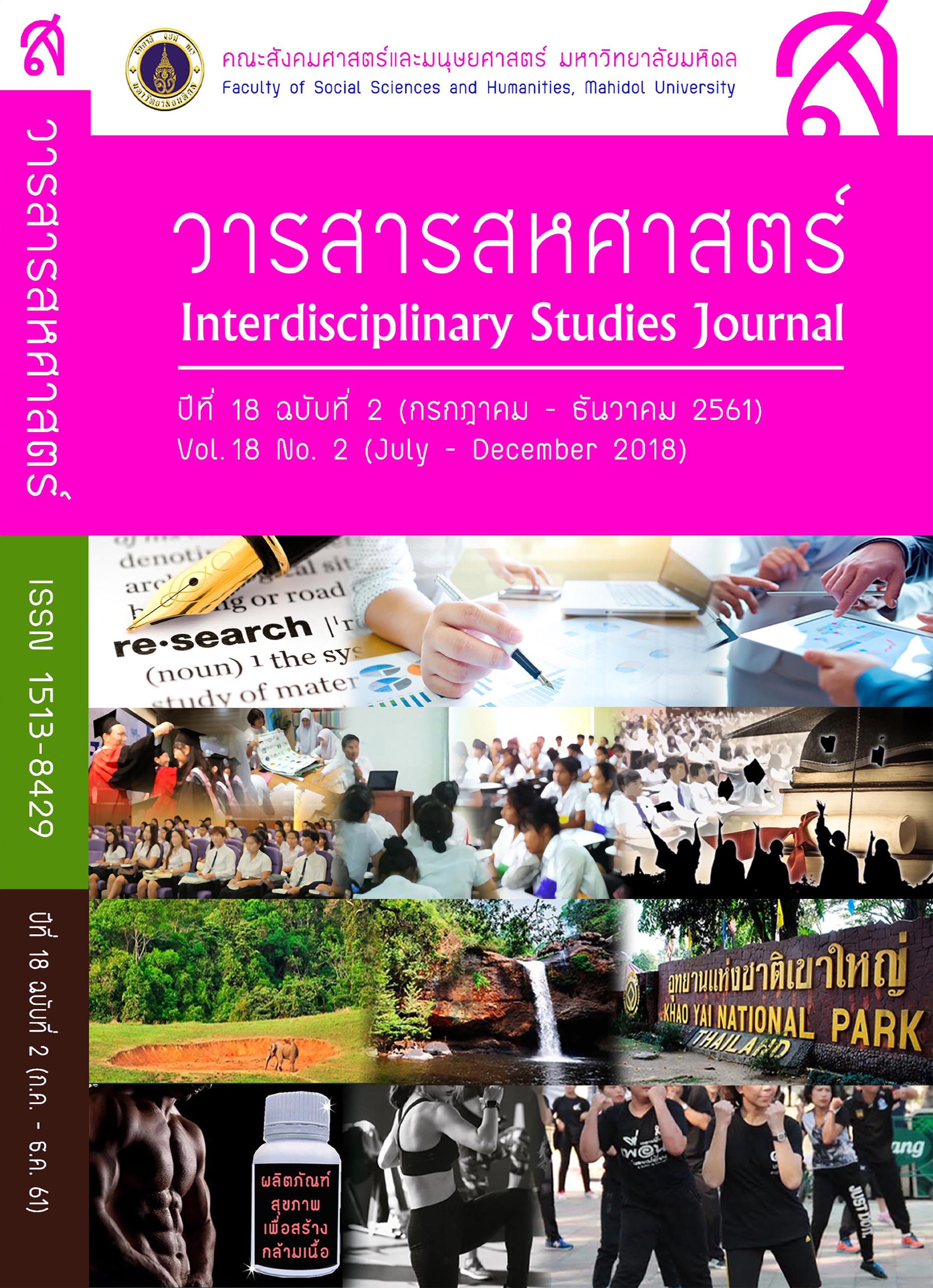
Women and Thai Boxing Exercise and Gender Fluidity
Keywords:
THAI BOXING, EXERCISE, FEMININITY, GENDER, INJURIESAbstract
This research aims to explain the perception of womanhood among women who exercise by doing Thai boxing. The study also explores the range of meaning in all possible deviations in female boxing as well as the physical problems which can occur by doing Thai boxing. The research used qualitative strategies, and in-depth interviews were conducted with of 20 women who exercise by doing Thai boxing, two gym managers and two Thai boxing trainers from two gyms in Bangkok’s parameter area. The participant observation method was applied in this study for total 240 hours, and the researcher participated in the exercise for four months. The content analysis was used to analyze data. The results of the study state that women who exercise by doing Thai boxing perceive their femaleness as the inferior sex. Therefore, they have to increase more endurance and more masculinity when they exercise by doing Thai boxing. Nevertheless, the women boxers still recognize themselves as masculine rather than feminine, and this recognition can be clearly seen by action of saying words “Man up”. The meanings of exercise with Thai boxing vary from each other and they do it for good health, for self-protection, for self-identification of being healthy, for relaxing and for socializing. Thai boxing might cause nerve and muscle injuries. However, those injuries are understood as the normal effect of exercise by seeing from “The worrier would have wound”. The research examined the contradiction of the femininity in the area of Thai boxing exercise.
Downloads
Published
How to Cite
Issue
Section
License

This work is licensed under a Creative Commons Attribution-NonCommercial-NoDerivatives 4.0 International License.
Sahasarts: Journal of Social Sciences and Humanities places great importance on safeguarding copyright and protecting authors’ rights in the dissemination of academic works. The objective is to promote transparency, academic integrity, and adherence to international publishing standards. The journal has established the following policies:
|
1. Acceptance of Publication Conditions - Authors submitting manuscripts for publication must strictly comply with the journal’s policies and publication conditions. - Submission of a manuscript constitutes acceptance of the review and publication process in accordance with the journal’s standards. |
|
2. Copyright Transfer - Upon acceptance for publication, authors agree to transfer the copyright of the article to Sahasarts: Journal of Social Sciences and Humanities. - The journal reserves the right to publish, reproduce, and disseminate the article in all formats, including print, online, and other digital media. |
|
3. Authors’ Rights after Copyright Transfer - Authors retain the right to use their articles for academic purposes, such as teaching, personal research, inclusion in theses or dissertations, or dissemination on non-commercial platforms. - Any use of the article for commercial purposes requires prior written permission from the journal. |
|
4. Publication under Creative Commons License - All articles are published under the Creative Commons Attribution-NonCommercial-NoDerivatives 4.0 International License (CC BY-NC-ND 4.0). - Others may share or distribute the article with proper credit to the original author(s) but may not modify, adapt, or use it for commercial purposes. |
|
5. Accuracy of Content and Use of Third-Party Materials - Authors must certify that the submitted manuscript is their original work, has not been simultaneously submitted elsewhere, and does not infringe copyright, plagiarize, falsify data, or otherwise violate academic publishing ethics. - Authors are responsible for obtaining permissions to use third-party materials (e.g., figures, tables, graphics) and must provide appropriate citations or acknowledgments. |
|
6. Disclaimer - All published articles are the copyright of Sahasarts: Journal of Social Sciences and Humanities. - The content, data, and opinions expressed in the articles are the sole responsibility of the respective authors and do not necessarily reflect the views of the editorial board or affiliated institutions. - In cases of error, copyright infringement, or ethical misconduct, full responsibility rests with the author(s). - Any commercial use of published articles requires prior written permission from the journal’s editor, including a clear statement of purpose and intended use. Unauthorized commercial use shall be the sole responsibility of the user. |