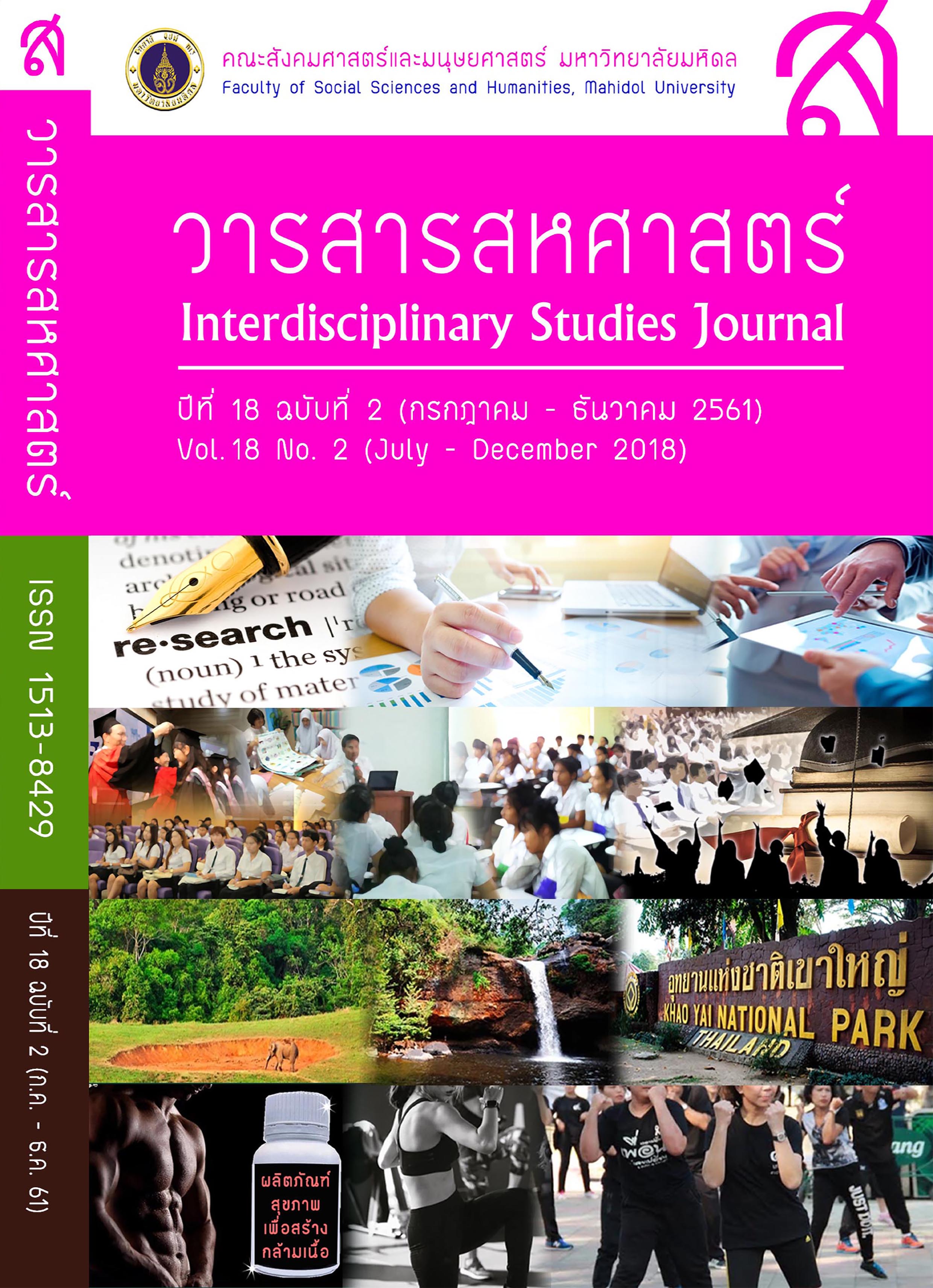
"Muscle...as a Self": The Thinking Processes on Health Product Used for Muscle Construction among Thai Male A Case Study in Mueang Nakhon Pathom District of Nakhon Pathom Province
Keywords:
muscle building, health products, desired body shapeAbstract
The purpose of this qualitative research was to study the Thai male thinking processes on using health products. The results can be used in the development of health consumer protection. In-depth interview method was used to collect the data of 15 Thai males with different attributes based on age, occupation and fitness center location. The collected data was analyzed using a content analysis method and the research conclusions were produced using data grouping and categorizing.
The results showed the desired body shape as the shape of a toned muscle. Muscle building can be separated by individual areas according to the cost and interest of the body owner. When they compared their own body with the perfect body, they agreed that their shapes were far from the desired shape and believed that they must be constantly evolving. It could be seen as the body was a project building without an end. Muscle building products were used as a necessity to build muscles. Moreover, if somebody wanted to expand beyond the super body, muscle building products like steroid drugs, e.g. Testosterone Propionate were needed. The marketing channels of muscle building products were many channels, such as people who build muscles, trainers in fitness centers, drug stores and cyberspace. These were easy to access, widespread used without medical knowledge and understanding. The body was built in such a way that would provide benefits in several dimensions, such as attracting the attention of the surrounding person and partner that gave realization of the sense of self. In conclusion, the use of health products to build muscles was the fifth factor in male muscle building. Muscle building products were used in contexts and their own experiences and in groups, contributing to health risks from health product consumption.
References
ญดาณัฎ โชติวิจิตร และ กันยาวีร์ เมฆีวราพันธุ์. (2560). กลยุทธ์ทางการตลาดสำหรับธุรกิจเครื่องดื่มเพื่อสุขภาพ ประเภทโปรตีนหางนมในเขตภาคกลางของไทย. วารสารวิชาการ มหาวิทยาลัยฟาร์อีสเทอร์น. 11(2): 49-61.
ธนกร ศิริสมุทร. (2557). สเตอรอยด์ที่มีฤทธิ์เสริมสร้างและมีฤทธิ์ฮอร์โมนเพศชาย การนำ ไปใช้และความเป็นพิษ. วารสารวิทยาศาสตร์การกีฬาและสุขภาพ. 15(1): 1-11.
ประชาชาติธุรกิจ. (สืบคืนเมื่อ 9 ตุลาคม 2560). "ฟิตเนส" แรงไม่หยุด ใหญ่-เล็กแห่ชิงหมื่นล้าน. [อินเตอร์เน็ต]. สืบค้นจาก http://m.prachachat.net/news_detail.php?newsid=1451579549
ปริตตา เฉลิมเผ่า กออนันตกูล. (2541). เผยร่าง พรางกาย ทดลองมองร่างกายในศาสนา ปรัชญาการเมือง ประวัติศาสตร์ ศิลปะ และมานุษยวิทยา. หน้า 33-35. กรุงเทพมหานคร: โครงการจัดพิมพ์คบไฟ
วรกมล วิเศษศรี. (2560). ผู้ชายพันธุ์ใหม่: ความภาคภูมิใจกับการใช้ร่างกายเสมือนวัตถุทางเพศ. วารสารวิจัยและพัฒนา มหาวิทยาลัยราชภัฎสวนสุนันทา. 9(2): 24-33.
ศูนย์ตรวจสอบสารต้องห้ามในนักกีฬา. (สืบค้นเมื่อ 7 กรกฎาคม 2560). สารโด๊ป “กับมะเร็ง”. [อินเตอร์เน็ต]. สืบค้นจาก http://www.dc.mahidol.ac.th/th/index.php/2013-04-01-04-20-50/2013-04-02-04-10-50/41-20
สำนักงานงานสถิติแห่งชาติ. (2554). การสำรวจพฤติกรรมเล่นกีฬาหรือออกกำลังกายของประชากรและสุขภาพจิตปี 2554. กรุงเทพมหานคร: สำนักงานงานสถิติแห่งชาติ.
Consumer report. (cited 9 Oct 2017). Health risks of protein drinks. [internet]. Available from https://www.consumerreports.org/cro/2012/04/protein-drinks/index.html
Hakim, C. (2010). Erotic capital. European Sociological Review, 26(5): 499–518.
Simonart T. (2012). Acne and whey protein supplementation among bodybuilders. Dermatology. 225(3): 256-8.
Downloads
Published
How to Cite
Issue
Section
License
Sahasarts: Journal of Social Sciences and Humanities places great importance on safeguarding copyright and protecting authors’ rights in the dissemination of academic works. The objective is to promote transparency, academic integrity, and adherence to international publishing standards. The journal has established the following policies:
|
1. Acceptance of Publication Conditions - Authors submitting manuscripts for publication must strictly comply with the journal’s policies and publication conditions. - Submission of a manuscript constitutes acceptance of the review and publication process in accordance with the journal’s standards. |
|
2. Copyright Transfer - Upon acceptance for publication, authors agree to transfer the copyright of the article to Sahasarts: Journal of Social Sciences and Humanities. - The journal reserves the right to publish, reproduce, and disseminate the article in all formats, including print, online, and other digital media. |
|
3. Authors’ Rights after Copyright Transfer - Authors retain the right to use their articles for academic purposes, such as teaching, personal research, inclusion in theses or dissertations, or dissemination on non-commercial platforms. - Any use of the article for commercial purposes requires prior written permission from the journal. |
|
4. Publication under Creative Commons License - All articles are published under the Creative Commons Attribution-NonCommercial-NoDerivatives 4.0 International License (CC BY-NC-ND 4.0). - Others may share or distribute the article with proper credit to the original author(s) but may not modify, adapt, or use it for commercial purposes. |
|
5. Accuracy of Content and Use of Third-Party Materials - Authors must certify that the submitted manuscript is their original work, has not been simultaneously submitted elsewhere, and does not infringe copyright, plagiarize, falsify data, or otherwise violate academic publishing ethics. - Authors are responsible for obtaining permissions to use third-party materials (e.g., figures, tables, graphics) and must provide appropriate citations or acknowledgments. |
|
6. Disclaimer - All published articles are the copyright of Sahasarts: Journal of Social Sciences and Humanities. - The content, data, and opinions expressed in the articles are the sole responsibility of the respective authors and do not necessarily reflect the views of the editorial board or affiliated institutions. - In cases of error, copyright infringement, or ethical misconduct, full responsibility rests with the author(s). - Any commercial use of published articles requires prior written permission from the journal’s editor, including a clear statement of purpose and intended use. Unauthorized commercial use shall be the sole responsibility of the user. |