
ผลการจัดการเรียนรู้สุขศึกษาเรื่องพฤติกรรมเสี่ยงทางเพศโดยใช้การคิดเป็นฐาน เพื่อเสริมสร้างทักษะการคิดอย่างมีวิจารณญาณและความรอบรู้ด้านสุขภาพของนักเรียนชั้นประถมศึกษาปีที่ 6
Article Sidebar
Main Article Content
บทคัดย่อ
การวิจัยครั้งนี้มีวัตถุประสงค์เพื่อ 1) พัฒนาและหาประสิทธิภาพแผนการจัดการเรียนรู้เรื่องพฤติกรรมเสี่ยงทางเพศโดยใช้การคิดเป็นฐานเพื่อเสริมสร้างทักษะการคิดอย่างมีวิจารณญาณและความรอบรู้ด้านสุขภาพ ตามเกณฑ์ 80/80 2) เปรียบเทียบทักษะการคิดอย่างมีวิจารณญาณ และ 3) เปรียบเทียบความรอบรู้ด้านสุขภาพก่อนเรียนและหลังเรียนด้วยแผนการจัดการเรียนรู้เรื่องพฤติกรรมเสี่ยงทางเพศโดยใช้การคิดเป็นฐาน เป็นการวิจัยแบบกึ่งทดลอง กลุ่มตัวอย่างคือนักเรียนชั้นประถมศึกษาปีที่ 6 โรงเรียนอนุบาลลำพูน ภาคเรียนที่ 1 ปีการศึกษา 2567 จำนวน 35 คน ได้มาโดยการสุ่มอย่างง่าย เครื่องมือที่ใช้ในการวิจัย ประกอบด้วย 1) แผนการจัดการเรียนรู้เรื่องพฤติกรรมเสี่ยงทางเพศโดยใช้การคิดเป็นฐาน 2) แบบวัดความสามารถในการคิดอย่างมีวิจารณญาณ และ 3) แบบวัดความรอบรู้ด้านสุขภาพเรื่องพฤติกรรมเสี่ยงทางเพศ วิเคราะห์ข้อมูลด้วยการหาค่าร้อยละ ค่าเฉลี่ย ส่วนเบี่ยงเบนมาตรฐาน ทดสอบสมมติฐานการวิจัยด้วยสถิติ Wilcoxon Matched-pairs Signed-rank Test และ Paired-sample t-test
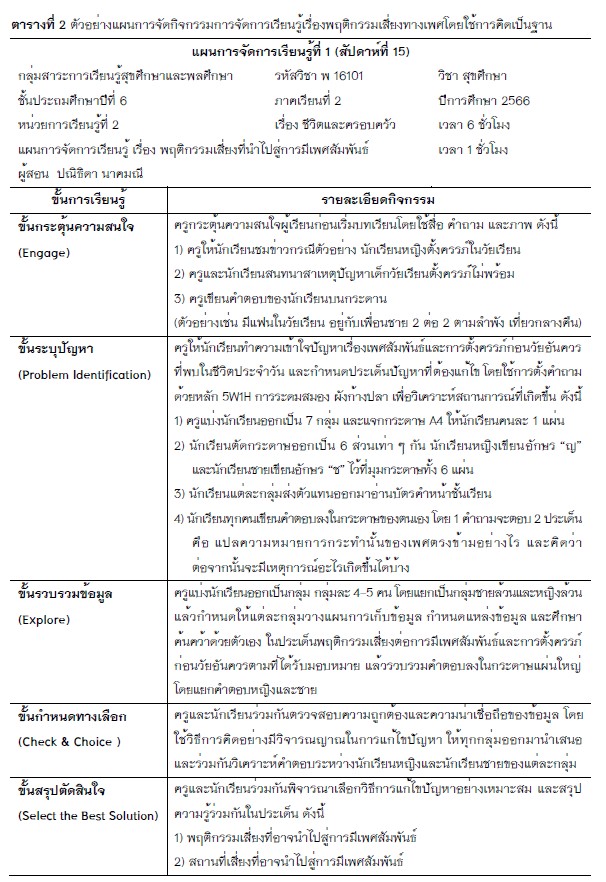
ผลการวิจัยพบว่า 1) แผนการจัดการเรียนรู้เรื่องพฤติกรรมเสี่ยงทางเพศโดยใช้การคิดเป็นฐานเพื่อเสริมสร้างทักษะการคิดอย่างมีวิจารณญาณและความรอบรู้ด้านสุขภาพ ชั้นประถมศึกษาปีที่ 6 มีจำนวน 6 แผน แต่ละแผนมีกิจกรรม 5 ขั้นตอน ประกอบด้วย ขั้นกระตุ้นความสนใจ ขั้นระบุปัญหา ขั้นรวบรวมข้อมูล ขั้นกำหนดทางเลือก และขั้นสรุปตัดสินใจ มีประสิทธิภาพกระบวนการ (E1) และประสิทธิภาพผลลัพธ์ (E2) เท่ากับ 95.71/91.00 สูงกว่าเกณฑ์ 80/80 2) นักเรียนมีทักษะการคิดอย่างมีวิจารณญาณ (M = 28.74, S.D. = 1.17) และ 3) นักเรียนมีความรอบรู้ด้านสุขภาพ (M = 4.91, S.D. = 0.80) หลังเรียนสูงกว่าก่อนเรียนอย่างมีนัยสำคัญทางสถิติที่ระดับ .05
Downloads
Article Details

อนุญาตภายใต้เงื่อนไข Creative Commons Attribution-NonCommercial-NoDerivatives 4.0 International License.
เอกสารอ้างอิง
Anderson, L. W., & Krathwohl, D. R. (Eds.). (2001). A taxonomy for learning, teaching, and assessing: A revision of Bloom's taxonomy of educational objectives. Longman.
Bureau of Reproductive Health. (2018). A survey on sexuality education and life skills for adolescents aged 10-19 years. Department of Health. https://rh.anamai.moph.go.th/web-upload/7x027006c2abe84e89b5c85b44a692da94/tinymce/kpi64/2_4/2_4_44_7.pdf [In Thai]
Bureau of Reproductive Health. (2020). Reproductive health situation in adolescents and youth 2020. Department of Health. https://rh.anamai.moph.go.th/th/cms-of-1/207028 [In Thai]
Chomthananan, N., Sarayuthpitak, J., & Changkaew, W. (2021). Effects of “Moderate Class More Knowledge” activity using reflective thinking on health literacy on electronic cigarette of secondary school students. Academic Journal of Thailand National Sports University, 14(1), 225–236. https://he02.tci-thaijo.org/index.php/TNSUJournal/article/view/250860 [In Thai]
Facione, P., Gittens, C. A., & Tiwari, A. (2008). Critical thinking and clinical reasoning in the health sciences: An international multidisciplinary teaching anthology. California Academic press.
Facione, P. (1990). Critical thinking: A statement of expert consensus for purposes of educational assessment and instruction—The Delphi report. California Academic Press.
Fongtanakit, K. (2022). Rational choice theory and its challenges. Journal of Public Administration, Public Affairs, and Management, 20(2), 83–101. https://so05.tci-thaijo.org/index.php/pajournal/article/view/257479 [In Thai]
Health Education Division. (2021). Performance report on the development of health literacy and health behaviors 2021. Department Of Health Service Support. [In Thai]
Johnson, A. B., & Smith, C. D. (2021). Cognitive processes in health literacy and decision-making among adolescents. Academic Press.
Khaemmanee, T. (2021). Science of teaching: Knowledge for effective learning process management (25th ed.). Chulalongkorn University Press. [In Thai]
Konkam, B., Pinchaleaw, D., & Keskomon, T. (2021). Effects of a participatory promotion program for early adolescents on sex education, life skills, and unplanned pregnancy preventing behaviors. The Southern College Network Journal of Nursing and Public Health, 8(1), 196–210. https://he01.tci-thaijo.org/index.php/scnet/article/view/220092 In Thai]
Kruon, Y. (2023). Effects of learning activities applied by using LOVE Model on responsible citizen of ninth grade students [Master’s thesis, Silpakorn University]. DSpace at Silpakorn University. http://ithesis-ir.su.ac.th/dspace/bitstream/123456789/5130/1/620620117.pdf [In Thai]
Manganello, J. A. (2008). Health literacy and adolescents: A framework and agenda for future research. Health Education Research, 23(5), 840-847. https://doi.org/10.1093/her/cym069
Manyanon, U., & Sarayuthpitak, J. (2020). Effects of analytical thinking process in sex education on the sexual behavior of eight grade male students. Journal of Education Studies, Chulalongkorn University, 48(3), 428–442. https://doi.org/10.14456/educu.2020.42 [In Thai]
Ministry of Education. (2008). The Basic Education Core Curriculum B.E. 2551 (A.D. 2008). Bureau of Academic Affairs and Educational Standards. https://academic.obec.go.th/web/images/document/1725597180_d_1.pdf [In Thai]
Moolkam, S. (2008). Writing a lesson plan that emphasizes thinking (3rd ed.). EK Books. [In Thai]
Nanthum, J., & Kota, N. (2024). The development of problem-based learning activities learning unit promoting health in the community for Mathayom 3 students. Journal of Arts and Science Chaiyaphum Rajabhat University, 11(1), 107-118. (pp. 1-2). https://so06.tci-thaijo.org/index.php/JAS_CPRU/article/view/269069/183739 [In Thai]
Narakorn, K., Sirisawat, C., & Panpruksa, K. (2017). The effect of learning management in health education by using inquiry method on learning achievement and attitude towards learning management for Prathomsuksa 5 students. Silpakorn University Journal of Education, 15(1), 110–122. https://so02.tci-thaijo.org/index.php/suedujournal/article/view/174848/125153 [In Thai]
Noppakunwong, T. (2023). Development of a thinking-based learning model with social networking sites to enhance media literacy skill of undergraduate students. Journal of Graduate School Chaiyaphum Review, 1(2), 1-13. https://so15.tci-thaijo.org/index.php/JGCR/article/view/507 [In Thai]
Nutbeam, D. (2008). The evolving concept of health literacy. Social science & medicine, 67(12), 2072–2078. https://doi.org/10.1016/j.socscimed.2008.09.050
Porkitfuangfoo, N., & Koraneekid, P. (2020). Development of a learning model using thinking-based learning with social media to promote media literacy for undergraduate students. Journal of Education. 15(2), 1-13. https://so01.tci-thaijo.org/index.php/OJED/article/view/245023/165746 [In Thai]
Pathanang, K., & Anguravirutt, S. (2018). Development of learning activities using a problem-based learning and Socratic questioning technique to promote critical thinking in Mathayomsuksa 4 students. Journal of Humanities and Social Sciences Mahasarakham University, 37(2), 57-60. https://hujmsu.msu.ac.th/Eng/pdfsplitE.php?p=MTU5OTAxNTk0Ni5wZGZ8NjYtNzY= [In Thai]
Phansin, A. (2022). Factors affecting intention of premature pregnancy prevention among female senior high school and vocational certificate student in Khanuworalaksaburi District, Kamphaeng Phet Province. [Master thesis, Naresuan University]. NU Intellectual Repository. https://nuir.lib.nu.ac.th/dspace/bitstream/123456789/5934/3/AutcharaPhansin.pdf [In Thai]
Phetkliang, D., & Phetkliang, R. (2024). Guidelines for enhancing decision-making skill via Social Studies learning management. Journal of Education Bansomdejchaopraya Rajabhat University, 17(1), 64–71. https://so17.tci-thaijo.org/index.php/EduBSRU/article/view/254 [In Thai]
Pinasa, C., Kumyoung, A., Kessung, P., Inyai, C., & Srijumnong, J. (2024). Development of authentic assessment tools in educational measurement and evaluation, Faculty of Education, Loei Rajabhat University. Trends of Humanities and Social Sciences Research, 12(2), 323–346. https://so03.tci-thaijo.org/index.php/Humanties-up/article/view/280330/186142 [In Thai]
Promwong, C. (2013). Media performance testing or teaching series. Silpakorn Education and Research Journal, 5(1), 7-20. https://so05.tci-thaijo.org/index.php/suedureasearchjournal/article/view/28419 [In Thai]
Prongprommarat, J., Hongkhuntod, A., & Talasi W. (2021). The development of sexual literacy scale and norm of secondary school students. Sikkha Journal of Education, 8(2), 23-35. https://so05.tci-thaijo.org/index.php/sikkha/article/view/251154/172334 [In Thai]
Pubumrung, S. (2020). The organization of decision-making activities in elementary school students: A case study of results with the IGTTM2 test [Master thesis, Burapha University]. Burapha University Research Information. https://buuir.buu.ac.th/bitstream/1234567890/9190/1/58910148.pdf [In Thai]
Safitri, Y., & Nurhayati, S. (2023). Sex education using problem-based learning approach: An effort to raise adolescent awareness of the dangers of promiscuity. Jurnal Simki Pedagogia, 6(2), 279-286. https://doi.org/10.29407/jsp.v6i2.265
Salachua, P. (2021). Effects of developing media sexual health literacy on the premarital sex prevention among lower secondary school students [Master thesis, Burapha University]. DSpace at Burapha University. https://ir.buu.ac.th/dspace/bitstream/1513/341/1/61920073.pdf [In Thai]
Smart-Morstad, K. (2012). Thinking-based learning: Promoting quality student achievement in the 21st century, by R. J. Swartz, A. L. Costa, B. K. Beyer, R. Reagan, & B. Kallick. Critical Questions in Education, 3(1), 50–51. https://academyforeducationalstudies.org/wp-content/uploads/2014/12/morstad_book_review_final.pdf
Sricharun, S., Tuntiwaranuruk, C., & Sirisawad, C. (2017). The effect of inquiry cycle learning (7E) with higher order question on rational thinking and learning achievement in the topic “digestive system” of grade 10 students. Journal of Education Naresuan University, 19(2), 83-94. https://so06.tci-thaijo.org/index.php/edujournal_nu/article/view/88741/69774 [In Thai]
Thaipong, S., Rodpipat, S, & Sarayuthpitak, J. (2023). The development of health education learning using problem-based approach and Socratic questioning to enhance learning achievement and creative problem solving of secondary school students. Academic Journal of Thailand National Sports Univesity, 15(1), 259-274. https://he02.tci-thaijo.org/index.php/TNSUJournal/article/view/257623/177778 [In Thai]
Swartz, R. J., & McGuinness, C. (2014). Developing and assessing thinking skills: Final report part 1, literature review and evaluation framework. International Baccalaureate. https://doi.org/10.13140/RG.2.1.4917.6163
Swartz, R. J., & Parks, S. (1994). Infusing the teaching of critical and creative thinking into content Instruction. Critical Thinking & Software.
Tangnorakul, P., Sananreangsak, S., & Teerarungsikul, N. (2019). The relationship between sexual health literacy and sexual behavior among middle school female students. Royal Thai Navy Medical Journal, 46(3), 607–620. https://he01.tci-thaijo.org/index.php/nmdjournal/article/view/231178 [In Thai]
Taphad, W., & Sarayuthpitak, J. (2017). Effects of health education learning management using analytical thinking skill and assessing situation for learning achievement in media literacy of lower secondary school students. Journal of Education, Chulalongkorn University, 45(4), 177–189. https://so02.tci-thaijo.org/index.php/EDUCU/article/view/125461 [In Thai]
Waraporn, F. (2022). Report of individual behavior records of grade 6 students, academic year 2022. Anuban Lamphun School. [In Thai]
Wattanaburanon, A. (2020). LOVE model and health education learning management. Journal of Maejo Liberal Arts, 8(1), 233-245. https://so03.tci-thaijo.org/index.php/liberalartsjournal/article/view/244245 [In Thai]
Wongpairin, K., & Songsern, U. (2022). The development of instructional model by thinking-based learning to enhance English reading comprehension abilities and analytical thinking skills of upper secondary school students. Journal of International Buddhist Studies, 13(1), 87-103. https://so09.tci-thaijo.org/index.php/jibs/article/view/2576/1839
