
An Analysis of the Teachings on Abhisaṅkhāra in Buddhist Scriptures
Article Sidebar
Main Article Content
Abstract
This research article, entitled “An Analytical Study of the Teaching on Abhisaṅkhāra in Buddhist Scriptures,” has three objectives: (1) to study the teachings concerning Saṅkhāra in Buddhist scriptures; (2) to study the teachings concerning Abhisaṅkhāra in Buddhist scriptures; and (3) to analyze the doctrine of Abhisaṅkhāra as presented in Buddhist scriptures. This reserch employed a documentary research methodology by examining data from the Tipiṭaka, the commentaries, and related Buddhist academic works. The collected data were descriptively analyzed in accordance with the three research objectives.
The findings revealed that: (1) the term Saṅkhāra carries different meanings depending on its doctrinal context. Within the framework of Dependent Origination (Paṭiccasamuppāda), it denotes volitional kamma formations conditioned by ignorance and functioning as a condition for the arising and continuity of consciousness. (2) Abhisaṅkhāra refers to intentional kamma formation and is classified into three categories: Puññābhisaṅkhāra (meritorious formations), comprising volitions associated with the eight sense-sphere wholesome consciousnesses (kāmāvacara-kusala-cittas) and the five fine-material-sphere wholesome consciousnesses (rūpāvacara-kusala-cittas), leading to fortunate realms of rebirth; Apuññābhisaṅkhāra (demeritorious formations), comprising volitions associated with the twelve unwholesome consciousnesses (akusala-cittas), leading to unfortunate realms of rebirth; and Āneñjābhisaṅkhāra (imperturbable formations), comprising volitions associated with the four immaterial-sphere wholesome consciousnesses (arūpāvacara-kusala-cittas), leading to rebirth in the immaterial Brahma realms. Each category produces results corresponding to the ethical and contemplative quality of the mind. Nevertheless, all formations conditioned by ignorance and craving remain within saṃsāra. (3) Through the integration of the Sutta and Abhidhamma perspectives, the study identified a coherent causal structure linking mind, volition, kamma, karmic results, rebirth-linking consciousness, and planes of existence. The Suttas emphasize ethical conduct, causality, and practice, whereas the Abhidhamma explains the constituent mental factors and momentary processes through which kamma is accumulated and produces results.
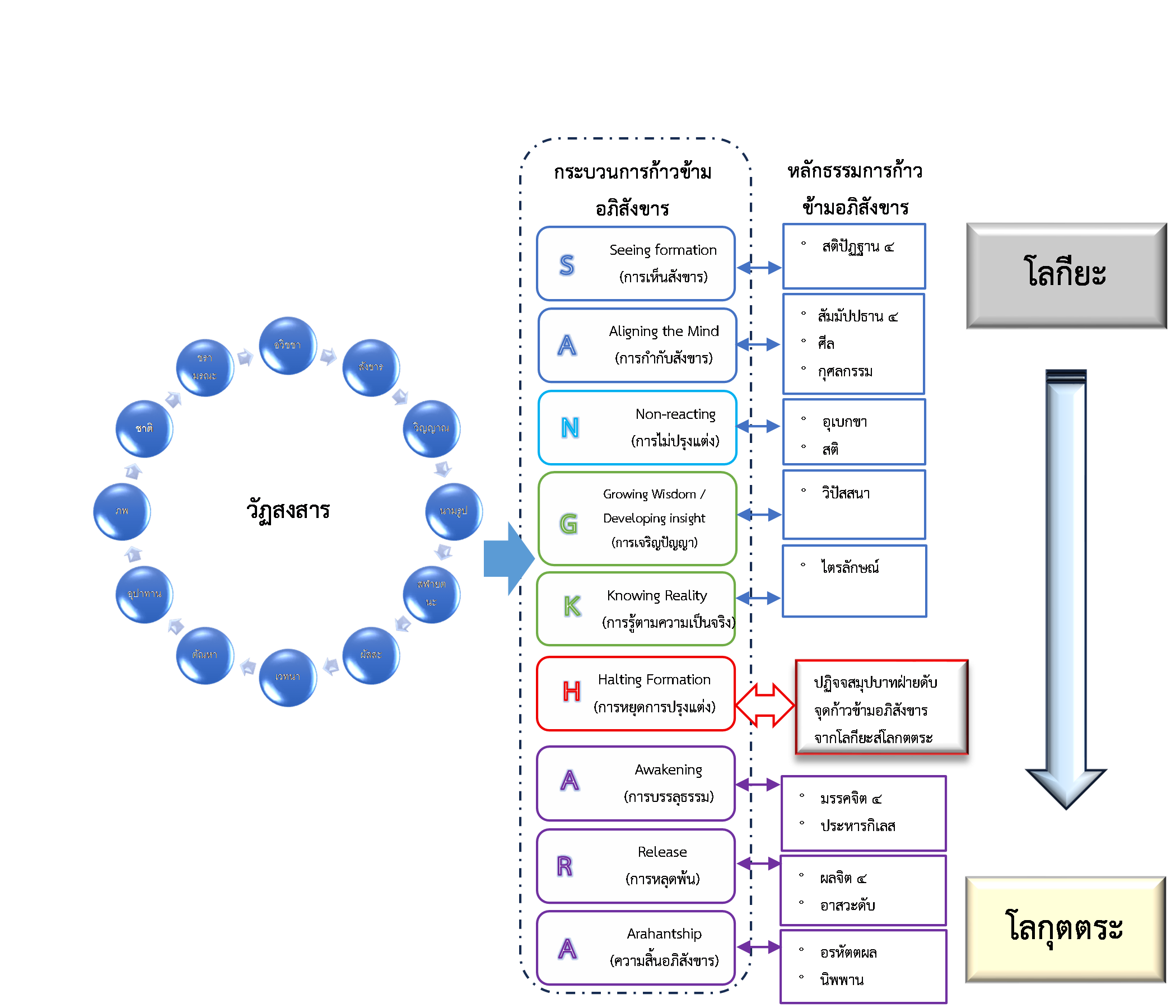
The study proposes a nine-stage SANGKHARA Model, consisting of Seeing Formations, Aligning the Mind, Non-reacting, Growing Wisdom, Knowing Reality, Halting Formation, Awakening, Release, and Arahantship. The model demonstrates that the transcendence of Abhisaṅkhāra requires the cultivation of morality (sīla), concentration (samādhi), and wisdom (paññā), leading to the progressive abandonment of ignorance (avijjā), craving (taṇhā), and clinging (upādāna). The process culminates in the cessation of renewed existence through the attainment of the path and fruition of Arahantship.
Article Details

This work is licensed under a Creative Commons Attribution-NonCommercial-NoDerivatives 4.0 International License.
บทความนี้เป็นความคิดเห็นส่วนผู้แต่ง กองบรรณาธิการไม่จำเป็นต้องเห็นด้วยเสมอไป
References
ภาษาไทย
พระธัมมานันทมหาเถระแปลโดย พระคันธสาราภิวงศ์. อภิธัมมัตถสังคหะและปรมัตถทีปนี. พิมพ์ ครั้งที่ ๔.กรุงเทพมหานคร: หจก. ประยูรสาสน์ไทย การพิมพ์, ๒๕๕๕.
พระนาคเสนเถระ แปลโดย ไชยวัฒน์ กปิลกาญจน์ และคณะ. มิลินทปัญหา เล่มที่ ๑. พิมพ์ครั้งที่ ๔. กรุงเทพมหานคร: สุสวัสดิ์พริ้นเตอร์, ๒๕๕๔.
พระพรหมบัณฑิต (ประยูร ธมฺมจิตฺโต). โลกทัศน์ชาวพุทธ. กรุงเทพมหานคร: โรงพิมพ์มหาจุฬาลงกรณราชวิทยาลัย. ๒๕๔๘.
พระมหาหรรษา ธมฺมหาโส. “การวิเคราะห์กรรมในพระพุทธศาสนา”. วิทยานิพนธ์พุทธศาสตรดุษฎีบัณฑิต สาขาพระพุทธศาสนา. บัณฑิตวิทยาลัย: มหาวิทยาลัยมหาจุฬาลงกรณราชวิทยาลัย, ๒๕๔๘.
มหาจุฬาลงกรณราชวิทยาลัย. พระไตรปิฎกภาษาไทย ฉบับมหาจุฬาลงกรณราชวิทยาลัย. กรุงเทพมหานคร : โรงพิมพ์มหาจุฬาลงกรณราชวิทยาลัย, ๒๕๓๙.
สมเด็จพระพุทธโฆษาจารย์ (ป.อ.ปยุตฺโต). พจนานุกรมพุทธศาสตร์ ฉบับประมวลธรรม. พิมพ์ครั้งที่ ๓๔. กรุงเทพมหานคร: โรงพิมพ์พระพุทธศาสนาของธรรมสภา, ๒๕๕๙.
