Authentic Leadership of School Administrators Affecting of Efficiency Teachers in School Under Loei Primary Education Service Area Office 1
Article Sidebar
Main Article Content
Abstract
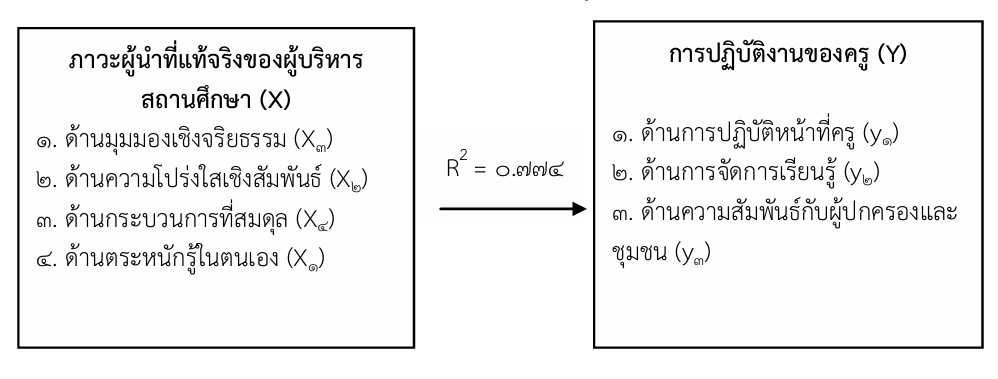
This research aimed to study: 1) the level of authentic leadership of school administrators and the level of teachers’ performance, 2) the relationship between authentic leadership of school administrators and teachers’ performance, and 3) the authentic leadership factors of school administrators that could predict teachers’ performance under Loei Primary Educational Service Area Office 1. The sample group consisted of 300 school administrators and teachers. The research instrument was a five-point rating scale questionnaire. The reliability coefficient of the authentic leadership questionnaire was 0.981, while that of the teachers’ performance questionnaire was 0.960. The findings revealed that: 1) the overall level of authentic leadership of school administrators was at the highest level (x̄ = 4.51), and the overall level of teachers’ performance was also at the highest level (x̄ = 4.52); 2) authentic leadership of school administrators had a high positive relationship with teachers’ performance at the .01 level of statistical significance (r = 0.805); and 3) all four dimensions of authentic leadership ethical perspective, relational transparency, balanced processing, and self-awareness, could jointly predict teachers’ performance at 77.40 percent, with ethical perspective having the strongest influence.
The findings further reflected that authentic leadership of school administrators did not enhance teachers’ performance through only a single dimension, but rather through the integration of all four dimensions of authentic leadership. In particular, the ethical perspective dimension served as a key mechanism in fostering trust, motivation, and collaboration in work performance, leading to sustainable improvement in educational management quality.
Article Details

This work is licensed under a Creative Commons Attribution-NonCommercial-NoDerivatives 4.0 International License.
บทความนี้เป็นความคิดเห็นส่วนผู้แต่ง กองบรรณาธิการไม่จำเป็นต้องเห็นด้วยเสมอไป
References
ภาษาไทย
พปุณณิฐฐา มาเชค. การบริหารองค์กรทางการศึกษาในยุคดิจิทัล. ชลบุรี : คณะศึกษาศาสตร์ มหาวิทยาลัยบูรพา, ๒๕๖๕.
สำนักงานเลขาธิการสภาการศึกษา. แผนการศึกษาแห่งชาติ พ.ศ. ๒๕๖๐–๒๕๗๙. กรุงเทพมหานคร : สำนักงานเลขาธิการสภาการศึกษา, ๒๕๖๐.
จิราภรณ์ นวลน้อย. “ปัจจัยที่ส่งผลต่อประสิทธิภาพในการปฏิบัติงานของบุคลากรสายสนับสนุน สังกัดมหาวิทยาลัยเทคโนโลยีราชมงคลศรีวิชัย.” วารสารนวัตกรรมการจัดการทางการศึกษาและสังคม ๑, ฉบับที่ ๒ (๒๕๖๑) : ๔๕–๕๘.
วรรณวิสาข์ รัตนพันธ์, ณัฐวรรณ พุ่มดียิ่ง และพิชญาภา ยืนยาว. “ภาวะผู้นำที่แท้จริงของผู้บริหารสถานศึกษาที่ส่งผลต่อประสิทธิภาพการปฏิบัติงานของข้าราชการครู สังกัดสำนักงานเขตพื้นที่การศึกษาประถมศึกษาสมุทรสาคร.” วารสารสิรินธรปริทรรศน์ ๒๒, ฉบับที่ ๒ (กรกฎาคม–ธันวาคม ๒๕๖๔).
วรัชญ์ขวัญ ปัญวิยะ. ภาวะผู้นำที่แท้จริงที่ส่งผลต่อการปฏิบัติงานตามมาตรฐานวิชาชีพของครูในสถานศึกษา เขตอำเภอแม่ฟ้าหลวง จังหวัดเชียงราย สังกัดสำนักงานเขตพื้นที่การศึกษาประถมศึกษาเชียงราย เขต ๓.วิทยานิพนธ์ สาขาวิชาการบริหารการศึกษา, มหาวิทยาลัยพะเยา, ๒๕๖๔.
สำนักงานเขตพื้นที่การศึกษาประถมศึกษาเลย เขต ๑. รายงานผลการดำเนินงาน. เลย : สำนักงานเขตพื้นที่การศึกษาประถมศึกษาเลย เขต ๑, ๒๕๖๘.
ภาษาอังกฤษ
Northouse, Peter G. Leadership: Theory and Practice. Thousand Oaks, CA: Sage, 2010.
Sharma, Chandradhar. A Critical Survey of Indian Philosophy. Varanasi: Motilal Banarsidass, 1964.
Krejcie, Robert V., and Daryle W. Morgan. “Determining Sample Size for Research Activities.” Educational and Psychological Measurement 30, (1970): 607
Shulman, Lee S. “Knowledge and Teaching: Foundations of the New Reform.” Harvard Educational Review 57, (1987): 1–22.
Walumbwa, Fred, Bruce J. Avolio, William L. Gardner, Tara S. Wernsing, and Suzanne J. Peterson. “Authentic Leadership: Development and Validation of a Theory-Based Measure.” Journal of Management 34, no. 1 (2008): 89–126.
Organisation for Economic Co-operation and Development (OECD). PISA 2022 Results (Volume I and II): Country Notes – Thailand. Paris: OECD Publishing, 2023.
