Guidelines for Developing MCU Language Institute
Article Sidebar
Main Article Content
Abstract
This research project, titled “Guidelines for Developing the Structure, Work Systems, and Personnel of the Language Institute, Mahachulalongkornrajavidyalaya University,” has three primary objectives: 1) to examine the current status, problems, and obstacles concerning the organizational structure, work systems, and personnel competencies of the Language Institute, Mahachulalongkornrajavidyalaya University (MCU); 2) to study the elements required for the efficient development of its structure, work systems, and personnel competencies; and 3) to propose an efficient model for its organizational structure, work systems, and personnel competencies.
A mixed-methods research design was employed, combining qualitative and quantitative methodologies. Buddhist doctrines, specifically the Four Paths of Accomplishment (Iddhipāda IV) and the Four Sublime States of Mind (Brahmavihāra IV), were integrated to guide the development of the Language Institute, MCU. Research instruments included documentary analysis, questionnaires, and in-depth interviews. Quantitative data were collected from a population of 84 individuals/monks, yielding a sample group of 60 individuals/monks, alongside 48 key informants. In-depth interviews were conducted with 5 key informants (out of 6 out of 6 targeted university and institute executives from Mahachulalongkornrajavidyalaya University, Chulalongkorn University, and Thammasat University, representing directors, deputy directors, and department heads). Quantitative data from the Likert-scale questionnaires were analyzed using SPSS and Cronbach’s alpha coefficient, and the resulting statistical data were synthesized, compiled, and summarized for discussion and recommendations. Qualitative data from the purposive in-depth interviews underwent Content Analysis; transcripts were coded and categorized question-by-question, synthesized into key themes, and presented through a descriptive presentation format. The questionnaire consisting of 60 items yielded an overall Item-Objective Congruence (IOC) index of 0.82, which surpassed the specified threshold (0.50), indicating satisfactory content validity and congruence for research application. Similarly, the 12-item interview guide yielded a high overall IOC index of 0.92, demonstrating excellent content validity, consistency, and appropriateness for qualitative data collection.
The findings for Objective 1 regarding the current status and problems revealed that, from an internal perspective (n = 17), satisfaction toward the organization across the three dimensions stood at moderate levels: personnel competency (xˉ=3.87), organizational structure (xˉ=3.79), and work systems (xˉ=3.66). Although these means were slightly above the baseline, the One-Sample t-test comparison against the standard criterion of 3.50 showed p-values greater than 0.05 (p>0.05) across all dimensions. This lack of statistically significant difference from the baseline serves as a critical indicator establishing a clear “Need for Development,” thereby aligning with the research focus on discovering development components. Furthermore, the “work system” dimension (Sat_system) obtained the lowest mean score (xˉ=3.66), indicating delays or redundant procedures. This reflects underlying structural ambiguities, rigid work processes, and personnel competencies requiring urgent development, which altogether signify a “Stagnant Administrative State” and “Hidden Problems” in public administration and organizational development within the administrative framework of the Language Institute, MCU.
The findings for Objective 2 regarding development components from an external perspective (students and test-takers) indicated that service users were highly satisfied with the operations of the Language Institute, with mean scores reaching very high levels (xˉ=4.36−4.48), illustrating strong academic and service quality. Hypothesis testing confirmed statistically significant success across all aspects (p<0.05). Specifically, teaching and learning delivery (Sat_teaching) achieved the highest mean score (xˉ=4.48), indicating that the MCU-GET preparation courses and instructional strategies (e.g., the FSA Strategy) effectively fulfilled learners' needs and demonstrated a robust “academic potential” that attracts and fosters trust among users. Moreover, service quality exceeded expectations, with overall services (Sat_service) and project activities scoring high (xˉ=4.36−4.42) at a statistically significant level (p=.005), demonstrating that the institute manages its front-end operations efficiently to create positive experiences despite internal resource constraints or back-end system limitations. Qualitative insights from 5 participating executives from MCU, Chulalongkorn University, and Thammasat University emphasized the necessity of formulating systematic policy proposals and organizational development plans at the university level, alongside strategies to elevate the Language Institute, MCU, into a premier international language hub. This was underscored by a Reality Gap analysis comparing the external and internal perspectives, which highlighted critical areas requiring immediate improvement.
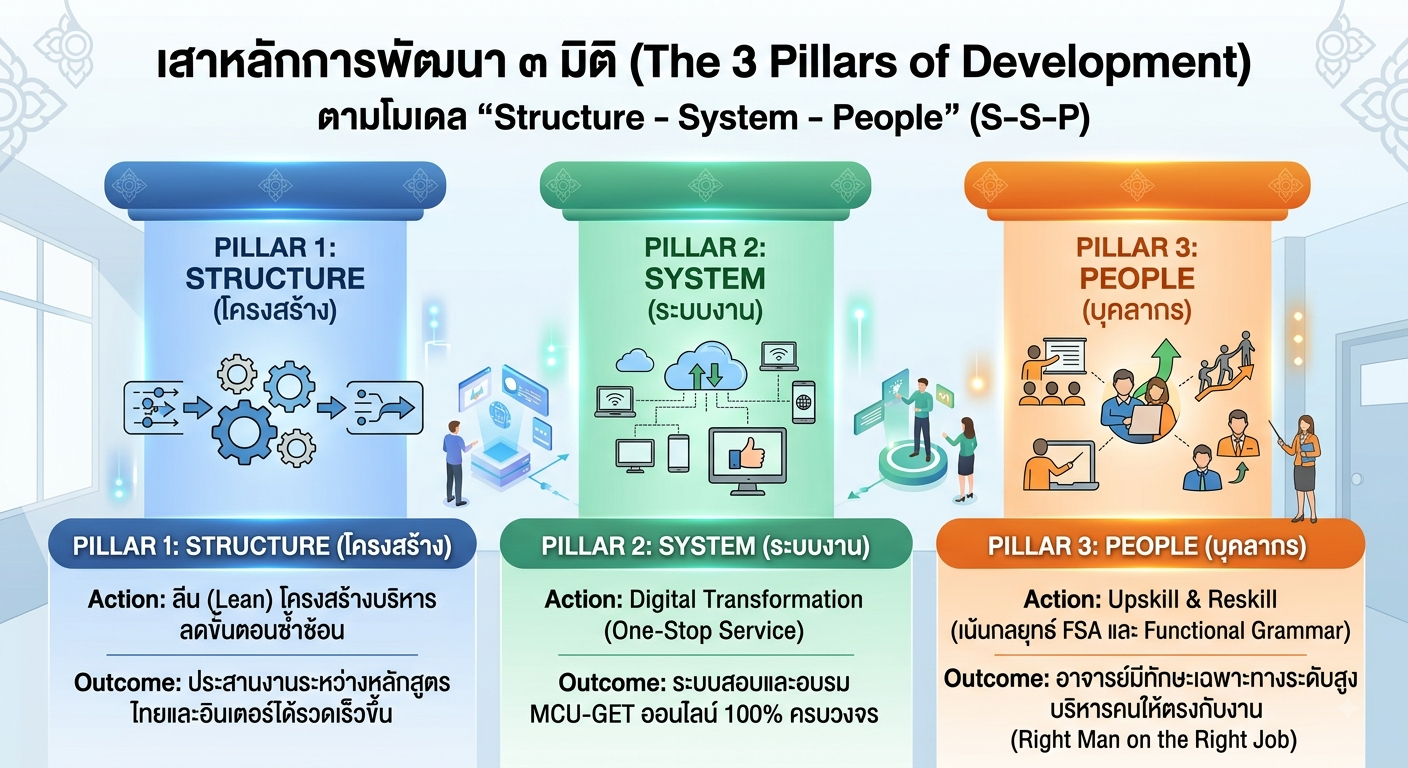
The findings for Objective 3 regarding the presentation of an efficient structural, work system, and personnel competency model culminated in the “Triple-S Transformation Model” (Structure-System-Staff) for sustainable development, comprising three core dimensions: 1) Structure: restructuring the chain of command, reducing redundancies, defining clear job descriptions, and streamlining decision-making processes; 2) System: developing a Digital One-Stop Service to support English coursework (MCU 001-006), MCU-GET examinations, and language training, thereby reducing operational steps and waiting times; and 3) Staff: emphasizing the principle of “Put the right man on the right job,” enhancing competencies through English language learning via the FSA Strategy, and strengthening professional ethics to elevate expertise to international standards. Accelerating the stabilization and agility of the administrative structure, fully integrating digital technology into work systems, and aligning personnel’s specialized skills with core missions will effectively transition the Language Institute from a moderate-performing state into a High-Performance Organization (HPO) in the future.
Article Details

This work is licensed under a Creative Commons Attribution-NonCommercial-NoDerivatives 4.0 International License.
บทความนี้เป็นความคิดเห็นส่วนผู้แต่ง กองบรรณาธิการไม่จำเป็นต้องเห็นด้วยเสมอไป
References
ภาษาไทย
กลุ่มงานพัฒนาโครงสร้างองค์กร กลุ่มพัฒนาระบบบริหาร. คู่มือการปฏิบัติงาน กระบวนงานปรับปรุงโครงสร้างส่วนราชการ. กรุงเทพ: สำนักงานปลัดกระทรวงสาธารณสุข, ๒๕๖๐.
กิตติทัต วงษ์พวง. “พฤติกรรมและทัศนคติในการพัฒนาทักษะภาษาอังกฤษแบบนำตนเองของนักศึกษาในสถาบันอุดมศึกษาเอกชน”. การค้นคว้าอิสระ หลักสูตรบริหารธุรกิจมหาบัณฑิต สาขาวิชานวัตกรรมทางธุรกิจ. โครงการหลักสูตรปริญญาโทออนไลน์ มหาวิทยาลัยธรรมศาสตร์, ๒๕๖๖.
ดีน แอนเดอร์สัน และลินดา อัคเคอร์แมน แอนเดอร์สัน. เกินกว่าการจัดการการเปลี่ยนแปลง: วิธีการบรรลุผลลัพธ์ที่ก้าวล้ำผ่านการเป็นผู้นำการเปลี่ยนแปลงที่มีสติ. ซานฟรานซิสโก: ไฟฟ์เฟอร์, ๒๐๑๐.
ภัทรภร บุญศร. “การพัฒนาทักษะการพูดภาษาอังกฤษในชีวิตประจำวันโดยใช้บทฝึกการสนทนาภาษาอังกฤษ”. รายงานการวิจัย. มหาวิทยาลัยราชภัฏมหาสารคาม, ๒๕๖๒.
มณัญญา มานะรัชศักดิ์ และ อุบลวรรณ ส่งเสริม. “การพัฒนารูปแบบการจัดการเรียนการสอนภาษาอังกฤษตามแนวการสอนภาษาเพื่อการสื่อสาร ร่วมกับการเรียนรู้แบบร่วมมือเพื่อพัฒนาทักษะการสื่อสารและความมั่นใจในการใช้ภาษาอังกฤษ สำหรับนักเรียนชั้นประถมศึกษา”. วารสารศึกษาศาสตร์ มหาวิทยาลัยศิลปากร. ปีที่ ๒๑ ฉบับที่ ๑ (มกราคม - มิถุนายน ๒๕๖๖): ๓๖๗-๓๘๑.
วิรัช วิรัชนิภาวรรณ. การบริหารจัดการและการบริหารการพัฒนาของหน่วยงานของรัฐ. E-book: ExpernetBooks, ๒๐๒๐.
วรพจน์ พรหมสัตยพรต. การบริหารงานสาธารณสุขท้องถิ่น. E-book: ExpernetBooks, ๒๐๒๐.
ว่าที่ร้อยตรีหญิงมณัญญา มานะรัชศักดิ์. “การพัฒนารูปแบบการจัดการเรียนการสอนภาษาอังกฤษ ตามแนวการสอนภาษาเพื่อการสื่อสารร่วมกับการเรียนรู้แบบร่วมมือ เพื่อพัฒนาทักษะการสื่อสารและความมั่นใจในการใช้ภาษาอังกฤษสำหรับนักเรียนชั้นประถมศึกษา”. วิทยานิพนธ์ปรัชญาดุษฎีบัณฑิต. หลักสูตรและ
การสอน: มหาวิทยาลัยศิลปากร, ๒๕๖๕.
วิลเลียม เจ. โรธเวลล์ และคณะ. การปฏิบัติการพัฒนาองค์กร: คู่มือสำหรับการเป็นผู้นำการเปลี่ยนแปลง. (ซานฟรานซิสโก: ไฟฟ์เฟอร์, ๒๐๑๐.
วิลเลียม เอ. พาสมอร์ และคณะ. การวิจัยการเปลี่ยนแปลงและการพัฒนาองค์กร เล่มที่ ๑๘. บิงลีย์: Emerald Group Publishing Limited, ๒๐๑๐
ศิราภรณ์ เรืองแก้ว.“ปัญหาและความต้องการของผู้เรียนภาษาต่างประเทศที่มีต่อการให้บริการของสถาบันภาษา มหาวิทยาลัยรามคำแหง”. รายงานการวิจัย. มหาวิทยาลัยรามคำแหง, ๒๕๕๗.
สถาบันภาษามหาวิทยาลัยราชภัฏนครปฐม. แผนยุทธศาสตร์สถาบันภาษามหาวิทยาลัยราชภัฏนครปฐม ประจำปีงบประมาณ พ.ศ. ๒๕๖๔. นครปฐม: มหาวิทยาลัยราชภัฏนครปฐม, ๒๕๖๔.
สมเด็จพระพุทธโฆษาจารย์ (ป. อ. ปยุตฺโต). พุทธธรรม ฉบับปรับขยาย. ฉบับข้อมูลคอมพิวเตอร์, ๒๕๖๘.
สมพร โกมารทัต. “การศึกษาการใช้กลยุทธ์การเรียนภาษาต่างประเทศของนักศึกษาระดับปริญญาตรีในกรุงเทพฯและปริมณฑล”. รายงานผลการวิจัย. มหาวิทยาลัยธุรกิจบัณฑิตย์, ๒๕๕๙.
สำนักงานปลัดกระทรวงแรงงาน. แผนบริหารความต่อเนื่อง (Business Continuity Plan: BCP). กรุงทพ: กระทรวงแรงงาน, ๒๕๖๓.
หลุยส์ คาร์เตอร์ เดวิด อุลริช และมาร์แชลล์ โกลด์สมิธ. แนวทางปฏิบัติที่ดีที่สุดในการพัฒนาความเป็นผู้นำและการเปลี่ยนแปลงองค์กร: บริษัทที่ดีที่สุดจะรับประกันการเปลี่ยนแปลงที่มีความหมายและความเป็นผู้นำที่ยั่งยืนได้อย่างไร. ซานฟรานซิสโก: ไฟฟ์เฟอร์, ๒๐๐๕.
เฮลมี่ เอช บาลีห์. โครงสร้างองค์กร: ทฤษฎีและการออกแบบ การวิเคราะห์และการกำหนด. สหรัฐอเมริกา: Springer Science + Business Media, Inc., 2006.
