
Learning in the MCU-GET Preparation Course via FSA Strategy Functional Sentence Analysis
Article Sidebar
Main Article Content
Abstract
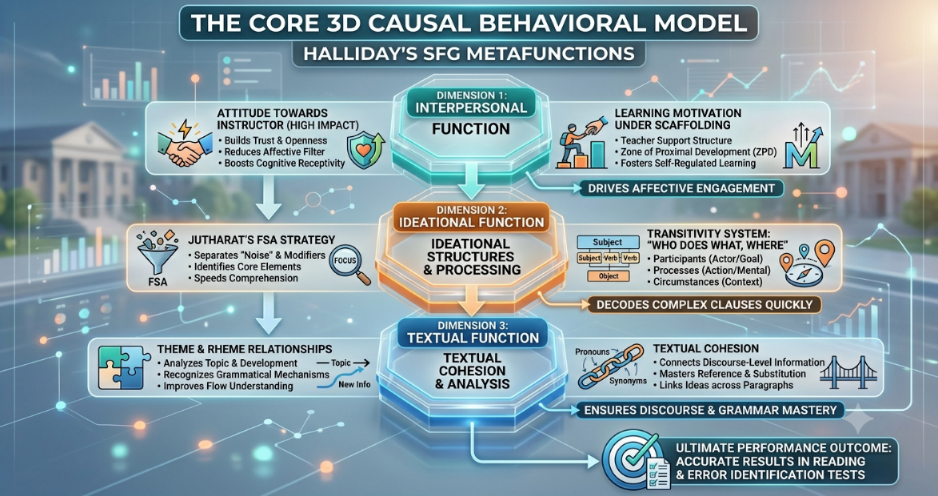
The objectives of this research article were to: (1) investigate the English proficiency problems of learners in the MCU-GET preparation course utilizing the Functional Sentence Analysis (FSA) strategy; (2) examine the effects of learners’ attitudes on their learning outcomes using the FSA strategy; and (3) analyze the relationship between the instructional outcomes and the learners' actual MCU-GET test scores. Utilizing a quantitative research methodology, the research population consisted of 45 graduate students, from which a sample of 39 students was selected through the simple random sampling technique. The research instruments comprised a four-skill instructional package developed by extracting frequently miscoded grammatical structures from past exams, PowerPoint-based animation media, and a 5-point Likert scale attitude questionnaire. The instruments yielded an Item-Objective Congruence (IOC) index of 0.760 and a reliability coefficient of 0.972. Data were analyzed using descriptive statistics, Pearson’s correlation coefficient, and One-Sample t-test. The research findings revealed that: (1) Learners' Problems: The majority of learners (38.5%–46.2%) experienced difficulties across listening, speaking, reading, and writing skills. Specifically, these included problems in learning pronunciation combined with writing (30.8%), writing combined with grammar (25.6%), and writing alone (20.5%). (2) Effects of Attitudes on Learning Outcomes: Learners' attitudes exerted statistically significant effects on learning outcomes in 4 dimensions. Ranked from the highest to lowest impact, these were: instructional process (p = 0.664), instructor’s teaching capability (p = 0.700, indicating an inverse relationship), FSA strategy (p = 0.495), and attitude toward the English language (p = 0.328). The remaining 4 dimensions showed no statistically significant effects (p > 0.05). (3) Relationship with actual MCU-GET Scores: Overall, the correlation between the FSA instructional outcomes and the test scores was not statistically significant at the 0.05 level. However, a comparative analysis of the subgroup that took the exam more than once revealed that their average scores increased from 57.67 to 70.33, representing a total improvement of 21.95%. This demonstrates that the FSA strategy can significantly elevate learners' MCU-GET scores.
Article Details

This work is licensed under a Creative Commons Attribution-NonCommercial-NoDerivatives 4.0 International License.
บทความนี้เป็นความคิดเห็นส่วนผู้แต่ง กองบรรณาธิการไม่จำเป็นต้องเห็นด้วยเสมอไป
References
ภาษาไทย
มหาจุฬาลงกรณราชวิทยาลัย. พระไตรปิฎกภาษาไทย ฉบับมหาจุฬาลงกรณราชวิทยาลัย. กรุงเทพมหานคร:
โรงพิมพ์มหาจุฬาลงกรณราชวิทยาลัย, ๒๕๓๙.
จุฑารัตน์ คัมภีรภาพ. “การใช้กลยุทธ์การวิเคราะห์ประโยคเชิงคู่ความสัมพันธ์ในการตรวจทานงานเขียน”. วารสารภาษาปริทัศน์. ปีที่ ๓๔ (๒๕๖๒): ๑๒–๒๕.
จุฑารัตน์ คัมภีรภาพ. “ผลการใช้กลยุทธ์ Functional Sentence Analysis (FSA) ในการตรวจทานการเขียนด้วยตนเองที่มีต่อความถูกต้องในการใช้ไวยากรณ์ของนิสิตในรายวิชาภาษาอังกฤษเพื่อการเรียนรู้ในชีวิตจริง”. วารสารภาษาปริทัศน์. ปีที่ ๓๖ (๒๕๖๔): ๓๒–๔๘.
จุฑารัตน์ คัมภีรภาพ. “พุทธนวัตกรรมการพัฒนาคุณลักษณะหลักอิทธิบาท ๔ ด้วยกลยุทธ์ FSA เพื่อการเรียนรู้ไวยากรณ์อังกฤษ สำหรับนิสิตระดับบัณฑิตศึกษา มจร”. วารสารบัณฑิตศึกษาปริทรรศน์. ฉบับที่ ๑ (๒๕๖๗).
ดวงกมล เสนีย์วงศ์ ณ อยุธยา. “การศึกษาผลสัมฤทธิ์ทางการเรียนและเจตคติต่อวิชาภาษาอังกฤษของนักศึกษาโดยใช้การสอนตามแนวคิดหน้าที่นิยม”. วารสารวิชาการศึกษาศาสตร์. ปีที่ ๑๙ ฉบับที่ ๒ (๒๕๖๑): ๔๕–๕๘.
นภดล สังข์โพธิ์. “ผลของการจัดกิจกรรมการเรียนรู้ตามแนวไวยากรณ์เชิงหน้าที่ที่มีต่อความสามารถในการเขียนภาษาอังกฤษของนักศึกษาระดับปริญญาตรี”. วารสารมนุษยศาสตร์และสังคมศาสตร์. ปีที่ ๑๑ ฉบับที่ ๑ (๒๕๖๒): ๑๑๒-๑๒๙.
สุมิตรา อังวัฒนกุล. “ความสัมพันธ์ระหว่างความสามารถในการสื่อสารกับผลสัมฤทธิ์ในการเรียนภาษาอังกฤษ”. รายงานการวิจัย. โรงพิมพ์จุฬาลงกรณ์มหาวิทยาลัย, ๒๕๓๗.
อภิสิทธิ์ ศรีราชา. “การพัฒนากลยุทธ์การวิเคราะห์โครงสร้างประโยคเพื่อยกระดับทักษะการอ่านและการเขียนภาษาอังกฤษสำหรับนักศึกษาในหลักสูตรเตรียมสอบ”. วารสารภาษาและวัฒนธรรม. ปีที่ ๔๑ ฉบับที่ ๒ (๒๕๖๕): ๘๙–๑๐๔.
ภาษาอังกฤษ
Biber, D. University language: A corpus-based study of spoken and written registers, 2006.
Bloor, T., & Bloor, M. The functional analysis of English: A Hallidayan approach. 3rd ed. Routledge, 2013.
Butt, D., Fahey, S., Feez, S., & Spinks, S. Using functional grammar: An explorer's guide. Palgrave Macmillan, 2012.
Cheng, L. Changing language teaching through language testing: A washback study. Cambridge University Press, 2005.
Derewianka, B. A new grammar companion for teachers. Primary English Teaching Association Australia (PETAA), 2011.
Eggins, S. An introduction to systemic functional linguistics. 2nd ed. Continuum International Publishing Group, 2004.
Halliday, M. A. K. Spoken and written language. Deakin University Press,1985.
Halliday, M. A. K. An introduction to functional grammar. 2nd ed. Edward Arnold, 1994.
Halliday, M. A. K., & Matthiessen, C. M. I. M. Halliday's introduction to functional grammar. 4th ed. Routledge John Benjamins Publishing, 2014.
Martin, J. R., & Rose, D. Working with discourse: Meaning beyond the clause. 2nd ed. Continuum, 2007.
Richards, J. C. Communicative language teaching today. Cambridge University Press, 2006.
Thompson, G. Introducing functional grammar. 3rd ed. Routledge, 2014.
