Development of Buddhist Oriented Creative Media Innovation for Social Literacy Among Thai Adolescents
Article Sidebar
Main Article Content
Abstract
The objectives of this research Article were: 1) to analyze and design creative Buddhist media innovations for social literacy suitable for Thai youth; 2) to develop and pilot these innovations; and 3) to evaluate the innovations and develop a manual for their implementation. This study employed a Research and Development (R&D) methodology divided into three phases: Phase 1 (R1) involved a synthesis of the Tripitaka and expert interviews to establish a conceptual framework and select six Jataka tales. Phase 2 (D1) focused on the design and development of Jataka-based video clips, validated through Index of Item-Objective Congruence (IOC) analysis. Phase 3 (R2–D2) consisted of a field trial with 30 secondary school students. Data were analyzed using mean, standard deviation, t-test, and qualitative content synthesis to finalize the innovation model.
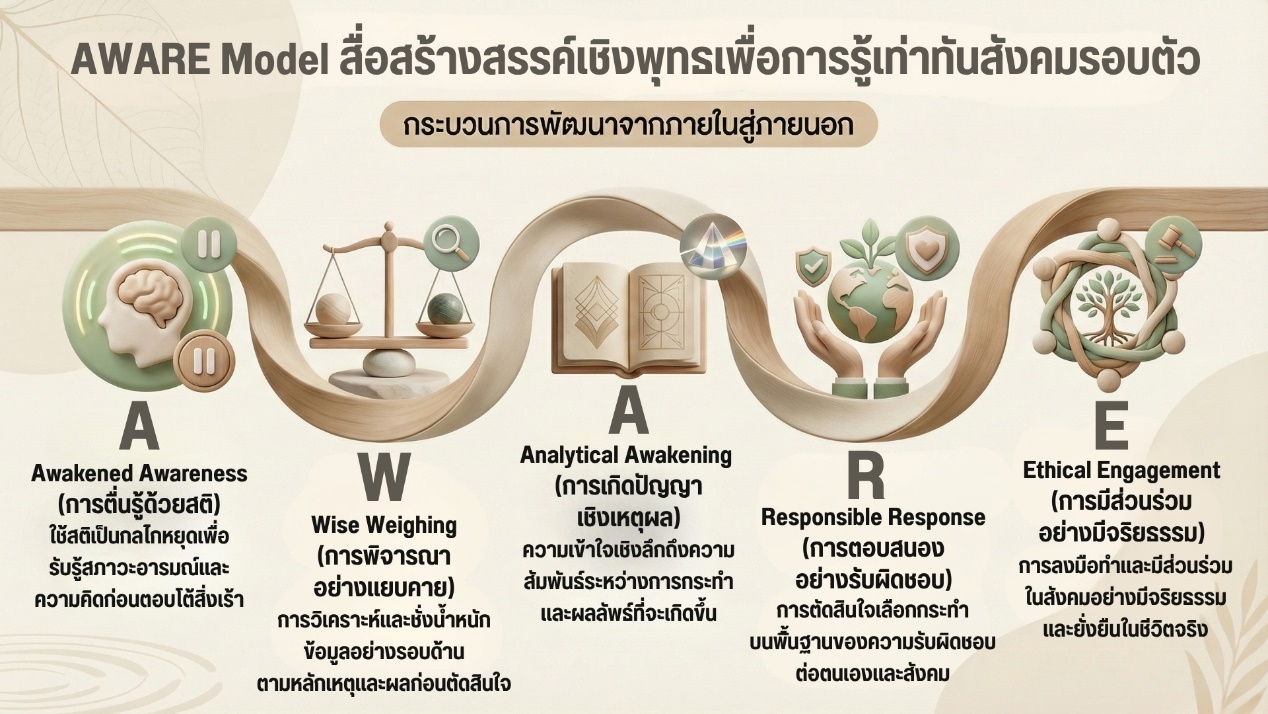
The research findings revealed that in Phase 1 (R1), Thai youth demonstrated high levels of digital media consumption with a tendency for impulsive responses. Key Buddhist principles—namely Mindfulness (Sati), Analytical Reflection (Yonisomanasikara), and Causal Wisdom—were synthesized to facilitate the transition from awareness to virtuous decision-making, serving as the foundation for the innovation design. In Phase 2 (D1), six situational Jataka video clips were systematically developed, achieving high content validity (IOC 0.67–1.00). In Phase 3 (R2–D2), the field trial results showed that the target group’s post-test scores increased significantly at the .05 level across all dimensions: information verification, impact assessment, and deliberate consideration.
Article Details

This work is licensed under a Creative Commons Attribution-NonCommercial-NoDerivatives 4.0 International License.
บทความนี้เป็นความคิดเห็นส่วนผู้แต่ง กองบรรณาธิการไม่จำเป็นต้องเห็นด้วยเสมอไป
References
มหาจุฬาลงกรณราชวิทยาลัย. พระไตรปิฎกภาษาไทย ฉบับมหาจุฬาลงกรณราชวิทยาลัย. กรุงเทพมหานคร : โรงพิมพ์มหาจุฬาลงกรณราชวิทยาลัย, ๒๕๓๙.
หนังสือ
สำนักงานพัฒนาธุรกรรมทางอิเล็กทรอนิกส์. รายงานผลการสำรวจพฤติกรรมผู้ใช้อินเทอร์เน็ตในประเทศไทย ปี ๒๕๖๖. กรุงเทพมหานคร: กระทรวงดิจิทัลเพื่อเศรษฐกิจและสังคม, ๒๕๖๖.
สำนักงานสถิติแห่งชาติ. การสำรวจการใช้เทคโนโลยีสารสนเทศและการสื่อสารในครัวเรือน พ.ศ. ๒๕๖๕. กรุงเทพมหานคร: สำนักงานสถิติแห่งชาติ, ๒๕๖๕.
บทความ
ชโรชีนีย์ ชัยมินทร์. “การประเมินทักษะการคิดเชิงวิเคราะห์ในการรู้เท่าทันสื่อของนักเรียนระดับประถมศึกษาในยุคการศึกษา ๔.๐ โดยใช้เกมเป็นฐาน”. วารสารวิจัย สมาคมห้องสมุดแห่งประเทศไทย. ปีที่ ๑๖ ฉบับที่ ๒ (กรกฎาคม–ธันวาคม ๒๕๖๖): ๑–๑๕.
ชุติมา สุวรรณกูล. “การพัฒนาทักษะการกำกับตนเองในวัยรุ่นไทย”. วารสารจิตวิทยา. ปีที่ ๒๘ ฉบับที่ ๑ (มกราคม–มิถุนายน ๒๕๖๔): ๑๕–๒๘.
ณัฐพร ศรีวงศ์. “การเรียนรู้ผ่านเรื่องเล่าในบริบทการศึกษาไทย”. วารสารศึกษาศาสตร์ มหาวิทยาลัยเชียงใหม่. ปีที่ ๒๖ ฉบับที่ ๒ (พฤษภาคม–สิงหาคม ๒๕๖๔): ๕๕–๖๘.
ธนพล ใจดี. “การพัฒนาความรับผิดชอบต่อสังคมของเยาวชนไทยด้วยกระบวนการอภิปรายแบบมีโครงนำ”. วารสารศึกษาศาสตร์ มหาวิทยาลัยศรีนครินทรวิโรฒ. ปีที่ ๒๓ ฉบับที่ ๑ (มกราคม–มิถุนายน ๒๕๖๕): ๕๕-๗๒.
พิมพ์ชนก ศรีสุข. “ผลของการใช้กิจกรรมสะท้อนคิดร่วมกับสื่อสถานการณ์ต่อการคิดเชิงวิพากษ์ของนักเรียนมัธยมศึกษา”. วารสารครุศาสตร์ จุฬาลงกรณ์มหาวิทยาลัย. ปีที่ ๔๙ ฉบับที่ ๓ (กันยายน–ธันวาคม ๒๕๖๔): ๘๕–๑๐๒.
ภารดี พึ่งสำราญ. “การวิเคราะห์องค์ประกอบเชิงยืนยันการรู้เท่าทันสื่อของเยาวชนไทย”. วารสารสารสนเทศและการเรียนรู้. ปีที่ ๓๕ ฉบับที่ ๑ (มกราคม–เมษายน ๒๕๖๗): ๑๓–๒๕.
วสันต์ สุขสมบูรณ์.“ผลของการใช้คำถามสะท้อนคิดต่อการพัฒนาการคิดเชิงวิเคราะห์ของนักเรียนระดับมัธยมศึกษา”. วารสารวิจัยและพัฒนาการศึกษา. ปีที่ ๑๗ ฉบับที่ ๑ (มกราคม–มิถุนายน ๒๕๖๕): ๔๕–๕๙.
วิภา วงศ์ศรี. “ผลของโปรแกรมสติรู้ตัวต่อการควบคุมอารมณ์ของวัยรุ่นไทย”. วารสารพฤติกรรมศาสตร์. ปีที่ ๒๙ ฉบับที่ ๒ (กรกฎาคม–ธันวาคม ๒๕๖๕): ๘๙–๑๐๔.
สุชาดา นิ่มนวล. “การพัฒนาสื่อคุณธรรมสำหรับเยาวชนไทยโดยกระบวนการมีส่วนร่วมของผู้เชี่ยวชาญ”. วารสารศึกษาศาสตร์ มหาวิทยาลัยนเรศวร. ปีที่ ๒๓ ฉบับที่ ๒ (พฤษภาคม–สิงหาคม ๒๕๖๔): ๑๑๓–๑๒๕.
สุชาดา นิ่มนวล. “การพัฒนาสื่อคุณธรรมสำหรับเยาวชนไทยโดยกระบวนการมีส่วนร่วมของผู้เชี่ยวชาญ”. วารสารศึกษาศาสตร์ มหาวิทยาลัยนเรศวร. ปีที่ ๒๓ ฉบับที่ ๒ (พฤษภาคม–สิงหาคม ๒๕๖๔): ๑๑๓–๑๒๕.
