
The Process of Fehabilitating Children and Youth Who Have Made Mistakes Using Buddhist Communication Innovations
Article Sidebar
Main Article Content
Abstract
This research aimed to: (1) study the current state of the rehabilitation process for delinquent children and youth; (2) develop a rehabilitation process for delinquent children and youth through Buddhist communication innovation; and (3) propose a rehabilitation process for delinquent children and youth based on Buddhist communication innovation. This study employed a qualitative research methodology, collecting data through observation, interviews, and related documents, including theories, concepts, academic journals, printed materials, and online sources. The qualitative target group consisted of 35 participants. Research instruments included interview forms, and the obtained data were analyzed and synthesized to define key concepts in accordance with the research objectives and presented descriptively.
The research findings revealed that the current rehabilitation process for delinquent youth focuses on developing both behavior and mental well-being. The application of Buddhist communication innovation enhanced the rehabilitation process by creating a learning environment that fosters self-reflection and mindfulness practice. Consequently, youth participants developed greater self-understanding, recognized the value of behavioral improvement, demonstrated better emotional regulation, improved relationships with family members and practitioners, and became more motivated to change positively.
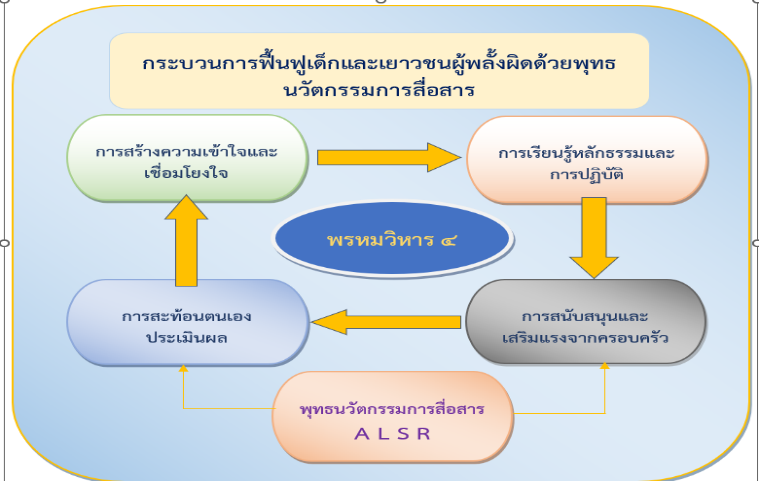
The developed rehabilitation model can be applied and adapted by relevant organizations to suit different contexts. It integrates Buddhist principles with creative communication processes to cultivate both behavioral and mental transformation, enabling youth to reintegrate into society sustainably. The process is structured under the A–L–S–R Model, which consists of: A = Awareness and Emotional Connection L = Learning Buddhist Principles and Practice S =Support and Reinforcement from Family and Community R = Reflection and Evaluation
Article Details

This work is licensed under a Creative Commons Attribution-NonCommercial-NoDerivatives 4.0 International License.
บทความนี้เป็นความคิดเห็นส่วนผู้แต่ง กองบรรณาธิการไม่จำเป็นต้องเห็นด้วยเสมอไป
References
กรมพินิจและคุ้มครองเด็กและเยาวชน, แนวทางการฟื้นฟูและพัฒนาเด็กและเยาวชนผู้กระทำผิด, กรุงเทพมหานคร: กระทรวงยุติธรรม, ๒๕๖๔.
พระครูวิจิตรสาธุรส ได้ทำวิจัยเรื่อง การใช้หลักพรหมวิหารธรรมในการบริหารงานของผู้บริหาร สถานศึกษาตามทัศนะของครูกลุ่มโรงเรียนการกุศล จังหวัดสงขลา,วารสาร มหาจุฬานาครทรรศน์ ปีที่ ๔ ฉบับที่ ๑ (มกราคม – มิถุนายน ๒๕๖๐), หน้า ๑-๙.
มหาจุฬาลงกรณราชวิทยาลัย. พระไตรปิฎกภาษาไทย.ฉบับมหาจุฬาลงกรณราชวิทยาลัย.กรุงเทพมหานคร: โรงพิมพ์มหาจุฬาลงกรณราชวิทยาลัย,๒๕๓๙.
โยตะ ชัยวรมันกุล,พุทธนวัตกรรมในการพัฒนาการเรียนรู้ของเด็กและเยาวชน,วารสาร มจร พุทธปัญญาปริทรรศน์ ปีที่ ๗ ฉบับที่ ๒ (เมษายน – มิถุนายน ๒๕๖๕)หน้า ๙๐-๙๘.
วศิน ประดิษฐศิลปะ, นวัตกรรมทางวิธีคิดเพื่อการสื่อสารศาสนาของพระไพศาล วิสาโล, ศิลปะศาสตรมหาบัณฑิต (นิเทศศาสตร์และนวัตกรรม),คณะนิเทศศาสตร์และนวัตกรรมการจัดการ สถาบันบัณฑิตพัฒนบริหารศาสตร์ ๒๕๕๖,หน้า บทคัดย่อ.
สำนักงานสถิติแห่งชาติ, Statistical Yearbook Thailand 2025, กรุงเทพมหานคร: สำนักงานสถิติแห่งชาติ, ๒๕๖๗).
