
Development of Preschool Children 's Social Behavior through Project Approach on the STEM Education of Saint Joseph Nakhon Sawan School.
Article Sidebar
Main Article Content
Abstract
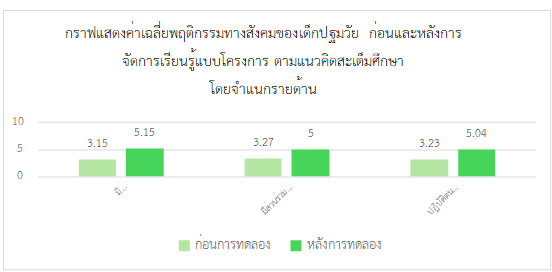
This research aimed to compare preschool children’s social behavior before and after implementation of Project Approach on the STEM Education. The samples preschool children boys and girls, aged between 5-6 years old, were 26 preschool children from preschool level 3 room 6 in the second semester of the academic year 2024 at Saint Joseph Nakhon Sawan School, Mueang Nakhon Sawan District, Nakhon Sawan Province. They were selected by using cluster random sampling. This study was quasi-experimental research with one group pretest-posttest design. The research instruments included 32 lesson plans for Project Approach on the STEM Education with the IOC of 1.00 and an observation form for preschool children's social behavior, covering 3 aspects: positive interactions with others, participation in setting and following group agreements, and appropriate leadership and followership behavior with the IOC of 1.00 The experiment lasted for 8 weeks, 4 days a week, with 40 minutes per day, during the experience promotion activities. The statistics used for data analysis were mean, standard deviation, and t-test.
The research finding revealed that preschool children’s social behavior before and after the implementation of Project Approach on the STEM Education was higher than before the experiment in each aspect and behavior.
Article Details

This work is licensed under a Creative Commons Attribution-NonCommercial-NoDerivatives 4.0 International License.
บทความนี้เป็นความคิดเห็นส่วนผู้แต่ง กองบรรณาธิการไม่จำเป็นต้องเห็นด้วยเสมอไป
References
กระทรวงศึกษาธิการ. หลักสูตรการศึกษาปฐมวัย พุทธศักราช ๒๕๖๐. กรุงเทพฯ : ชุมนุมสหกรณ์ การเกษตรแห่งประเทศไทย, ๒๕๖๐.
ถนอม แสงอรัญ. “ผลของการจัดประสบการณ์การเรียนรู้แบบโครงงานที่มีต่อความสามารถทางภาษาและพฤติกรรมทางสังคมของเด็กปฐมวัย” วิทยานิพนธ์ครุศาสตรมหาบัณฑิต สาขาวิชาหลักสูตรและการสอน บัณฑิตวิทยาลัย มหาวิทยาลัยราชภัฏนครราชสีมา, ๒๕๕๗.
พรรณทิพย์ ศิริวรรณบุศย์. ทฤษฎีจิตวิทยาพัฒนาการ (พิมพ์ครั้งที่ ๓). กรุงเทพมหานคร: จุฬาลงกรณ์มหาวิทยาลัย, ๒๕๕๓
พระราชบัญญัติการพัฒนาเด็กปฐมวัย พ.ศ. ๒๕๖๒. (๓๐ เมษายน ๒๕๖๒). ราชกิจจานุเบกษา. เล่ม ๑๓๖ ตอนที่ ๕๖ ก, หน้า ๕-๑๖.
โรงเรียนนานาชาติบางนา D-PREP, (๒๕๖๖), การเรียนแบบ Project Approach มีประโยชน์กับเด็กอย่างไร, โรงเรียนนานาชาติบางนา D-PREP, [ออนไลน์], แหล่งที่มา: https://www.dprep.ac.th/th/project-approach/ [๑ พฤศจิกายน ๒๕๖๖].
สุทธิ์ธนา ขันอาสา. ความสามารถทางพหุปัญญาของเด็กปฐมวัยที่ได้รับการจัดประสบการณ์แบบโครงการ. กรุงเทพฯ : มหาวิทยาลัยศรีนครินทร์วิโรฒ, ๒๕๕๐.
สำนักงานเลขาธิการสภาการศึกษา. แผนการศึกษาแห่งชาติ พ.ศ. ๒๕๖๐ – ๒๕๗๙. กรุงเทพมหานคร : พริกหวานกราฟฟิค จำกัด, ๒๕๖๐.
เสาวลักษณ์ สีตะบุษย์. “การพัฒนาพฤติกรรมทางสังคมของเด็กปฐมวัย ที่ได้รับการจัดกิจกรรมศิลปะสร้างสรรค์ตามแนวคิดไฮสโคปสำหรับชั้นเรียนคละอายุ โรงเรียนวัดท่า จังหวัดชัยนาท” วิทยานิพนธ์ครุศาสตรมหาบัณฑิต สาขาการศึกษาปฐมวัย มหาวิทยาลัยราชภัฏพระนคร, ๒๕๖๖.
Hurlock, E.B. Child Development. 5th ed. (New York: McGraw – Hill, 1964).
Hurlock, E.B. Perilaku Anak. (Jakarta: Erlangga, 1978).
McClure, E. R., Guernsey, L., Clements, D. H., Bales, S. N., Nichols, J., Kendall-Taylor, N., & Levine, M. H. STEM starts early: Grounding science, technology, engineering, and math education in early childhood. (New York: The Joan Ganz Cooney Center at Sesame Workshop, 2017).
National Research Council (NRC). A framework for K-12 science education: Practices, crosscutting concepts, and core ideas. (Washington, DC: National Academic Press, 2012).
Turner, K. Northeast Tennessee educators' perception of STEM education implementation. (Electronic Theses and Dissertations, 2013).