
Promoting the Propagation of Buddhist Culture Through Holistic Activities in Kabinburi District, Prachinburi Province
Article Sidebar
Main Article Content
Abstract
This research aims to:1.Examine the problems and obstacles in promoting Buddhist-based culture in Kabin Buri District, Prachinburi Province;2.Investigate the development of holistic activities in promoting Buddhist-based culture in Kabin Buri District, Prachinburi Province; and3.Propose a model for promoting Buddhist-based culture through holistic activities in Kabin Buri District, Prachinburi Province.The study employed a mixed-methods research design, integrating both quantitative and qualitative approaches. Literature, concepts, and theories were reviewed from documents, journals, printed media, and online sources. Data collection was carried out with 250 participants (monks and laypeople) using questionnaires, and in-depth interviews were conducted with 30 participants. The data were analyzed and presented in a descriptive manner.
Research Findings:The findings revealed that the major problems and obstacles in promoting Buddhist-based culture in Kabin Buri District include the lack of community participation in Buddhist activities. Most activities were organized by temples or specific groups without providing opportunities for community members or relevant organizations to be involved. Furthermore, there was a limited use of modern technology and media in disseminating Buddhist teachings.The study suggests that effective development approaches should integrate Buddhist principles with local ways of life across all age groups, using holistic activities that encompass mental, social, and cultural dimensions. Such integration would foster deep learning experiences that align with the local context and address community needs.
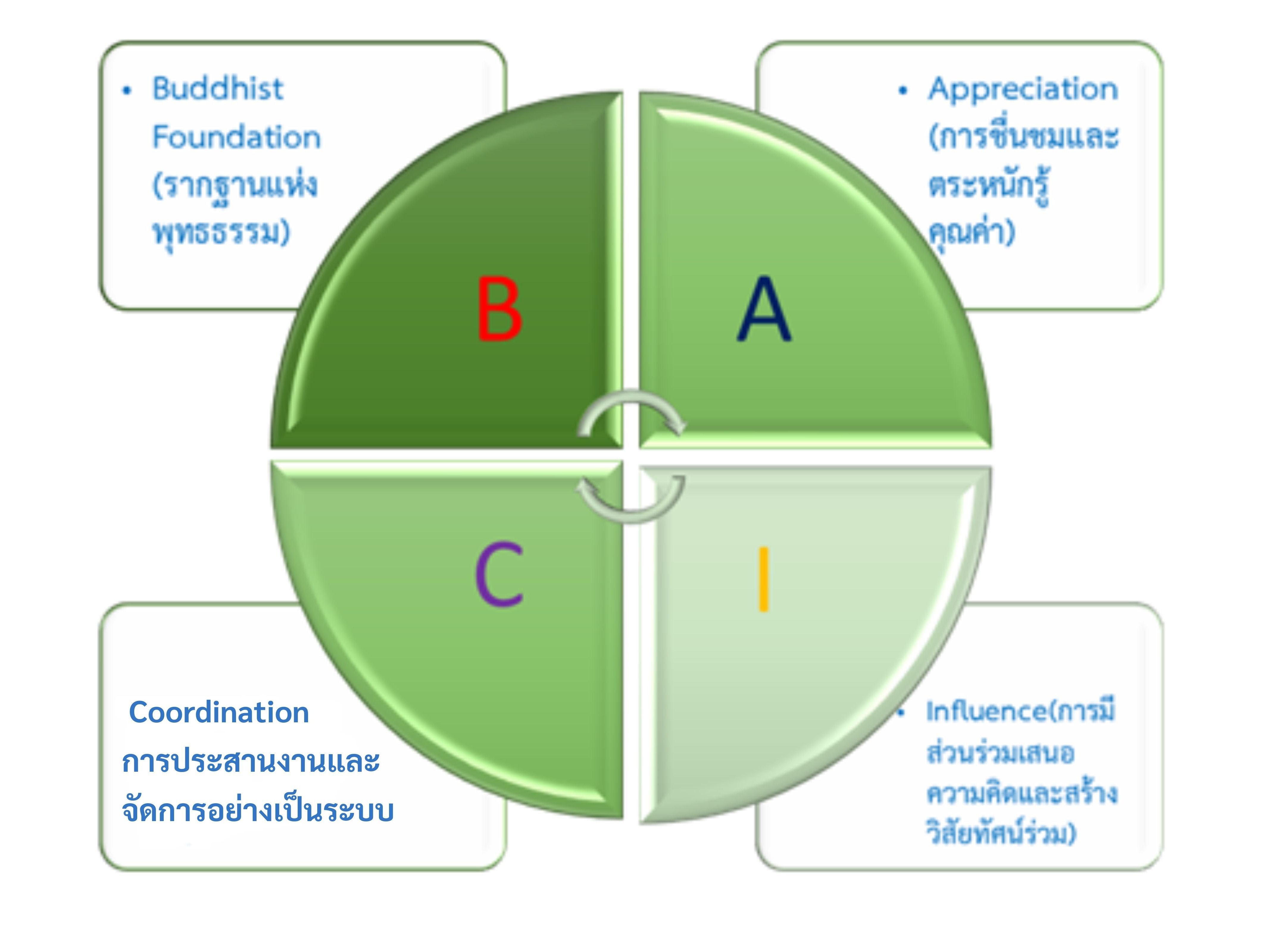
The proposed model for promoting Buddhist-based culture through holistic activities is the B–AIC Model, which consists of: 1.Buddhist Foundation: Placing Buddhist principles at the core of development. 2.Appreciation: Creating opportunities for all community sectors to share ideas and perspectives. 3.Influence: Allowing all stakeholders to propose directions for organizing activities .4. Coordination: Planning and implementing activities systematically and effectively, with the integration of modern technology and media for disseminating Buddhist teachings.This model aims to establish Buddhism as a vital force in the development of both individual minds and the wider society.
Article Details

This work is licensed under a Creative Commons Attribution-NonCommercial-NoDerivatives 4.0 International License.
บทความนี้เป็นความคิดเห็นส่วนผู้แต่ง กองบรรณาธิการไม่จำเป็นต้องเห็นด้วยเสมอไป
References
๑.ภาษาไทย:
ก.ข้อมูลปฐมภูมิ
มหาจุฬาลงกรณราชวิทยาลัย. พระไตรปิฎกภาษาไทย.ฉบับมหาจุฬาลงกรณราชวิทยาลัย.กรุงเทพมหานคร: โรงพิมพ์
มหาจุฬาลงกรณราชวิทยาลัย,๒๕๓๙.
ข.ข้อมูลทุติยภูมิ
(๑) หนังสือ :
พระอุทัย อติชาคโร (โพนกระโทก),การส่งเสริมการเข้าร่วมกิจกรรมทางพระพุทธศาสนาของเยาวชนในอำเภอโชคชัย จังหวัดนครราชสีมา,วารสารมณีเชษฐาราม วัดจอมมณี ปีที่ 7 ฉบับที่ 2 (มีนาคม – เมษายน 2567).
สำนักงานพระพุทธศาสนาจังหวัดปราจีนบุรี,การจัดกิจกรรมในวันสาคัญทางพระพุทธศาสนา,[ออนไลน์], แหล่งที่มา: https://pri.onab.go.th/th/page/item/index/id/18 [ วันที่๒๐ตุลาคม๒๕๖๖].
สำนักงานพระพุทธศาสนาจังหวัดปราจีนบุรี,การจัดกิจกรรมในวันสำคัญทางพระพุทธศาสนา, [ออนไลน์], แหล่งที่มา: https://pri.onab.go.th/th/page/item/index/id/18 [ วันที่ ๒๐ ตุลาคม ๒๕๖๖].
สำนักแม่กองธรรมสนามหลวง,กิจกรรมการเผยแผ่พระพุทธศาสนา, [ออนไลน์], แหล่งที่มา: https://www.gongtham.net/web/news.php, [วันที่ ๒๐ ตุลาคม ๒๕๖๖].
หน่อแก้วพระพุทธศาสนา, ความสำคัญทางพระพุทธศาสนา,[ออนไลน์], แหล่งที่มา: https://www.norkaew.netE, [๒๐ ตุลาคม ๒๕๖๖].
