The Analytical Study of Virtues from Jataka in Buddhist Scriptures
Article Sidebar
Main Article Content
Abstract
In this thesis, three objectives were purposely made: (1) to study the history, structure, and content of Jataka tales in Buddhism, (2) to study the virtues expressed in these tales, and (3) to analyze their ethical significance. The research adopts a documentary approach, drawing on the Tipitaka and Jataka Aṭṭhakathã (commentaries).
The findings showed that the Jataka tales recount the Buddha’s past lives and the perfections he cultivated, serving as narratives to transmit virtues through the exemplary conduct of the Bodhisatta. In particular, the Jataka scripture, comprising over 500 stories known as “The 500 Jataka Tales,” functions as a key medium for instilling moral values and ethics in youth, presenting the Bodhisatta as a role model.
The study identifies ten central virtues consistently cultivated by the Bodhisatta: (1) loving-kindness, (2) sacrifice, (3) gratitude, (4) patience, (5) truthfulness, (6) justice, (7) perseverance, (8) humility, (9) forgiveness, and (10) generosity. These virtues serve as guidelines for personal development and for fostering responsible members of society.
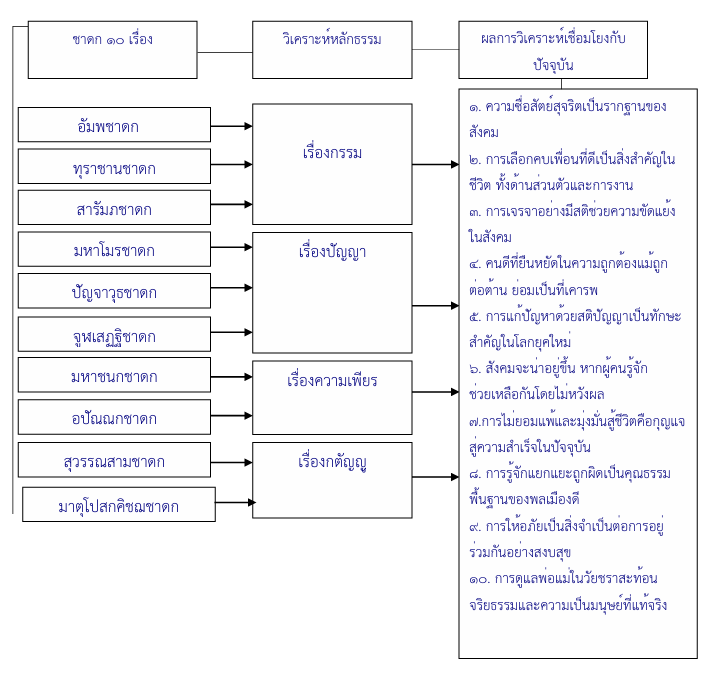
An analysis of ten selected tales—Amba Jataka, Durajana Jataka, Sarambha Jataka, Mahamora Jataka, Pañcavudha Jataka, Cũḷaseṭṭhi Jataka, Mahajanaka Jataka, Apaṇṇaka Jataka, Suvaṇṇasãma Jataka, and Matuposaka Gijjha Jataka—highlights key ethical lessons: (1) honesty and integrity, (2) choosing good friends, (3) mindful negotiation, (4) respect for the righteous, (5) problem-solving through wisdom, (6) social harmony through altruism, (7) perseverance in life, (8) discernment of right and wrong, (9) forgiveness as a foundation for coexistence, and (10) filial care as the essence of ethics and humanity respectively.
Article Details

This work is licensed under a Creative Commons Attribution-NonCommercial-NoDerivatives 4.0 International License.
บทความนี้เป็นความคิดเห็นส่วนผู้แต่ง กองบรรณาธิการไม่จำเป็นต้องเห็นด้วยเสมอไป
References
กมล บุตรชารี และคณะ. “การศึกษาเชิงวิเคราะห์ชาดกตามแนวพุทธปรัชญาเถรวาทที่ปรากฏในคัมภีร์อรรถกถาธรรมบท”. วารสารชัยภูมิปริทรรศน์. ปีที่ ๗ ฉบับที่ ๓ (กันยายน-ธันวาคม ๒๕๖๗): ๑๑-๒๐.
พระครูปลัดเฉลิม โชติกโร (บุญเยี่ยม). “วิเคราะห์หลักธรรมส่งเสริมชุมชนคุณธรรมต้นแบบ”. วารสารพุทธศาสน์สังคมร่วมสมัย. ปีที่ ๑ ฉบับที่ ๒ กรกฎาคม-ธันวาคม ๒๕๖๕): ๑๙-๓๖.
พระธรรมปิฎก (ป. อ. ปยุตฺโต). สมาธิฐานสู่สุขภาพจิตและปัญญาหยั่งรู้. พิมพ์ครั้งที่ ๔. กรุงเทพมหานคร: สำนักพิมพ์ศยาม, ๒๕๔๒.
มหาจุฬาลงกรณราชวิทยาลัย. พระไตรปิฎกภาษาไทย ฉบับมหาจุฬาลงกรณราชวิทยาลัย. กรุงเทพมหานคร: โรงพิมพ์มหาจุฬาลงกรณราชวิทยาลัย, ๒๕๓๙.
.อรรถกถาภาษาไทย ฉบับมหาจุฬาลงกรณราชวิทยาลัย.กรุงเทพมหานคร:โรงพิมพ์มหาจุฬาลงกรณราชวิทยาลัย,๒๕๕๓.
สมเด็จพระพุทธโฆษาจารย์ (ป. อ. ปยุตฺโต). พจนานุกรมพุทธศาสน์ ฉบับประมวลศัพท์.
พิมพ์ครั้งที่ ๓๑. กรุงเทพมหานคร: โรงพิมพ์สหธรรมิก จำกัด, ๒๕๖๑.
สมิทธิพล เนตรนิมิต,“การศึกษาวิเคราะห์ชาดกในเชิงสหวิทยาการ”,วารสารบัณฑิตศึกษา
ปริทรรศน์,ปีที่ ๑๓ ฉบับที่ ๓ (กันยายน-ธันวาคม):๘-๙.
